Who is this reply? A 3-line answer for outbound emails
Who is this reply moments happen when context is missing. Use a 3-line identity and credibility response that adds clarity and keeps the next step moving.
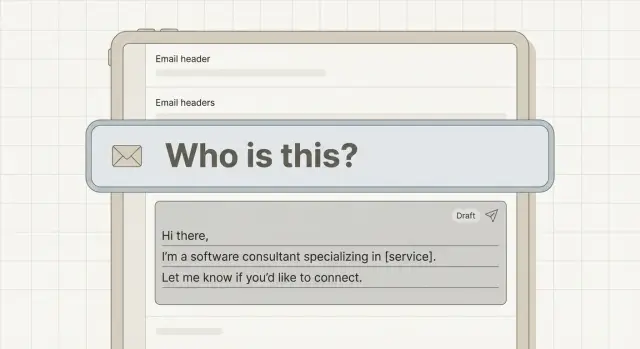
Why you get a “Who is this?” reply
A “Who is this?” message is rarely about your name. It’s the prospect asking two quiet questions: “Do I recognize this conversation?” and “Is this a real person with a valid reason to be in my inbox?” They want quick proof of context and legitimacy before they spend another second.
It can happen even if your first email was polite and clear. People skim on their phone and move on. Your note might’ve been forwarded to a coworker, opened days later, or resurfaced after a busy week. Some recipients also have privacy habits: they avoid clicking, avoid signatures, and reply with the shortest possible line to test you.
Sometimes the trigger is simple. Your subject line was vague, their email client showed a clipped preview, or your message landed in a secondary tab and lost its place among other threads. If you follow up, they might see the newest line first and not scroll up. That’s how a “Who is this?” reply happens even when your first touch was normal.
Your goal isn’t to defend yourself. Your goal is to restore context in seconds, then move forward.
A good reply does three things:
- Names who you are and what company you’re with
- Reminds them why you emailed (one sentence, specific)
- Offers a small next step (one question or two options)
Keep it calm and matter-of-fact. If you sound annoyed or pushy, they’ll stop replying. If you overshare your life story, they still won’t know what to do next.
What “Who is this?” usually means
Most of the time, it means they lost the thread. They saw your email, but didn’t connect it to a person, a reason, or a recent moment.
Common triggers:
- Mobile skim: they only saw a subject line and the first few words
- Forwarding: a teammate forwarded your note with no intro
- Busy inbox: they recognize the topic, but not the sender
This can be a good sign. You got a response, which means you didn’t go straight to spam or get ignored. Often they’re basically saying, “Remind me why I should care.”
It can also be a warning sign. If your original message felt vague, hype-y, or didn’t explain why you picked them, their guard goes up. In that case, your reply needs to be even simpler and more specific.
Example: you emailed a VP, their assistant forwarded it with “FYI,” and the VP replies “who is this?” from their phone between meetings. They’re not rejecting you. They’re asking for a fast reset.
What your response must include (and what to skip)
A “Who is this?” reply isn’t a request for your life story. It’s the other person saying, “I don’t have enough context to place you, so I’m pausing.” Your job is to remove confusion fast and keep the conversation moving.
What to include:
- A clean identity line: your name, company, and what you do there (one line)
- A single sentence of context tied to your original reason for emailing
- One clear next-step question
If your company name won’t mean anything to them, add a plain-English hint (for example, “we help B2B teams book more demos via outbound”). For the context line, mention the trigger you used (their role, a recent hire, a tool they use, a relevant problem) without dumping research or sounding creepy. Think “reminder,” not “proof you looked them up.”
What to skip: long intros, full company overviews, multiple questions, attachments, and defensive lines like “Sorry if this is random.” With “Who is this?” messages, extra words often create more doubt.
Quick filter before you hit send:
- Can they identify you in 5 seconds?
- Does the reason match your original email?
- Is there exactly one next step?
- Would it still make sense on a phone?
If your team gets these often, save a short template so you’re not rewriting the basics every time.
A concise 3-line reply template you can copy
A “Who is this?” reply is a cue to lower friction. They want identity, context, and a clear next step.
Keep the subject line as-is and reply in the same thread.
Neutral
Hi [First name] - it’s [Your name] at [Company].
I emailed because we help [ICP] with [specific outcome] (noticed [personal trigger]).
Worth a quick chat this week, or should I send 2 bullets and you can tell me yes/no?

Friendly
Hey [First name] - [Your name] here from [Company].
Reached out since you’re [role] at [Company] and I had an idea to improve [area] by [outcome].
Open to a 10 min call, or prefer I email a short summary first?

Slightly formal
Hello [First name], this is [Your name], [Title] at [Company].
I contacted you regarding [topic] because we support [similar companies] in [measurable outcome].
Would you like to explore this, or should I close the loop?
A few small rules keep this working:
- Use plain words, not a pitch.
- Anchor the context to something real (their role, a recent change, a relevant goal).
- End with a two-choice question so they can answer with one word.
If you’re emailing from a new domain, add one credibility detail without oversharing, like “we work with a few teams in [industry]” or “I’m reaching out personally, not a marketing list.” Save everything else for later, after they say “yes.”
How to personalize it fast without oversharing
You don’t need a backstory. You need one clear anchor that helps them place you.
First, reuse their context in plain words. Restate the same subject idea once in the body: “About your hiring for SDRs” or “Quick note on reducing no-shows.” It makes your reply feel familiar, not random.
Then add one personal detail that answers “why you?” without turning into a bio. Pick just one: your role, your team, your location, or a simple, verifiable change (“I just joined the outbound team”).
Keep proof light. One credible detail is enough: a client type, a specific outcome, or a shared connection (only if it’s real). Avoid long credentials and paragraphs about your company.
A tiny personalization menu helps you edit in under a minute:
- One identifier: role + company (or team)
- One relevance hook: what you noticed
- One light proof: “we help X do Y” (no case study)
- One next step: a single question or two time options
Example:
“Totally fair - I’m Sam, I run outbound at BrightOps (based in Denver).
Reached out about your new CS hiring push - I help SaaS teams tighten follow-up so fewer trials go quiet.
Worth a 10-min chat, or should I send 2-3 ideas by email?”
That’s enough identity to build trust, and enough focus to keep the conversation moving.
Variations for common situations
Keep the same structure every time: (1) identity, (2) context, (3) one next step. Only the context line changes.
Quick variations you can copy
-
They replied inside an older email thread "Totally fair - this is [Name] from [Company]. Replying on the thread about [original topic] from [month/week]. If it helps, should I resend a 2-sentence summary and the one question I had?"
-
It might be an assistant or a teammate responding "Hi [Name] - I’m [Your Name] with [Company]. I reached out to [Executive Name] about [reason in 5-7 words]. Are you the right person to route this, or should I address it directly to someone else?"
-
They ask again: “Remind me how you got my email?” "Good question - I’m [Your Name] from [Company]. I found your work info listed publicly (company site/press/profile) and used it only to reach you about [relevant reason]. If you’d rather I don’t email again, say so and I’ll stop."
-
You are reaching out cold "Thanks for checking - I’m [Your Name] from [Company]. I’m contacting a few [role] teams because of [specific trigger]. Is it worth a 10-minute chat, or should I close the loop?"
-
You were referred "Of course - I’m [Your Name] from [Company]. [Referrer Name] suggested I reach out about [reason]. Are you the right person to discuss it, or is there someone else I should contact?"
If you want to reduce back-and-forth, add one concrete detail and end with a binary question. It keeps momentum without oversharing.
Step-by-step: how to reply and keep momentum
Speed matters. If you can, reply while your name is still fresh in their inbox, ideally within 5 to 60 minutes. A fast, calm answer reads confident, not defensive.
Stay in the same thread and keep the subject line exactly as-is. That preserves context and prevents you from looking like a brand-new sender.
Pull in a tiny reminder from your original email so they don’t have to hunt. Quote only 1 or 2 lines: the reason you reached out and the outcome you mentioned.
A simple flow that works:
- Name + company + one-line reason
- 1 to 2 line quote from your last email
- One next step (call, quick answer, or referral)
- End with one easy question
Keep the question low-effort. “Is this on your plate?” and “Who owns this on your team?” work well. If they sound annoyed or suspicious, don’t jump straight to “Can you meet?” Earn a small yes first.
Common mistakes that make it worse
The fastest way to lose them is to turn a simple question into a long pitch.
Over-explaining is the big one. A paragraph about your company’s background, mission, or origin reads like marketing and forces them to work just to understand why you’re emailing.
Another mistake is “proving legitimacy” by dumping stuff: multiple resources, attachments, a hard calendar push, or a long signature. That often reads like pressure and can trigger spam suspicion.
Tone matters more than most people think. If you sound offended (“We already emailed you...”) or sarcastic (“As mentioned below...”), you create friction. Treat it like a normal mix-up.
If your reply needs scrolling, it’s probably too much. Aim for identity, context, and one simple next step.
Quick checklist before you hit send
Read your draft once as if you’re on a phone and have no idea who the sender is.
- Identity is obvious in the first line (name, company, what you do in plain words)
- You restate the reason in one sentence
- You end with one question they can answer fast (yes/no or a short choice)
- You removed big claims, links, attachments, and pitch-deck energy
- It fits on a small screen
A useful trick: if a sentence needs a comma to make sense, shorten it. Clarity beats clever.
Final test: can they understand who you are, why you wrote, and what you want them to do in under 10 seconds? If yes, send it.
Realistic example: turning confusion into a next step
Maya is an SDR at a SaaS company. She emailed Jordan, an operations leader at a 600-person manufacturer. Her first note was short, but Jordan didn’t recognize the name.
Jordan replies:
Who is this?
Maya answers with a 3-line identity and credibility reply that keeps things moving:
Totally fair - I’m Maya from NorthPeak.
I reached out because we help ops teams cut manual scheduling work (often 3 to 5 hours/week) with a simple approval flow.
If this isn’t on your plate, who owns scheduling and dispatch?
That last line gives Jordan an easy out and still creates a next step.
If Jordan responds but stays vague, Maya asks one tight follow-up that forces clarity without pressure:
Thanks - are you the right person to sanity-check whether this is worth exploring, or should I speak with someone on your team?
If Jordan doesn’t respond after the clarification, Maya doesn’t keep explaining. She follows up once, then moves on cleanly:
- Wait 2 business days, then send a 1-sentence bump: “Just checking I reached the right person for scheduling and dispatch.”
- If no reply, try a different channel with the same simple context.
- Stop after 2 follow-ups total unless they engage.
- Note the thread so you don’t re-introduce yourself again later.
Used well, a “Who is this?” reply becomes a quick reset that earns trust and turns confusion into a clear handoff or a simple yes/no.
Next steps: stay organized and follow up cleanly
A “Who is this?” reply is easy to mishandle because it feels small, then gets buried. Treat it like a real lead signal: someone saw your message and took a second to respond.
Tag the reply type the moment it comes in (identity check, not now, referral request). Then pick one clear next step and pause the rest of your sequence for that contact until they respond. The fastest way to trigger annoyance is to keep blasting automated steps after they’ve replied.
A simple follow-up flow:
- Send your 3-line identity reply the same day.
- Ask one qualifying question or offer two time windows.
- If there’s no reply, send one short nudge 2 to 3 business days later, then stop.
If you’re running outbound at scale, LeadTrain (leadtrain.app) can help keep domains, mailboxes, warm-up, multi-step sequences, and reply classification in one place, so “Who is this?” messages get surfaced and handled quickly instead of getting lost in the inbox.
FAQ
What does “Who is this?” actually mean in a cold email reply?
It usually means they lost the context, not that they’re rejecting you. Reply calmly in the same thread with one line of identity, one sentence of why you emailed, and one easy next step question.
What’s the simplest reply I can send back?
Use a 3-line reset: “Hi [Name]—it’s [Your Name] at [Company]. I reached out because [one specific reason tied to them]. Would you prefer a quick 10-min call, or should I send 2 bullets by email?” Keep it short enough to read on a phone.
How do I quickly prove I’m a real person without oversharing?
Start with your name and company in the first line, then add a plain-English hint of what you do if your company name won’t ring a bell. Avoid long titles, big claims, and anything that makes them work to figure out why you’re emailing.
How do I add personalization fast when they reply “Who is this?”
Give one concrete anchor that matches your first email, like their role, a recent change, or a specific problem you help with. Don’t dump research, and don’t mention personal details; the goal is “reminder,” not “look how much I know.”
What should I avoid saying so I don’t make it worse?
Don’t sound annoyed, sarcastic, or defensive, and don’t apologize repeatedly. Skip long company intros, multiple questions, attachments, and heavy “pitch” language; extra words often increase suspicion instead of reducing it.
Should I change the subject line or start a new thread?
Stay in the same thread and keep the subject line unchanged so the email history stays visible. If helpful, quote just one or two lines from your previous message so they don’t have to scroll or search.
How do I respond if they ask, “How did you get my email?”
Answer directly and briefly: say you used their work contact info listed publicly and you’re reaching out only about a relevant business reason. Add a clear opt-out line like “If you’d rather I don’t email again, tell me and I’ll stop.”
What if an assistant or coworker replies “Who is this?”
Ask a routing question instead of pitching: “Thanks—are you the right person for this, or who should I speak with?” Keep it respectful and simple, since assistants and teammates are often just trying to triage quickly.
How fast should I respond to a “Who is this?” message?
Reply as soon as you can while your message is still near the top of their inbox, ideally within the hour. A fast, calm response reads confident and reduces the chance they move on without re-opening the thread.
How do I keep my sequence from sending more emails after they replied?
Pause the rest of your automated sequence for that contact until they respond, or you risk looking spammy. Tools like LeadTrain help by keeping sending domains, mailboxes, warm-up, sequences, and reply classification in one place so identity-check replies get surfaced and handled before automation keeps going.