When to broaden your ICP (and when to narrow it)
Learn when to broaden your ICP and when to narrow it, spot saturation warning signs, and follow a safe expansion process that protects deliverability and pipeline.
The real problem: not knowing if your ICP still fits
Your ICP (ideal customer profile) answers one question: who is most likely to buy, succeed, and stick with what you sell.
It’s more than an industry label. A useful ICP includes company size, a clear pain, the person who owns that pain, and what “success” looks like on their side.
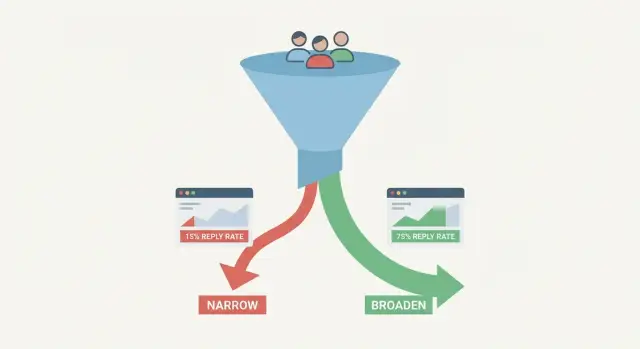
Teams get stuck because both extremes hurt. Too narrow, and you burn through a small list fast, re-contacting the same accounts until replies go cold. Too broad, and you send messages to people who will never care. That wastes time and can hurt deliverability in cold email.
“Segment saturation” in outbound often looks like this: your copy still reads well, your offer hasn’t changed, but results fade because you’ve already reached the reachable part of that segment. The market didn’t disappear. You ran out of fresh, high-intent targets that match your current rules.
The core issue is simple: most teams can’t tell whether the ICP needs to change, or whether execution needs to improve. That uncertainty turns “when should we broaden?” into guesswork.
It helps to separate two kinds of waste:
- Wasted outreach: good prospects who never see your message or don’t understand it
- Wasted targeting: people who see it, understand it, and still don’t care
Reducing both means you don’t chase “more volume.” You send fewer emails to better-fit people, and you change targeting only when the evidence says your current ICP is losing its edge.
The few numbers that tell you if you should change course
The easiest way to make the wrong ICP call is to stare at one big average. Overall numbers hide what’s happening inside segments: one group can be dying while another is quietly working.
To decide when to broaden your ICP, watch a small set of metrics that move early (leading) and late (lagging). Leading indicators tell you whether you’re still getting attention. Lagging indicators tell you whether that attention turns into revenue.
Start with leading indicators:
- Reply rate (any reply)
- Positive reply rate (clear interest)
- Meeting booked rate
- Bounce rate (deliverability signal)
- Unsubscribe or complaint rate (message-market mismatch)
Then confirm with lagging indicators:
- Pipeline created from outbound
- Win rate on outbound-sourced deals
- Average sales cycle length
Compare time windows the same way every time. Looking at the last 2 to 4 weeks against a baseline (like the prior 4 to 8 weeks) is usually enough. You’re not reacting to a single bad week. You’re watching for a sustained shift.
Most importantly, split the data by segment instead of relying on campaign totals. “Segment” can mean industry, company size, job title, geography, or tech stack. If one vertical is pulling down the average, you may need to narrow. If an adjacent segment is rising while your core slows, you may be able to broaden, carefully.
A quick example: your “HR managers at 200-500 employee SaaS” segment drops from 9% reply to 4% over four weeks, while meetings fall from 1.2% to 0.5%. At the same time, “People Ops leaders at 200-500 employee SaaS” stays stable. That points to a persona shift more than a product problem.
If you’re using tooling that categorizes replies (for example, interested vs not interested vs out-of-office vs bounce), make sure your reporting stays segment-tagged. Blended results create false stories.
Warning signs you are saturating a segment
Saturation usually shows up as a quiet decline, not a sudden crash. Deliverability can look fine. Subject lines can still get opened. But fewer people move the conversation forward.
One of the clearest patterns is this: positive replies drop while opens and bounces stay roughly the same. That suggests the email is getting seen, but the offer or angle is no longer landing with that audience.
Common saturation signals:
- Meeting rate slips even as you increase send volume
- You hear “we already use [competitor]” more often, and it’s said confidently
- “Not a priority” and “we tried this before” become the default, even from good-fit titles
- Replies feel repetitive: same objections, same org charts, same buying process
- Your lists start to look like duplicates: the same companies and titles you’ve already emailed
A small example: you target VP Sales at mid-market SaaS. For two months you book 8 meetings per 1,000 emails. Then you push volume harder, but meetings fall to 4 per 1,000. Opens stay steady, bounces stay low, and replies shift from curious questions to “we already have Outreach/Salesloft” and “we tested this last year.” That segment isn’t “dead,” but it’s heard the pitch.
Saturation can also show up inside reply reasons before your top-line numbers fully drop. If “not now” and “already have a tool” start climbing, treat that as early feedback.
When you see these signs, assume something needs to change: the offer, the angle, or the segment. Sending more to the same pool usually just burns the remaining goodwill.
When narrowing your ICP is the safer move
Narrowing your ideal customer profile is often the right move when the problem isn’t interest, it’s focus. If your best prospects like the message and move forward, widening the audience usually adds noise, not growth.
A common pattern: reply quality is high, but your list is small. You get thoughtful replies and real conversations, yet you’re running out of accounts. That can feel like saturation, but it can also mean you haven’t defined the winning slice sharply enough to find more of the same.
Another strong signal is what happens after the first meeting. If prospects who show up tend to progress, your issue usually isn’t product-market fit. It’s the targeting and positioning that happens before the meeting.
Narrowing is also safer when you’re winning only in a specific sub-segment, such as one role, one size band, or one use case. Treat that sub-segment as the default and build your outbound segmentation strategy around it.
If sales feels overwhelmed by low-fit conversations, that cost is real. Time spent chasing poor-fit leads crowds out follow-ups that could close. Tightening the ICP reduces those conversations and makes the pipeline easier to manage.
Practical ways to narrow without overthinking it:
- Pick one use case you can explain in one sentence
- Focus on one buyer role who feels the pain most
- Add one hard qualifier (team size, tech stack, geography, or a trigger event)
- Drop any segment with high reply volume but weak meeting-to-opportunity conversion
If you notice that only founder-led teams respond well and convert after the first call, that’s a clue to focus your list and messaging on the founder workflow. You can expand later, but first make the winning slice repeatable.
When broadening your ICP makes sense
Broadening makes sense when your current best segment still performs well, but you’re running out of enough people to contact. If reply rates, meeting rates, and retention are healthy, yet pipeline feels capped by list size, that’s a growth ceiling, not an execution problem.
Another good signal is pull from the edges: adjacent roles start describing the same pain and the same “success” outcome as your best customers. They may use different job titles, but the problem sounds the same. If your offer solves the same core issue for them, you can often expand without changing the product.
Repeated objections are useful here. If you keep hearing “we don’t own that budget” or “another team handles this,” your message may be landing on the wrong owner. A nearby segment might be the real buyer and won’t raise that objection.
Broadening is safest when you already have something repeatable: a clear offer, a consistent sales process, and proof points you can reuse. You’re not guessing. You’re copying what works into a new lane.
Signs you can define a second segment cleanly:
- You can name a specific role, company type, and trigger event in one sentence
- Your value proposition stays the same, only the wording changes
- Your best results story still makes sense to them
- You can source a fresh list with enough volume to matter
Example: if your best segment is agency founders booking more sales calls through outbound, you might expand to consulting firm owners who also need qualified discovery calls, using the same basic sequence structure and reply handling.
A safe step-by-step process to expand your ICP
The safest approach is to expand in one controlled direction, measure results, and only then widen the circle.
1) Expand along one axis, not five
Pick a single change: a new industry, a new role, a bigger or smaller company size, or a new trigger event (like hiring, funding, or switching tools). One new variable makes the outcome easier to trust.
Turn that choice into a tight hypothesis: who you’re targeting, what problem they feel, and what outcome they want soon (not someday). If you can’t say it in one sentence, it’s too broad.
2) Test small, separate, and specific
Build a small list and keep it isolated from your main segment so you don’t muddy your baseline. Practically, that means a separate campaign, separate tracking, and clear labels for replies.
Write a message that sounds like it was written for that segment only. Use one clear pain point, one proof point, and one simple next step. If the email could be sent to three different roles without changing a word, it’s generic.
A simple sequence for the test:
- Choose 100 to 300 prospects in the new segment
- Run a short sequence (5 to 10 business days)
- Keep volume modest while you learn
Define pass-fail thresholds before you send. For example: you want replies above a minimum, negative signals (bounces, unsubscribes, complaints) below your limits, and at least a few qualified conversations, not just polite replies.
3) Scale only after you see repeatable wins
If it passes, increase volume gradually and widen one notch at a time (for example, one adjacent industry before adding three). Keep campaigns separate so you can see whether the new segment is genuinely working or just creating noise.
How to test expansion without breaking what already works
Treat a new persona or segment like an experiment, not a new identity. Keep your current best-performing segment running unchanged so you always have a baseline. That control group tells you whether changes are real or just a good (or bad) week.
Change one variable at a time. If you change the persona, offer, and subject line all at once, you won’t know what caused the result. This is where many teams talk themselves into the wrong expansion.
A test setup that usually works:
- Keep 70-90% of volume on the proven segment (control), and send 10-30% to the new segment (test)
- Change only one thing per test: persona OR offer OR subject line
- Set a minimum sample size before judging results (for example, a few hundred sends, or enough replies to feel stable)
- Watch deliverability first: bounce rate, spam complaints, and unsubscribe rate
- Compare outcomes to the control: positive reply rate, meetings booked, and time-to-first-reply
When results are mixed, decide ahead of time how you’ll respond. For example: if replies are good but deliverability worsens, tighten the list and reduce volume. If opens improve but replies don’t, keep the persona and change the offer. If metrics match the control, run one more round with a clearer message before scaling. If it’s worse across the board, pause and try a closer adjacent persona.
Common mistakes that make ICP changes backfire
The fastest way to break outbound is to forget why an ICP exists: focus. If you broaden to “anyone who might need this,” targeting gets fuzzy, messaging gets generic, and even your best segment stops responding.
Another common failure is changing too much at once. Teams adjust industry, company size, and persona in the same week, then debate results that can’t teach them anything. If you can’t isolate the change, you can’t learn.
Messaging is where many tests quietly die. A new persona isn’t a new list with the same sequence. The pain, proof, and language often shift. A CFO, a RevOps lead, and a founder can all buy the same product, but they rarely care about the same first sentence.
Deliverability mistakes can also make a good expansion look like a bad one. If you ramp sending too fast before domains and mailboxes are stable, inbox placement drops and every segment starts to look “saturated.” Warm-up and gradual increases matter.
Finally, teams ignore the most honest feedback: negative replies. “Not for us,” “wrong person,” and “we already use X” are targeting signals. They’re not just noise.
Five failure patterns to watch for:
- You broaden your definition until it stops being specific
- You change multiple variables and can’t learn from the test
- You reuse the same sequence for a different persona
- You scale sending too fast and hurt deliverability
- You dismiss negative replies instead of tagging and reviewing them
A simple rule: if you can’t explain the new ICP in one sentence and match it to a tailored angle, you’re not expanding safely. You’re guessing.
Quick checklist before you broaden or narrow
Changing your ICP feels like a messaging project, but it’s also a measurement project. Before you widen the net or tighten it, make sure you have a clean baseline and a way to stop fast if results slide.
Protect a control group you won’t touch. Keep one segment, one message, and one list source exactly as it is today. That control becomes your benchmark for what “normal” looks like while you test changes.
Then sanity-check the new segment. If you can’t name their pains in plain language, you’ll end up sending vague emails and blaming the audience. A useful rule is that you should be able to write three specific problems they feel this quarter, not generic “needs efficiency” phrases.
Checklist:
- Control and benchmark: Do you have a protected control segment and a baseline for reply rate, positive rate, and bounce rate?
- Problem clarity: Can you name the top three pains and the one outcome they’ll pay for?
- List reality: Do you have a reliable way to build the list for this segment (titles, filters, verified emails)?
- Reputation safety: Are your domains and mailboxes protected with authentication and sensible send limits so a bad test doesn’t hurt everything else?
- Stop rules: Do you know exactly when to pause (for example, bounce rate spikes, complaints rise, or positive replies drop below baseline for a full week)?
If any item is a “no,” pause and fix it first. The fastest way to waste a good channel is to treat ICP changes as a creative experiment instead of a controlled one.
Example scenario: expanding from one persona to an adjacent one
You start with a simple ICP: mid-sized SaaS companies (100-500 employees) and one persona, IT managers. Your offer is easy to explain, your list is clean, and outreach is consistent.
After a few months, the early wins are harder to repeat. You see the same domains across providers, more duplicates in your CRM, and fewer people replying with real interest.
What the saturation looks like:
- Positive replies drop from about 3.2% to 1.4% over 6 weeks
- More replies are some version of “already have a tool” or “talked to you last quarter”
- New lead lists contain many of the same accounts, just different contacts
- Meetings booked per 1,000 emails keeps sliding, even after copy tweaks
Now you hit a decision point: do you narrow or broaden?
Narrowing would mean going deeper into a sharper pain, like security teams (security managers, security engineers) inside the same types of SaaS companies. Broadening would mean moving sideways to operations (RevOps, BizOps, IT operations) where the pain might be similar, but the buying story changes.
To keep the answer grounded, you run a small expansion test while keeping the current segment as a control. For two weeks, you keep 80% of volume on IT managers and test 20% on operations in the same company size range. You keep the offer the same, but adjust the opener to match the ops job.
You compare three things: positive reply rate, meeting rate, and unsubscribe rate.
- If ops beats IT on meetings with similar unsubscribes, that’s a clear signal to broaden.
- If ops underperforms but security looks promising in a small follow-up test, you narrow and go deeper.
Then you update targeting rules and messaging based on the winning segment, and only after that do you increase volume.
Next steps: make ICP changes measurable and low-risk
If you change targeting without a plan, you won’t know what caused the results. The goal is to make each ICP move small, trackable, and reversible.
Write a one-page ICP note: who you target now, what problem you lead with, and what you believe will work next. Add one clear hypothesis, like “HR managers at 200-1000 person logistics firms will reply to the same deliverability-first angle.” One page forces clarity and is easy to share.
Keep outreach data clean. Run separate sequences per segment (and per persona) so you can compare apples to apples. If you mix segments in one sequence, you won’t know which change helped or hurt.
A low-risk plan for the next two weeks:
- Lock your current ICP as the control and don’t edit its messaging
- Launch one new segment with its own sequence and send schedule
- Scale slowly with small daily increases while keeping authentication and warm-up healthy
- Use reply categories (interested, not interested, out-of-office, bounce, unsubscribe) to spot mismatch quickly
- Decide in advance what “pass” looks like
If you want fewer moving parts while you run these controlled tests, LeadTrain (leadtrain.app) can keep domains, mailboxes, warm-up, sequences, and reply classification in one place, so it’s easier to compare segments without mixing your data.
FAQ
What exactly counts as an ICP (ideal customer profile)?
Your ICP is the kind of customer who is most likely to buy, get value fast, and keep using what you sell. A practical ICP includes company size, a specific pain, the person who owns that pain, and what success looks like for them.
How do I tell if my ICP needs to change or my outreach just needs fixing?
Start by separating your results by segment instead of looking at one overall average. Then compare a recent window like the last 2–4 weeks against a baseline like the prior 4–8 weeks so you’re reacting to a real trend, not a bad few days.
Which metrics matter most when deciding to broaden or narrow my ICP?
Watch reply rate, positive reply rate, meeting rate, bounce rate, and unsubscribe or complaint rate to see early movement. Then confirm with pipeline created, win rate, and sales cycle length to make sure interest is turning into revenue.
What are the clearest signs I’m saturating a segment?
Saturation often shows up as fewer positive replies and fewer meetings even while bounces stay low and deliverability looks “fine.” You may also notice repetitive objections like “already use a tool,” more duplicates in your lists, and weaker conversion even when you increase volume.
When is narrowing my ICP the safer move?
Narrow when the people who do engage are high quality and tend to progress after the first meeting, but too much of your volume is going to low-fit conversations. Tightening the persona, use case, or qualifiers usually improves focus and reduces wasted sales time.
When does it actually make sense to broaden my ICP?
Broaden when your current best segment is still healthy on replies, meetings, and downstream outcomes, but you’re running out of enough new accounts to contact. Expansion also makes sense when adjacent roles describe the same pain and the same near-term outcome as your best customers.
What’s a safe way to expand my ICP without guessing?
Change one axis at a time, like only the persona or only the industry, and keep the test separate from your main segment. Run a small batch long enough to get stable signals, decide pass/fail before you start, and only scale after you see repeatable wins.
How do I test a new segment without hurting what already works?
Keep your best-performing segment running unchanged as a control group, and send a smaller portion of volume to the new segment. This makes it clear whether the new ICP is working and prevents one experiment from distorting your baseline performance.
How does deliverability affect ICP expansion decisions?
Cold email deliverability can make a good segment look bad if you ramp too fast or send from unstable domains and mailboxes. Warm-up, authentication, and gradual volume increases help protect inbox placement so your ICP test is measuring targeting and messaging, not spam filtering.
How can reply classification help me decide whether to broaden or narrow, and how does LeadTrain fit in?
Classifying replies helps you see whether you’re wasting outreach or wasting targeting, because “interested,” “not interested,” “wrong person,” and “out of office” mean different things. A platform like LeadTrain can keep domains, mailboxes, warm-up, sequences, and reply classification together so your segment reporting stays clean while you test.