Social proof blocks for cold email that sound credible
Learn how to use social proof blocks for cold email with clear metrics, respectful logos, and honest testimonials that build trust without sounding salesy.
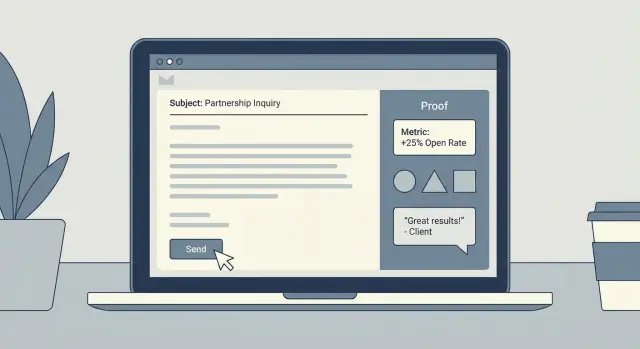
Why social proof often backfires in cold email
Social proof is meant to make you feel safer to trust. In cold email, it often does the opposite because it can read like pressure: big claims, big names, and a clear "you should be impressed" vibe. When someone didn't ask to hear from you, that tone triggers skepticism fast.
Most recipients do a quick, quiet risk check. They’re asking: Are you relevant to my world? Are you credible? And will replying create more work than it’s worth? If your proof doesn’t answer those questions, it feels like noise.
The key difference is proof vs bragging. Proof reduces doubt with something specific and verifiable. Bragging tries to inflate your status without helping them decide. "Trusted by 1,000+ companies" is bragging if you don’t say which kind of companies, what you did, and what changed.
A good proof line isn’t there to close the deal. It’s there to remove one objection so a small next step feels safe.
Social proof tends to backfire when it’s vague ("industry leader"), irrelevant (an impressive metric they don’t care about), mismatched (famous logos that don’t resemble their market or size), or formatted like an ad. It can also fail when it asks for trust before you’ve earned attention.
Imagine emailing a 12-person HR software startup and leading with, "We help Fortune 50 teams." Even if it’s true, it signals you may not understand their constraints. A better goal is simple: reduce doubt in one quick line that matches their situation.
What counts as social proof (and what does not)
Cold email proof works when it reduces doubt, not when it tries to impress. The best proof is specific, relevant to the reader, and easy to believe.
Real social proof usually looks like one of these:
- Metrics with a clear scope: a result tied to one audience, one channel, and one timeframe (for example, "booked 18 demos in 30 days from outbound email for a 12-person agency")
- Named customers or recognizable brands the reader can verify, ideally similar in market or size
- Short testimonials: 1-2 lines that mention the before/after or situation, not generic praise
- Mini case notes: one sentence on what you changed and what improved ("fixed deliverability, reply rate recovered within 2 weeks")
- Credentials used lightly: a relevant role, years doing the work, or a certification only if it clearly reduces risk
What doesn’t count (or often backfires) is proof that’s vague or impossible to check. "Trusted by 500+ companies" with no names, "#1 provider," and "best-in-class" reads like an ad because it gives the reader nothing solid.
Be careful with proof that’s risky or hard to verify: screenshots with no context, anonymized "stealth startup" claims, or big numbers with missing details (saved "200 hours" for whom, doing what, over what period?). If you can’t explain it in one reply, it’s usually better to leave it out.
A simple gut check: if a prospect asked, "How do you know?" could you answer in one sentence and a number?
Pick proof that fits the audience you’re emailing
The fastest way to make proof feel fake is to use proof that’s impressive, but irrelevant. A founder at a 10-person startup doesn’t read credibility the same way a RevOps manager at a 2,000-person company does. Before you drop a proof line into your template, ask: will this person see themselves in this example?
Match proof to three things: company size, industry, and role. If you sell to finance teams, a quote from a marketing agency might be true, but it won’t land. If you email SDR leaders, they care about reply rate, meetings booked, and time saved, not vague "great support."
When you have multiple options, use the closest comparable customer you have, even if they aren’t famous. "Helped a 40-person logistics company cut no-shows by 18%" usually beats "Trusted by a Fortune 500" if you’re writing to another 40-person logistics company.
Big-name proof works best when the reader already knows the brand and you connect it to a specific claim. If the logo is impressive but the use case is unclear, it can feel like name-dropping.
If you’re early-stage and don’t have much proof yet, lean on smaller but verifiable signals: a narrow metric from a pilot (with a timeframe), a before/after benchmark, process proof (what you built or automated), or a constraint you handled well (compliance, deliverability, speed).
Example: if you’re emailing an SDR manager about deliverability, "3 new domains warmed to stable inboxing in 14 days" beats "Loved by sales teams" because it’s concrete and job-relevant.
How to present metrics without sounding like an ad
Metrics can help, but only if they read like a real outcome, not a slogan. The fastest way to lose trust is to drop a big number with no time frame, no baseline, and no hint of what you actually changed.
Use a clear window and consider a range. A range often sounds more honest because results vary by list, offer, and timing. "10-15% more replies in 60 days" feels grounded. "Doubled replies" sounds like a headline.
Keep the metric in plain words. Instead of "improved conversion rate," say what changed: "more people replied," "more meetings booked," or "fewer emails went to spam." Pick the measure that matches the reader’s goal. If you sell booked meetings, "impressions" or "opens" is a weak flex.
Give the number a reason to exist with one short line of context. Not a case study, just the action that led to the result. A simple structure is:
- What changed (one thing)
- The outcome (one metric)
- The window (in 30 days, over 8 weeks, after 2 campaigns)
Sample size matters, but you don’t need to sound defensive. Mention it the way you would in a conversation: "across 38 sends" or "from 12 campaigns." If the sample is small, be straightforward: "early results" or "in our last two launches."
Example:
"After fixing authentication and warming new mailboxes, reply rates rose 10-15% over 8 weeks across 42K emails. Biggest lift came from tighter targeting, not volume."
That reads like a real result because it’s bounded, explained, and tied to outcomes people care about.
Using logos and customer names the right way
Logos and recognizable customer names can lift response rates, but they can also trigger instant skepticism. The goal is to make your proof feel like a simple fact, not a pitch.
First rule: only use logos or names you have permission to use. If a prospect notices a brand you aren’t allowed to mention, they’ll wonder what else is "rounded up." If you’re unsure, ask for written OK or stick to a description like "a mid-market payroll provider."
Keep it small. Two to four names is usually enough. A long wall of brands reads like an ad and pulls attention away from your offer.
Images are risky in cold outreach: some clients block images, and heavy HTML can hurt deliverability. Text-only names are safer and faster to skim.
Place names after you’ve earned attention. That usually means: one clear line about the problem you solve and what you’re offering (a short idea, a quick audit, a relevant case). Then use the names as quiet reinforcement before your question.
If your best proof is confidential, don’t force it. Use an anonymized but specific description (industry and size), share a metric without naming them, or offer to share details later under NDA.
Example: instead of "Worked with Stripe, Google, and Meta," try "We help 10-50 seat SDR teams at B2B SaaS companies. Recent wins include two Series B teams in HR tech and fintech." It sounds real because it’s specific.
Testimonials that feel real in 1-2 lines
A testimonial in a cold email works best when it reads like a quick message someone would actually send to a peer. If it needs a scroll, it will feel like marketing copy.
The most believable quotes mention the starting problem and the change, in plain words. "Great service" is easy to ignore because it doesn’t say what improved.
A few patterns that tend to land well:
- "We went from low replies to consistent meetings within two weeks." (VP Sales, B2B SaaS)
- "Setup was the hard part for us. After the domain and mailbox work was done, we could finally just send." (Founder, agency)
- "It cut the time we spent sorting replies and helped us focus on the right conversations." (SDR Lead, fintech)
Add who said it when you’re allowed to. Role + company (or company type) makes it feel real and gives context. If you can’t name the company, say why briefly: "(Head of Growth, HR software company - asked to stay private)." That reads more honest than leaving the source out.
Light edits are fine, but don’t change the meaning. Fix grammar, remove filler, shorten for clarity. Avoid stitching together two sentences into one "perfect" quote or adding stronger claims than the person made.
A simple rule: if the quote would make the customer cringe if they saw it, don’t use it.
Step-by-step: build a credible social proof block
A proof block isn’t a trophy case. It’s a short bridge between your claim and the reader’s doubt. If it feels like an ad, people skip it.
Here’s a simple way to write proof lines so they read like a normal sentence, not marketing.
The 5-step recipe
- Start with one clear claim you want to support. Keep it specific: "We help SDR teams get more replies without burning new domains."
- Pick one proof type (a number, a known name, or a short quote). Mixing all three often looks like you’re trying too hard.
- Add one line of context: who it was for, roughly when, and what changed.
- Format it as 1 to 3 short lines. Skip ALL CAPS, "AS SEEN IN," and long logo rows.
- End with a soft next step that matches the reader’s job: a simple question or a tiny action, not a big commitment.
A quick example
Claim: "We cut time spent sorting replies so reps can follow up faster."
Proof block (metric + context): "Recent outbound team (10 reps) went from 2+ hours/day triaging replies to about 20 minutes after adding auto-categorization (interested, not interested, OOO)."
Soft next step: "Want me to share how they set up the categories, or is reply triage already under control on your side?"
If you can’t add context, skip the proof. A plain, honest claim beats a shiny but vague line.
Where to place social proof in a cold email sequence
In the first email, proof should support the point, not replace it. A good spot is right after your one-sentence value statement and before the ask. The reader understands what you do, then gets a quick reason to believe you.
If your first email is very short (a true "quick question"), keep proof minimal or skip it. If adding proof makes the email feel crowded, it’s better to remove it and tighten the ask.
Across follow-ups, vary the proof instead of repeating the same line. People notice copy-paste sequences, and repeated metrics start to feel like an ad. Aim for one proof point per message, matched to that step.
A simple rotation looks like this: first follow-up uses a specific outcome, next uses a name or category ("two VC-backed HR teams"), then a short testimonial fragment, and later a clean bump with no proof at all.
Different proof fits different steps. Early emails need trust fast, so use the most universal proof (clear metric, recognizable company type). Later emails can use more niche proof that matches a segment.
Once the reader replies, stop selling. Drop the proof block and keep it human.
A realistic example: one offer, three proof styles
You’re emailing a mid-market Head of Sales at a B2B SaaS company. Your offer is simple: help their team book more qualified meetings from cold email without hurting deliverability.
A proof line that often sounds salesy:
Before: "We help sales teams boost meetings by 300% with our proven system."
A version that reads more believable:
After: "In the last 60 days, 3 SDR teams used our email sequence structure to add 8-15 qualified replies per rep per week (tracked in their inbox, not a dashboard)."
Same idea, but the second line has boundaries: timeframe, who, what changed, and how it was measured.
Three proof styles for the same offer
Pick one based on what you can honestly back up:
- Metric option: "Last quarter, a 40-rep team reduced bounce rate from 6.1% to 2.4% after fixing domains, auth, and warm-up, then ran a 4-step sequence."
- Logo or name option: "Teams at [Customer A] and [Customer B] use the same setup to run outbound without juggling multiple tools."
- Quote option: "'We stopped guessing what was working. Replies became easier to triage and meetings went up in week two.' - Head of Sales, 120-person SaaS"
If you mention names, only use companies you have permission to reference. If you don’t, keep it anonymous and lean on metrics.
How the CTA changes when proof is stronger
With weak proof, you often have to push harder: "Open to a 20-min call next week?"
With stronger proof, you can ask smaller: "If I send 2 subject lines and one proof line your reps can copy, should I tailor it to inbound-led or outbound-led prospects?"
Common mistakes that make proof feel salesy
Most "social proof" fails because it feels like a pitch, not evidence. If your reader has to work to believe it, they’ll treat it like marketing.
One common issue is stacking numbers. "312% growth, 10x ROI, 93% open rates" reads like a banner ad. Pick one metric that matches the promise you’re making, and keep it realistic. Avoid results that sound too perfect (like "0 bounces" or "100% inbox placement").
Brand name-dropping is another fast way to trigger doubt. If you mention a well-known company, make the connection obvious: what you did for them, and what’s similar about the person you’re emailing.
Testimonials often feel fake because they lack context. "Amazing tool!" tells the reader nothing. A believable snippet includes who said it and why it mattered.
Proof usually sounds salesy when you do things like this:
- cram in too many metrics, especially vanity metrics (like opens) without outcomes
- mention "BigBrand" with no role, team type, or use case
- use testimonials without a name, role, company, or specific change
- claim causation you can’t prove ("we caused 40% revenue growth") instead of contribution ("helped increase booked meetings")
- format it like an ad: ALL CAPS, too many exclamation points, bolding every number, or long blocks of badges
A quick comparison: "Doubled revenue in 30 days" is a red flag unless you can explain the setup. "Added 18 booked meetings in 6 weeks for a 3-person SDR team using a 4-step sequence" sounds human because it has boundaries, a timeframe, and a mechanism.
Keep proof short, specific, and easy to verify. If it can’t survive a skeptical read in three seconds, it will hurt more than it helps.
Quick checklist and next steps
Before you hit send, run your proof lines through a quick reality check. The goal is simple: easy to believe and easy to skim.
Quick credibility check
- Permission and privacy: you’re allowed to name the customer, show the logo, or share the quote.
- Relevance: the proof matches the reader’s role, industry, or problem.
- Clarity: one idea per block, with a baseline and time frame.
- Brevity: 1-2 lines, no hype words, no stacks of numbers.
- Specifics: what changed and how you measured it.
When you need a reusable proof block, keep the structure fixed and swap only the details for each persona:
Proof: Helped [similar company/type] achieve [measurable outcome] in [timeframe] by [simple method].
Example: “Cut first-response time from 48h to 12h in 30 days by fixing routing + follow-ups.”
To A/B test without muddying results, change one thing at a time. Keep the offer, subject line style, and email length consistent so you learn whether the proof itself helped. Track one primary outcome (reply rate or positive replies), not five.
Next, organize your proof assets in one place (metrics with sources, approved names, short quotes) and refresh them monthly. If you run outbound in LeadTrain (leadtrain.app), it can help to keep proof variants consistent across multi-step sequences and to separate "interested" replies from bounces, OOO, and unsubscribes so your proof is tied to outcomes, not noise.
FAQ
Why does social proof sometimes hurt my cold email reply rate?
It can feel like pressure when you lead with big claims or big names before you’ve earned attention. If the proof is vague, mismatched to their company, or reads like an ad, it increases skepticism instead of reducing it.
What’s the difference between social proof and bragging in a cold email?
Proof is specific and easy to check, and it helps them make a low-risk decision to reply. Bragging tries to impress with vague stats or status, but it doesn’t answer “what did you do, for who, and what changed?”
How do I choose the right proof for the person I’m emailing?
Use the closest comparable example you have by company size, industry, and role. A small, relevant win that matches their situation usually lands better than a famous logo that doesn’t fit their world.
How do I share metrics without sounding like a marketing slogan?
State one outcome in plain words, add a timeframe, and include a hint of what you changed. If you can’t explain the number in one sentence if they ask “how do you know?”, it’s usually better to skip it.
Can I use customer logos or names in cold emails, and where should they go?
Only mention names you have permission to use, and keep it to a few so it doesn’t look like a banner ad. Put names after your value line, as quiet reinforcement, not as the opening line.
What makes a testimonial feel real in a cold email?
Use 1–2 lines that mention the starting problem and the change, in normal language. Add the source as role and company type when allowed, because context is what makes the quote believable.
Where should I put social proof in a cold email sequence?
In the first email, place a single proof line right after your one-sentence value and before the ask. In follow-ups, rotate proof types so it doesn’t feel copy-pasted, and sometimes send a short bump with no proof at all.
What if I’m new and don’t have big customer logos yet?
Use smaller but verifiable signals like a pilot result with a timeframe, a before/after benchmark, or a clear process win (for example, fixing deliverability or reducing reply triage time). Specific and modest beats grand and fuzzy.
How do I A/B test social proof lines without messing up my results?
Change only the proof line while keeping the offer, email length, and general structure the same. Track one main outcome like reply rate or positive replies, so you can tell whether the proof helped or just added noise.
How can I keep proof consistent and tied to real outcomes over time?
Keep your proof assets organized and only use claims you can trace back to a real send or customer outcome. If you run outbound in LeadTrain, consistent multi-step sequences and automatic reply classification can help you separate interested replies from bounces, out-of-office, and unsubscribes so your proof is based on clean results.