Seasonal lead gen calendar for accounting firms: what to pitch
Use a seasonal lead gen calendar for accounting firms to time outbound pitches before busy season, after close, and during planning windows without spamming prospects.
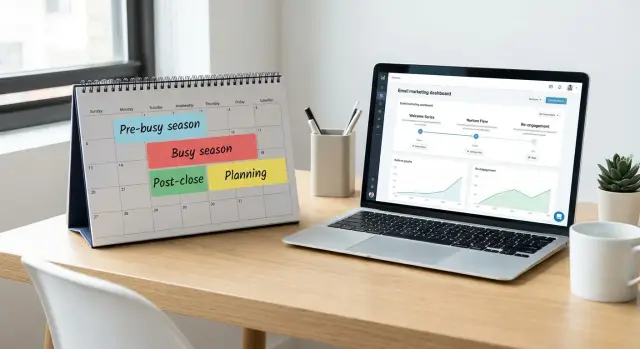
Why outbound timing is hard for accounting firms
For accounting buyers, timing often matters more than wording. A good email sent in the wrong week still gets ignored because the recipient is buried in deadlines, client fires, or internal planning.
The most common outbound mistake is pushing the right offer at the wrong time. A CFO two weeks from year-end close isn’t shopping for a new monthly bookkeeping partner. A controller stuck in audit requests isn’t eager to “hop on a quick call.” Even interested prospects can only act when their calendar allows it.
“Seasonal” also changes depending on what you sell. Tax spikes around filing deadlines and then resets. Audit fieldwork creates long stretches of low attention. CAS and bookkeeping demand is steadier, but decisions often happen right after close or during budgeting. Advisory interest rises during planning windows and drops during crunch time.
That’s why a seasonal lead gen calendar is less about clever pitches and more about matching your offer to the moment. The same firm might need tax resolution help urgently one month, then ignore anything not tied to next year’s planning the next.
A simple example: a 20-person company may be open to payroll cleanup right after close. During busy season, they only want fast fixes (late notices, misapplied payments, sales tax confusion) that reduce today’s stress.
The goal is consistent outbound that stays useful without feeling spammy. You reach out when prospects can actually respond, and you stay visible year-round with lighter, relevant asks. If you use a cold email platform like LeadTrain, the payoff is bigger because you can queue seasonal sequences in advance and spend busy weeks handling real replies instead of building campaigns.
Map your firm’s year in 30 minutes
A good seasonal calendar starts with a simple picture of your year, not a pile of new tactics. You’re trying to catch prospects when they can decide, approve, and switch.
Set a 30-minute timer and build one page with four columns: Services, Deadlines, Industries, and Planning windows.
Start with what you can sell without stretching your team. Include the obvious work (tax, audit, bookkeeping or CAS, payroll) plus any advisory that fits your clients. Keep it honest. If you don’t want new 1040s in March, don’t design outreach that attracts them.
Next, add deadlines by month for both clients and prospects. These are moments when pain is high but attention is low. The sweet spot is usually before the deadline rush.
Then list your best-fit industries and their busy periods. Industry cycles matter as much as tax dates. A contractor who closes job costing monthly feels a different urgency than a nonprofit preparing for a board meeting.
To keep this quick, use a simple method:
- Pick 4 to 6 services you want more of this year.
- For each service, write the top 2 deadlines and the months they hit.
- Add 2 to 3 industries you win in most often, and note their crunch months.
- Define a planning window for each offer (often 4 to 8 weeks before a deadline, plus 2 to 4 weeks right after).
- Circle 3 months where your team has capacity to onboard new work.
Example: If you sell monthly bookkeeping and cleanup work, your best window might be days 1 to 10 after month-end. That’s when owners see messy books and want them fixed before payroll and tax estimates. It’s usually a better time to pitch than the last week of the month.
Once this page is done, your outbound becomes more of a scheduling problem than a writing problem.
What to pitch before busy season
Pre-busy season is when people still have room to make changes. Your best offers are the ones that remove friction later: fewer missing docs, cleaner books, and a clear plan for extensions.
A simple, high-yes offer is a readiness check. Position it as a quick pass that finds missing paperwork, messy categories, and risk areas (1099s, payroll filings, sales tax). Keep it focused. You’re not selling a full engagement in the first email; you’re selling a small, safe step.
Bookkeeping cleanup is another easy win, especially for owners who fell behind after the holidays. Instead of “we do bookkeeping,” offer a “monthly close tune-up” that gets them back to a consistent close process before tax work starts. The payoff is clear: faster prep, fewer questions, less back-and-forth.
If you want higher-value leads, aim at new businesses and recent changes. Entity selection, payroll setup, and first-year compliance are time-sensitive, and founders often realize too late that their default setup is wrong.
CTAs that work well when time is tight tend to be specific and low-effort:
- “Reply with 2 numbers (revenue and headcount) and I’ll tell you if we can help.”
- “Want a 10-minute fit check this week?”
- “I can send a 6-question intake to see what’s missing.”
- “We have 5 pre-season readiness slots left. Should I reserve one?”
Example: A local retailer emails in February saying their books are “mostly done.” You offer a 20-minute readiness check, spot uncategorized card spend and missing W-9s, and propose a short cleanup project plus an extension plan.
If you build these outreach waves into a calendar, a tool like LeadTrain can help you schedule multi-step sequences and keep replies sorted so you don’t lose warm leads once things get busy.
What to pitch during busy season (without annoying people)
Busy season isn’t the time to sell a big change. Prospects are trying to hit deadlines, answer client emails, and keep work moving. If your message sounds like extra work, it gets ignored.
The safest busy-season pitch is a small, status-friendly offer that helps them stay on track. Think “reduce surprises” and “protect deadlines,” not “rebuild your process.” Your goal here is simple: be helpful, then get out of the way.
Busy-season-safe offers
A good busy-season offer is easy to say yes to and easy to start. For example:
- Overflow support for a specific task (cleanup, AP or AR catch-up, basic bookkeeping)
- A one-time review to prevent problems (quarterly estimates check, payroll audit, sales tax spot check)
- Deadline protection add-ons (extension management, missing-docs chase, client organizer setup)
- Record hygiene help (receipt capture coaching, naming rules, monthly close checklist)
- Quick “clean file” service for new clients who are behind
Avoid anything that sounds like a migration or major switch. No new ERP. No “move everything to a new stack.” No “let’s redesign your close process.” Even if it’s better, they hear “risk.”
Follow-ups that respect their time
During busy season, cadence matters as much as the message.
Send one short nudge 3 to 5 business days later. If there’s still no reply, pause until after the deadline window. If they reply “later,” confirm a specific month to reconnect.
Example: A small CPA firm is slammed in March. Instead of pitching a new monthly package, you offer “two-week catch-up + clean books for Q1” with a fixed start date after their biggest deadline. That feels like relief, not another project.
What to pitch after close
Right after close, many business owners feel two things at once: relief and anxiety. They want breathing room, but they also know a few messy items got pushed aside. This is the best window to offer help that feels like cleanup, not a new commitment.
A simple rule: after close is for fixing friction while the pain is still fresh.
Offers that land well after close
These pitches work because they solve last period’s problems and make the next period smoother:
- Cleanup and catch-up work: reconcile suspense accounts, tidy AP or AR, fix coding rules, update the chart of accounts.
- A short after-action review: what slowed close, what caused rework, and 3 to 5 changes to prevent it.
- Light advisory add-ons: cash flow check-ins, pricing or margin review, and a basic forecast tied to real drivers.
- Controls and process refresh: close checklist, handoffs, and simple timelines for the team.
- Systems tune-up: clean integrations, reduce duplicate entries, and set monthly routines that keep books close-ready.
Keep the promise small and clear. “Two-week cleanup sprint” is easier to say yes to than “ongoing advisory.”
Example: A 25-person services company finished close late again because expense coding was inconsistent. Your email offers a 60-minute close retro and a short cleanup sprint to lock in rules, fix recurring misc entries, and build a monthly checklist.
After close is also a strong time to ask for introductions. If a client just survived close with you, ask who else in their network is dealing with rushed reconciliations or late financials.
If you run these outreach waves by email, LeadTrain can help you schedule multi-step sequences and sort replies quickly, so “interested” leads don’t get buried during the post-close rush.
What to pitch during planning windows
Planning windows are the calm weeks when owners and finance leads can think, decide, and act. For many firms, that’s late spring after filings, mid-summer before Q3 estimates, and late fall for year-end moves. Your goal is to offer something that helps them make a decision now, not “learn more someday.”
A good calendar uses planning windows for a few pitches that feel useful instead of salesy.
1) Tax planning that prevents surprises
Lead with estimated payments and simple forecasting. Many owners aren’t avoiding tax, they’re avoiding uncertainty. Offer a quick check that turns “I think we’re fine” into a clear number and a plan.
Example: “If your revenue is up 20% this year, your estimates may be off. Want a 15-minute review to confirm Q3 and Q4 payments and avoid penalties?”
2) Entity and compensation decisions
This is where real money is won or lost. Keep it plain: when should someone revisit S-corp vs LLC, payroll vs distributions, or adding a spouse to payroll? You’re not promising savings. You’re offering a decision process.
Angles that often land well include an entity checkup after a revenue jump, a compensation review for S-corp owners before year-end, payroll and benefits setup for a first hire, a cleanup plan before financing or exit conversations, or a one-time scenario review after a big change (new state, acquisition, sale).
3) Quarterly owner reviews
Position it as a simple cadence: 4 touchpoints per year, focused on cash, tax, and next moves. CFOs and controllers like the structure. Owners like the clarity.
To make it easy to say yes, offer a planning packet: a one-page timeline plus 8 to 12 questions (income changes, payroll changes, capex, debt, state exposure). If you run outbound for this, LeadTrain can help you send the right sequence at the right time and keep replies sorted without extra admin work.
Step-by-step: build your seasonal outbound calendar
A seasonal outbound calendar works best when it’s built around offers you can deliver on time, even when your team is slammed. Keep it simple and repeatable.
A 30-minute build you can actually maintain
Start with three offers, not ten. Pick services with clear inputs, clear timelines, and a clean yes or no outcome so prospects can decide quickly.
Use this five-step process:
- Pick 3 offers you can deliver consistently (for example: year-end tax planning, bookkeeping cleanup, sales tax setup).
- Define one audience per offer by industry, company size, and role.
- Write one core email per offer, plus two short follow-ups. Make the follow-ups add something new, not just “bumping this.”
- Assign each offer to specific months, set volume caps, and add pauses for deadlines and holidays. When your firm is slammed, lower volume and extend gaps.
- Track replies by category, then adjust next month’s targeting, timing, and message based on what you learned.
If you’re unsure about volume caps, start small. Ten to twenty new prospects per day per sender is usually easier to control than blasting a list and dealing with deliverability problems.
Track replies so next month is smarter
Don’t measure only “meetings booked.” Categorize every reply so you know what to fix. A simple set is: Interested, Not interested, Out of office, Bounce, Unsubscribe.
Example: If your bookkeeping cleanup offer gets lots of “not interested” from founders but “interested” from operations managers, keep the offer and change role targeting next month.
If you use a platform like LeadTrain, reply classification can be automatic, which makes monthly adjustments faster when you’re juggling client work.
Common mistakes and timing traps
The biggest timing mistake is asking for a full firm-wide switch when your prospect is living in deadlines. In the middle of busy season, even a great offer feels like extra work. If you must reach out, keep it small: a quick second opinion on a specific issue, or a short planning call for after the deadline.
Another common trap is sending one generic message to everyone. A controller at a manufacturing company cares about different pain than a clinic owner, and neither reads the same as a founder. When you match the pitch to the role and industry, you can be shorter and still sound relevant.
Cadence is where many firms burn goodwill. If someone doesn’t reply, firing off three follow-ups in a week reads as pressure, not persistence. A better move is to pause and come back when the calendar changes (for example, two weeks after a filing deadline) with a timely angle.
Deliverability can quietly kill your calendar. New domains and mailboxes need warm-up time, and proper email authentication (SPF, DKIM, DMARC) matters. Ignore it and your best-timed email lands in spam.
Replies are the last timing trap: slow response equals lost intent. If a prospect replies “Yes, talk next week” and you answer three days later, that window is gone.
Keep these traps in mind:
- Don’t sell a full-service switch during deadlines. Offer a small, low-lift next step.
- Don’t use the same message for every industry and role. Write 2 to 3 versions based on common client types.
- Don’t over-email after silence. Space follow-ups, then pause until the next seasonal trigger.
- Don’t skip warm-up and authentication. Warm new mailboxes and set SPF, DKIM, and DMARC before sending.
- Don’t let replies sit. Aim for same-day responses, and use reply classification so interested leads don’t get buried with bounces and out-of-office messages.
Quick checklist before you hit send
A good plan can still fail if the offer is fuzzy or the follow-up gets out of hand. Use this quick pass to make sure your emails are easy to say yes to, and safe to run during your busiest weeks.
First, confirm you have three clear offers. Each one should have a simple promise and a simple next step. If you need three sentences to explain it, it’s not ready.
Then check the basics:
- Three offers, three clean CTAs. One action per email (for example: “Reply with 1-2 times next week” or “Want a quick checklist?”).
- Season and audience match. Tie each offer to a window (pre-busy season, busy season, post-close, planning) and one segment (owners, controllers, startup founders, real estate investors).
- Realistic send volume. Pick a daily number you can handle without rushed replies.
- Follow-up limit and pause rule. Cap it at 2 to 3 follow-ups. Pause immediately if they reply, unsubscribe, or say “not now.”
- Reply categories defined. Decide where each reply goes: interested, not now, referral, out-of-office, bounce, unsubscribe.
One practical example: your pre-busy season cleanup offer shouldn’t go to a CFO in late March with five follow-ups. Send it in early January, cap follow-ups, and pause on any hint of timing resistance.
If you use LeadTrain, setting up reply classification can save time and reduce mistakes when your inbox gets noisy.
Example: a simple calendar for a small CPA firm
Picture a 6-person CPA firm that serves 20 to 200 employee service businesses (agencies, IT services, home services, and B2B consultants). The goal isn’t to “sell tax prep.” It’s to offer timely help that reduces stress and improves cash flow decisions.
Here’s a simple year rhythm that fits a small team and still creates steady conversations.
A practical year rhythm (with what to say)
- Jan-Feb (readiness): Offer a quick “close the gaps before filing” check. Pitch clean books, a missing 1099 and W-9 process, payroll reconciliations, and a fast tax estimate so owners aren’t surprised.
- Mar-Apr (light touch): Send a short note that respects busy season. Share one helpful asset (deadline reminders, organizer tips) and ask permission to follow up later.
- May (cleanup): Pitch post-deadline cleanup: bookkeeping catch-up, chart of accounts fixes, Q1 reconciliation, and a monthly close cadence.
- Aug-Sep (planning): Pitch tax and cash flow planning: entity review, projected payments, year-end moves, and “what to change before December.”
Keep the call to action simple. Two options that work well are “reply with 2 times” (for a quick 10-minute fit check) or “send the checklist” (for people who want value first).
How to handle common replies without losing momentum
When prospects answer, respond in a way that keeps the thread moving:
- “After April”: Agree, then book the future. “Totally. Want me to circle back the week of May 6, or May 13?”
- “Already have a CPA”: Position a second opinion. “Makes sense. If it’s helpful, I can share a 7-point mid-year tax planning checklist to compare against what you’re doing now.”
- “Send info”: Send one tight overview plus one next step. “Will do. Are you more interested in cleanup (books) or planning (tax + cash flow)?”
If you run this by email, an all-in-one tool like LeadTrain can help you keep timing, follow-ups, and reply sorting organized when things get busy.
Next steps: run this calendar with less busywork
A calendar is only useful if you can run it without turning it into another admin project. For the next 30 days, narrow it down to one audience and one offer. Example: “real estate investors who file extensions” plus a “mid-year tax projection call.” That keeps your message clear and makes results easier to judge.
Set up a small outbound sequence you can manage even during deadlines. Keep it short, and decide your stop rule before you send anything. A simple stop rule is: stop when they reply (any reply), book a call, unsubscribe, or bounce. That prevents awkward follow-ups and protects your sender reputation.
A practical setup for most firms:
- One offer and one audience for 30 days
- A 3-step sequence (initial email, one follow-up, one final nudge)
- A clear stop rule (reply, book, unsubscribe, bounce)
- One weekly review (15 minutes) to adjust targeting and subject lines
The biggest busywork trap is juggling too many tools: buying domains in one place, setting up mailboxes in another, warming up elsewhere, and tracking replies in a spreadsheet. If you want this to stick, use a system that keeps domains, mailboxes, warm-up, and sequences in one place.
LeadTrain is built for that end-to-end flow. You can purchase and configure sending domains and mailboxes, handle warm-up, and run multi-step sequences without bouncing between tools. It also uses AI-powered reply classification to sort responses (interested, not interested, out of office, bounce, unsubscribe), so your team spends time on real conversations instead of inbox triage.
Run your seasonal outreach this way and you get two wins: consistent outbound during calm weeks, and a system that doesn’t fall apart when busy season hits.
FAQ
Why does timing matter more than wording for outbound to accounting buyers?
Start with a one-page map of your year: what you sell, when prospects are slammed, and when they can actually decide. Then assign each offer to a window like pre-busy season, busy season, post-close, or planning so you’re not forcing big decisions during deadlines.
What’s the fastest way to build a seasonal outbound calendar for my firm?
Pick 3 offers you can deliver reliably, then match each to a real decision window. A good default is one pre-deadline offer, one post-close cleanup offer, and one planning-window offer, so you stay relevant all year without sounding pushy.
What should I pitch before busy season to get more replies?
Lead with small, low-risk steps that remove friction later, like a readiness check or a short cleanup tune-up. You’re selling a safe first step, not a full engagement, because prospects still have time to change before the deadline crunch.
What’s a “safe” offer to pitch during busy season without annoying people?
Keep it helpful and low-lift, like overflow support for a specific task or a quick spot check that prevents surprises. Avoid anything that sounds like a migration or a big switch, because during deadlines people hear “extra work” and ignore it.
How often should I follow up during busy season?
Send one short follow-up after about 3 to 5 business days, then pause until the next seasonal trigger if there’s no response. If someone says “later,” lock in a specific month to reconnect so you don’t keep poking them at the worst time.
What should I pitch right after month-end or year-end close?
Right after close, pitch cleanup that fixes the pain they just felt, like reconciliations, coding rules, or a short close retro to prevent the same mess next month. Keep the promise tight, such as a two-week cleanup sprint, so it feels like relief instead of a new ongoing commitment.
What offers work best during planning windows?
Use planning windows for decisions that benefit from calm attention, like tax projections, entity and comp reviews, or a simple quarterly owner review cadence. The goal is a clear next step now, not a vague “let’s stay in touch” that drifts into next busy season.
How many cold emails should I send per day without hurting deliverability?
Start with about 10 to 20 new prospects per day per sender so you can respond fast and avoid deliverability issues. If your team is slammed or reply volume rises, lower the daily volume and extend the gaps so you don’t create slow-response losses.
What setup do I need before running seasonal cold email campaigns?
Warm up new mailboxes before sending and make sure SPF, DKIM, and DMARC are set correctly, because even perfect timing fails if messages land in spam. If you use a platform that handles warm-up and authentication setup for you, you reduce the chances of a silent deliverability problem.
How do I track replies so my next month’s outreach gets smarter?
Categorize every reply so you can adjust next month’s timing, targeting, and message instead of guessing. Tools like LeadTrain can auto-classify replies into buckets like interested, not interested, out-of-office, bounce, and unsubscribe so your team focuses on real conversations and doesn’t miss warm leads.