Real estate cold email outreach that brokers respond to
Real estate cold email outreach for proptech teams: segment brokers, property managers, and ops, lead with outcomes and proof, and follow up without spamming.
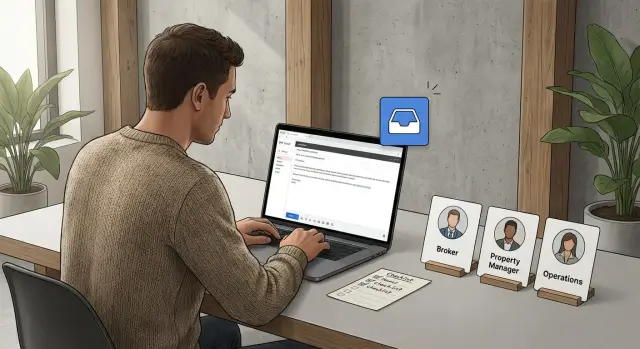
Why proptech outbound often gets ignored
Real estate inboxes are crowded. Brokers, property managers, and ops leaders see the same vendor email every week: a generic pitch, a long feature dump, and a request for 20 minutes. They delete fast because most messages don’t match how their day actually works.
It usually breaks down for a few predictable reasons. The email is written for “real estate” instead of their specific job. It leads with features (dashboards, integrations, AI) instead of a business result. It asks for a big commitment with no context. Or it shows up from a brand-new domain that looks risky, so it gets filtered or ignored.
Cold email works when it reads like a useful note from someone who understands the role. In B2B proptech, good outbound isn’t louder. It’s clearer: one problem, one outcome, one small next step.
A practical rule is “one of each”:
- One persona per message (broker vs property manager vs ops).
- One measurable outcome (faster leasing, fewer no-shows, cleaner reporting, fewer maintenance escalations).
- One proof point that fits in a sentence (a result, a recognizable workflow, or a short mini-case).
- One low-friction ask (permission to send details, a quick fit check, or the right referral).
The biggest shift is moving from features to outcomes. A broker doesn’t buy “automated follow-ups.” They buy more showings that turn into signed leases. A property manager doesn’t buy “work order routing.” They buy fewer resident complaints and less weekend chaos.
Set expectations correctly, too. In this space, cold email rarely closes a deal. A realistic win is a short meeting, a pilot at one property, or an intro to the person who owns the problem.
Pick your target: brokers vs property managers vs ops
If your real estate cold email outreach tries to speak to everyone, it feels vague to everyone. The fastest way to sound credible is to pick one role and write like you understand what their day looks like.
Brokers live in deals and competition. They care about speed to revenue, winning listings, and keeping a pipeline full. If you sell proptech, connect to outcomes like more qualified leads, faster follow-up, or fewer deals lost to slow response times. A broker rarely wants a long explanation of features. They want to know: will this help me win and close?
Property managers wake up to a different set of problems: tickets, calls, and small fires. They care about workload, renewals, and resident experience because that’s what keeps occupancy stable. Outreach lands when you talk about reducing repetitive work, shortening response times, or preventing avoidable churn. Pitching “growth” to a PM often misses the point. They want calmer operations.
Ops leaders (heads of operations, admin, revenue ops) look for cost control, risk reduction, reporting, and adoption. They worry about whether a tool will actually get used, whether it introduces compliance issues, and how it fits existing workflows. They respond to clarity: what changes, what it costs, what gets measured, and what could go wrong.
To keep the message believable, run one persona per sequence. It also makes your proof and examples tighter.
If you want a simple way to choose who to start with: if your product affects revenue first, start with brokers; if it reduces daily chaos, start with property managers; if it changes process or budget, start with ops.
Example: if you sell automated showing coordination, a broker email can focus on faster lead-to-showing time. A PM email should focus on fewer back-and-forth messages and fewer missed appointments. Same product, different win.
Map each persona to one clear outcome
Most proptech emails fail because they describe the product, not the result. The goal is to make the reader think, “Yes, that’s my problem, and the win is obvious.” Pick one persona, then choose one or two outcomes they care about this quarter.
Outcome angles that usually land tie to money, time, or risk:
- Brokers: faster comps (hours saved per deal), more qualified leads (reply-to-meeting rate), fewer no-shows (showing-to-offer efficiency).
- Property managers: fewer resident tickets (tickets per unit), faster turns (days vacant), higher renewals and fewer delinquencies (renewal rate, on-time payment rate).
- Ops and revenue ops: shorter cycle time (lead-to-meeting days), fewer manual steps (handoffs eliminated), cleaner reporting and auditability (consistent tracking and outcomes).
Once you pick the outcome, translate your offer into a simple before-and-after. Instead of “AI automation for leasing,” try “cut 2 days off unit turns by routing work orders and vendor follow-ups automatically.” One promise, one metric, one audience.
A quick test before you write:
- Can you say the win in under 10 words?
- Is there a number you can measure in 30 days?
- Would the reader recognize it as their KPI?
- Does it avoid feature words and focus on results?
Keep the promise narrow. You can expand later. You only get one first reply.
Add proof without sounding salesy
Real estate inboxes are full of big promises. Proof works when it’s specific, small, and tied to the exact job your reader does.
Good proof helps them picture a real change: a number, time saved, a before-and-after, or a named workflow. Bad proof is a claim with no anchor, like “increase efficiency.” If it can’t be measured, it sounds like marketing.
Proof formats that fit in one sentence:
- “Cut manual follow-ups from 45 minutes a day to 10.”
- “Went from 2-3 replies a week to 8-10, using the same list size.”
- “Stopped missing maintenance approvals by routing replies into 3 clear buckets.”
- “Booked 6 broker demos last month from a 3-email sequence.”
- “Replaced 4 tools (domains, mailboxes, warm-up, sequences) with one workflow.”
One strong detail beats three vague claims.
If you can’t share client names, you can still be credible. Use ranges and context, and describe what changed. Example: “Proptech team selling to regional brokerages; after fixing SPF/DKIM and warming new mailboxes, deliverability improved and replies doubled in 3 weeks.”
In real estate cold email outreach, the safest proof is often about process: fewer dropped balls, faster follow-up, clearer sorting of replies, fewer emails landing in spam.
Build a list that matches the persona
A good list does half the work. If you email the wrong role or the wrong kind of company, even great copy feels irrelevant. Build separate lists for brokers, property managers, and ops leaders, and keep them clean.
Collect only the details you’ll actually use. You don’t need 25 columns. You do need enough context to avoid guessing: name, job title, market, company, a simple size signal (doors, units, listings, AUM), and one line on why they fit.
Segment by the world they live in. Residential, commercial, mixed, and owner-operator groups have different pain points and different proof that lands. A broker focused on tenant rep won’t care about the same outcome as a manager judged on renewals or maintenance response times.
Before you send anything, do basic quality checks. This is where a lot of “bad outreach” starts: the list is sloppy, so the message has to work twice as hard.
Remove duplicates. Flag generic inboxes (info@, sales@) unless the business is tiny. Verify the role matches the persona you’re writing for. Spot-check a handful of companies to confirm they match your segment.
Example: if you sell a reporting tool for multi-site managers, a list of boutique brokers wastes your time. Build around “property manager, regional manager, director of operations,” and keep a one-line “why they fit” note so you can personalize quickly.
A simple message structure that works for real estate
Most real estate inboxes are full of templated pitches. Your email should look like something a person wrote quickly between calls. That starts with a plain subject line and a message that gets to one outcome.
Subjects should feel like normal email: “Quick question, {{Company}}” or “{{Area}} leasing ops.” Avoid hype, title case, and long subjects.
The first line is where outreach usually fails. Give a specific reason you chose them, based on something true: portfolio type, market, a hiring post, listing volume, or a tool they already use.
Then keep the body tight: outcome, proof, and a low-friction question.
A simple structure you can reuse:
- Reason: “Noticed you manage 12+ buildings in Austin and are adding a leasing coordinator.”
- Outcome: “Teams like yours cut vacancy days by getting showings scheduled faster.”
- Proof: “We did this for a 4,000-unit manager by routing inbound requests to the right property in under 5 minutes.”
- Question: “Is speeding up showing scheduling a priority this quarter?”
For the CTA, offer an easy next step that doesn’t feel like a trap: a 15-minute chat, a quick fit check (two questions), or “worth exploring?” if they’re the right owner.
A short P.S. can help if you have one extra proof point. Keep it to one line.
Step by step: launch a 3-email sequence in one afternoon
Pick one audience and one outcome, and stick to it for the whole sequence. “Brokers” isn’t an outcome. “More qualified buyer calls for your new development listings” is.
Write the three emails in one sitting and keep them short. Your first email can be 70-110 words. Follow-ups should be even shorter. The goal isn’t to explain everything. It’s to earn a reply.
A simple three-touch sequence:
- Email 1: relevance (why them), one outcome, one proof point, one easy question.
- Follow-up 1: one-sentence reminder plus the question again (or a softer version).
- Follow-up 2: a “close the loop” note with a polite off-ramp so they can say no.
Time it for how these teams work. Real estate people live in their inbox during business hours, but they’re often in the field midday. A safe default is morning sends (local time), then a follow-up 2-3 business days later, then another about a week after the first email.
Decide how replies will be handled before you send. Even a small team can run on one rule: interested replies get a calendar option within 30 minutes, “not interested” gets a quick thanks, and “wrong person” gets a simple ask for the right contact.
Launch to a small batch first. Start with 25-50 contacts that truly match your persona and outcome. Watch bounces, unsubscribes, and actual replies. If the signals are healthy, scale gradually.
Deliverability basics so you do not land in spam
If your email doesn’t reach the inbox, the copy doesn’t matter. Good deliverability is mostly boring basics done consistently, especially when you start a new domain or mailbox.
New sending domains and mailboxes need a slow start. Sending 200 emails on day one is a common way to get flagged. Think of it like building a reputation: steady volume and real replies build trust.
Set up authentication and keep sending steady
At minimum, your domain should have SPF, DKIM, and DMARC set up correctly. These records tell Gmail and Microsoft that your mail is legitimate. Once that’s in place, keep your sending patterns consistent: same from name, same domain, similar daily volume.
A simple ramp-up many teams use:
- Days 1-3: 10-20 emails per mailbox per day
- Days 4-7: 20-40 per day
- Week 2: 40-60 per day if bounces stay low
Instead of pushing one mailbox too hard, add mailboxes as you grow. Avoid big spikes (like a Monday blast after a quiet weekend).
If you want fewer moving parts, tools like LeadTrain can handle domain purchase, DNS setup, SPF/DKIM/DMARC, mailbox warm-up, and sequencing in one place, which makes it easier to keep sending healthy while you iterate on targeting.
Content rules that keep you out of trouble
Filters look for patterns. Keep emails plain and human. A short note that sounds like a normal message beats a glossy pitch.
Avoid heavy formatting, images, and multiple links. Avoid shouty words (FREE, GUARANTEED) and too many exclamation points. Don’t send the exact same paragraph to everyone.
Track the basics each week and fix problems quickly: bounce rate, spam complaints, reply rate, and unsubscribe rate. If bounces jump after you switch lists, pause and clean the data before you keep sending.
Handling replies like a real conversation
Most replies aren’t a clean “yes” or “no.” They’re signals. Treat them like you would on a quick call: acknowledge, clarify, and make the next step easy.
It helps to bucket replies into a few types: interested, not now, not a fit, out-of-office, bounce, and unsubscribe. The goal isn’t perfect labeling. It’s fast, polite responses.
Quick templates you can copy and adjust:
- Interested: “Great - what would be most useful to look at: reducing vacancy time, improving tour-to-lease, or reporting for owners? If you share your role and portfolio size, I’ll suggest a 10-minute agenda.”
- Not now: “Makes sense. When should I circle back? If you tell me what’s on your plate (renewals, staffing, budget cycle), I’ll time it better.”
- Not a fit: “Thanks for being direct. Before I close the loop, is there a different team that owns this (leasing ops, asset management, property management)?”
- OOO: “Thanks - I’ll ping you after you’re back. If someone else is covering vendor/tools decisions, I can reach out to them instead.”
- Unsubscribe: “Understood - I won’t email again. Take care.”
If they say “not me,” ask for a referral once, politely. In real estate firms, the owner can vary by persona: brokers may point to a team lead, property managers to regional ops, and ops to a systems admin.
To move from “interested” to a booked meeting in two messages, keep it simple:
- Ask one qualifier and offer two time options: “Are you managing 50+ units or multiple buildings? If yes, can you do Tue 11:00 or Wed 2:30?”
- Confirm and set expectations: “Booked. I’ll show 2 examples and you can tell me if it fits your workflow.”
Common mistakes that hurt response rates
Most reply problems aren’t about “copywriting skills.” They’re usually about relevance, trust, and basic email hygiene.
Common traps:
- Leading with features instead of a business problem. “We have dashboards and automation” rarely lands. Start with a day-to-day pain: vacant units sitting too long, slow turns, leasing team overwhelmed, broker time wasted chasing low-fit tenants.
- One sequence for everyone. Brokers, property managers, and ops leaders care about different wins. Mixing them in the same email makes your promise fuzzy.
- Personalization that feels wrong. Using the wrong property count, naming the wrong market, or referencing scraped personal details backfires. Keep it simple and verifiable.
- Heavy emails that look risky. Long paragraphs, attachments, and lots of links can trigger filters and skepticism.
- Too much volume too soon. New domains and mailboxes need time to earn trust.
A quick example: sending “increase NOI with AI leasing” to brokers and property managers in the same run usually fails both. The broker wants faster, higher-quality tenant matches for specific deals. The property manager wants fewer showings that go nowhere and more consistent occupancy.
If you want an easy guardrail, write one sentence that starts with: “For [role], we help you [outcome] without [common headache].” If you can’t finish it cleanly, the sequence is probably too broad.
Quick checklist and next steps
Before you hit send, make sure your plan is narrow enough to be believable. Mixing personas and outcomes, then hoping someone finds their own reason to reply, is the fastest path to silence.
A five-minute pre-send checklist:
- One persona only (broker, property manager, or ops) and one clear outcome they care about
- One proof point that matches that persona (a metric, a recognizable customer type, or a short result story)
- A clean, role-matched list (job title and company type actually fit)
- Sending setup is ready (mailbox warmed, SPF/DKIM/DMARC in place)
- A short first sequence (three touches max)
If you do only one thing for quality, do this: read your first email and underline every sentence that’s about you. If more than half is underlined, rewrite until it sounds like a helpful note from someone who understands their day-to-day.
Once the sequence is live, speed matters more than clever wording. Replies should be tagged and answered within one business day.
Next steps to get your first campaign out the door: pick one micro-offer and one small segment (for example, 50 mid-sized property managers managing 500 to 5,000 units). Send a small first batch, then expand. Track only three numbers in week one: delivered, replies, and positive replies. Keep what works and cut what doesn’t, especially in subject lines and first lines.
If you want to run the first campaign with fewer tools, LeadTrain (leadtrain.app) combines domains, mailboxes, warm-up, multi-step sequences, and AI-powered reply classification, so you can focus on targeting and follow-up instead of setup and inbox sorting.
FAQ
Why do most proptech cold emails get ignored?
Start by picking one persona and writing to their day-to-day reality. A broker, a property manager, and an ops leader want different outcomes, so one “real estate” pitch usually feels vague and gets ignored.
Should I start outreach with brokers, property managers, or ops?
Pick the role that feels the pain first. If your product impacts revenue and deal velocity, start with brokers; if it reduces daily workload and resident issues, start with property managers; if it changes process, budget, or reporting, start with ops.
How do I choose a single outcome for my email?
Lead with one measurable outcome they already care about this quarter, then tie your product to that win in a simple before-and-after. If you can’t say the win in one short sentence, the promise is probably too broad.
What’s the best way to add proof without sounding salesy?
Use one specific proof point that fits in a sentence, like time saved, a small performance lift, or a clear workflow change. If you can’t name the customer, add context (customer type, size, timeframe) so it still feels real and grounded.
What contact data do I actually need to build a good list?
Build separate lists per persona and segment, then keep only the fields you’ll actually use to personalize accurately. A clean, role-matched list beats fancy copy, because relevance is what earns replies.
What email structure works best for real estate outreach?
Keep it human and tight: a plain subject, a real reason you picked them, one outcome, one proof point, and one easy question. The goal is to earn a reply, not to explain the whole product.
How many follow-ups should I send, and when?
A simple three-email sequence is enough to start: one strong first note, then two short follow-ups that restate the outcome and ask a low-friction question. Send in the morning local time, then follow up a few business days later, then about a week after the first email.
How do I avoid landing in spam with a new domain?
Set up SPF, DKIM, and DMARC, then ramp volume slowly on new domains and mailboxes. Consistent sending patterns and low bounce rates matter more than clever wording, especially early on.
How should I handle replies so leads don’t go cold?
Treat replies like a conversation and respond fast with a clear next step. Bucketing replies into simple categories like interested, not interested, out-of-office, bounce, and unsubscribe helps you move quickly without overthinking every message.
What should I measure in week one, and how do I scale safely?
Start with a small batch and track only a few signals at first: delivery health, replies, and positive replies. If you want fewer moving parts, using one platform that handles domains, mailboxes, warm-up, sequences, and reply classification (like LeadTrain) can reduce setup mistakes and keep follow-up organized.