Persona Pain-Point Matrix for Outbound: Template + Examples
Build a persona pain-point matrix for outbound to map pains, proof, and CTAs for finance, ops, IT, and marketing in one simple planning sheet.
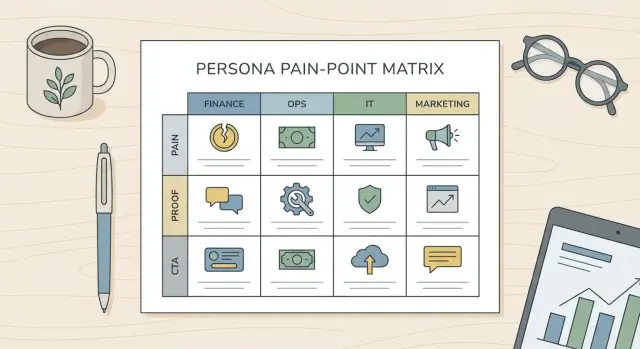
What a persona pain-point matrix is (in plain language)
Outbound starts to feel random when everyone writes from their own point of view. Sales wants replies fast. Marketing wants the “right” positioning. IT worries about risk. Finance asks about cost. Without a shared plan, you end up rewriting the same email five times and still not knowing why reply rates are low.
A persona pain-point matrix for outbound is a simple planning table that forces clarity about what you’re saying and why it should matter to a specific persona. It doesn’t try to make one message fit everyone. It helps you pick one clear pain, back it up with believable proof, then end with a small, realistic next step.
For each persona (finance, ops, IT, marketing), the matrix captures three things:
- Pain: the costly or stressful problem they already feel (not your feature list).
- Proof: a concrete reason to believe you (a metric, a result, a specific detail, or a credible process).
- CTA: the smallest next action that matches their risk level (often a short call, a quick audit, or a yes/no question).
This reduces rewrites because it creates message guardrails. When someone suggests changing a line, you can check the matrix: does the new line still match the persona’s pain, and do we have proof for it? It also cuts internal debate. Instead of arguing about wording, you focus on the parts that actually drive replies.
Use a matrix when you’re launching a new offer, moving into a new market, or your outbound is getting polite silence. It’s also useful when multiple people touch the same campaign (SDRs, founders, marketing) because it keeps your messaging consistent.
Example: if you sell a cold email platform like LeadTrain, IT might worry about deliverability and sending reputation, while finance cares about tool sprawl and wasted spend. The matrix forces you to address each concern with the right proof and a CTA that feels safe for that buyer.
The four personas and what they usually optimize for
A persona pain-point matrix works best when you stop guessing what people “care about” and name what they’re measured on. Four roles show up in a lot of B2B deals: Finance, Ops, IT, and Marketing. They can all like your idea, but for different reasons.
Finance: protect the downside, then justify the spend
Finance tends to optimize for risk reduction and predictable returns. They worry about budget timing, approvals, and whether a tool creates surprise costs later (extra seats, usage fees, compliance work).
A finance-minded message lands when it answers: “What do we save or avoid, and how soon?” If you sell outbound tooling, Finance often wants confidence that deliverability problems (spam, bounces, domain damage) won’t create rework or lost pipeline.
Ops: keep work moving with fewer handoffs
Ops usually optimizes for speed and reliability. They feel pain when a process breaks, when people have to chase updates, or when a simple task turns into five manual steps.
For outbound, Ops cares about how quickly campaigns can be launched, how often something needs babysitting, and whether the workflow is consistent across the team (so results don’t depend on one “expert”).
IT: reduce security and change risk
IT optimizes for security, access control, integrations, and change control. Their job is to prevent incidents and protect systems. They often resist tools that require messy DNS changes, unclear data access, or “just give us admin” requests.
With cold email, IT will care about email authentication, who can send, where data lives, and how the tool connects to the rest of the stack. A team might like the idea of automated DNS setup for SPF/DKIM/DMARC, but IT still needs clarity on permissions and ownership.
Marketing: grow pipeline without hurting the brand
Marketing optimizes for pipeline impact and attribution, but also brand risk. They worry about spam complaints, message quality, and whether outbound makes the company look careless.
A practical way to frame it: marketing wants outbound to be measurable and respectful. If reply handling is messy, Marketing sees it as a brand problem, not just a sales problem.
If you’re not sure which persona you’re writing to, ask which of these your email answers first:
- “Is this worth paying for, and what could go wrong?” (Finance)
- “Will this remove steps and reduce day-to-day chaos?” (Ops)
- “Is this safe, controlled, and compatible with our systems?” (IT)
- “Will this create pipeline while protecting our reputation?” (Marketing)
Picking pains that actually drive action
Most outbound fails because it targets a mild annoyance, not a decision-worthy problem. A persona pain-point matrix only works if each pain is tied to a real consequence: lost money, wasted time, higher risk, or missed targets.
Symptoms vs root pains
A symptom is what people complain about. A root pain is what forces them to act.
Example:
“Reporting takes forever” is a symptom.
The root pain might be: “Finance can’t close the month on time, which delays board reporting and creates fire drills.” That’s specific, costly, and urgent.
To get to root pain, keep asking what breaks when the symptom happens:
- What metric gets worse because of this?
- Who gets blamed when it goes wrong?
- What’s the measurable cost (hours, dollars, risk, churn)?
- What decision gets delayed?
- What happens if nothing changes for 90 days?
When you write the pain in your matrix, make it something the prospect could verify later. If you can’t imagine how they’d confirm it in a call, it’s probably too vague.
Use the persona’s words (not your category words)
People don’t wake up wanting “deliverability” or “workflow automation.” They talk about outcomes: “Our emails land in spam,” “We keep missing follow-ups,” “I spend my morning sorting replies,” “We can’t prove compliance.”
To capture real wording, pull phrases from job posts for that role, internal tickets or Slack snippets (if you have them), and call notes or objection emails. Then rewrite your pain statement using their language.
For example, “IT needs better email infrastructure” becomes: “IT is tired of getting dragged into DNS fixes every time Sales wants to send campaigns.”
Add a “why now” trigger
Even a strong pain can sit for months without a trigger. Add one line in the matrix that explains what makes it urgent now.
Common triggers:
- deadlines (quarter-end, month close, renewals)
- audits and compliance checks
- churn risk or pipeline targets
- backlog and support load
With outbound email, “We need more demos” is weak. “We need meetings before the quarter ends, and last month’s deliverability tanked” creates a clear reason to act.
If you use a platform like LeadTrain, a specific pain could be: “We lose weeks juggling domains, warm-up, and reply sorting across tools.” It’s easy to confirm and points to a fix you can prove.
Mapping proof points to each pain
A persona pain-point matrix only works if every pain has a believable reason to trust you. Proof is the bridge. Without it, your message sounds like every other pitch.
Proof doesn’t have to be complicated. It does have to match what the person is worried about, and it needs to stay specific.
Common proof types that work well in outbound:
- numbers (time saved, error rate reduced, reply rate improved, tickets avoided)
- a short customer story (before, after, and how long it took)
- process proof (how you prevent the risk)
- a shareable artifact like a screenshot or report snippet (only if you can share it)
- third-party signals like security reviews, public case studies, or well-known integrations
Match proof to the pain, not to your favorite metric. Finance usually cares about risk and predictability, so use cost ranges, payback timelines, and what changed in measurable terms. Ops cares about throughput and fewer handoffs, so show cycle time, steps removed, or fewer manual checks. IT cares about security and control, so lead with how access is managed and how deliverability risk is contained. Marketing is judged on pipeline and conversion, so show lift in qualified replies or meetings booked, not just volume.
Avoid claims you can’t back up. If you can’t show the exact number, don’t guess. Use bounded language like “typically 2 to 4 weeks,” “in our last 10 onboardings,” or “here’s the checklist we follow.” If you sell a cold email platform like LeadTrain, it’s safer to say “SPF/DKIM/DMARC setup is handled in-app” than to promise “we guarantee inboxing.”
It also helps to build a small proof library the whole team can reuse: a short list of defensible metrics (with sources), a few customer stories tied to specific persona pains, and a couple of clear “how we handle risk” explanations (security, deliverability, change control). When proof is mapped cleanly, your outbound template becomes easier to write and your CTAs feel earned.
CTAs by persona: what to ask for and when
A good CTA is a small, clear next step. It should match how much trust you’ve earned so far. If your first message asks for a 30-minute call, most people will ignore it, even if they like the idea.
Use a simple CTA ladder
Start low-friction, then step up only after you get a signal:
- Confirm fit: “Worth a quick look if reducing X is on your plate?”
- Two-line answer: “Should I send a 3-bullet summary, or is this irrelevant?”
- Quick call: “Open to a 10-minute call Wed or Thu?”
- Forward to owner: “If you’re not the right person, who owns this?”
- High-friction ask: “Can we review your current process together?”
Each ask is easy to say “yes” to, and also easy to say “no” to. That’s what keeps it from sounding pushy.
What each persona will usually commit to
Different roles have different comfort levels, especially on first touch:
- Finance: low-commitment questions and a short written summary they can share internally. Calls work best after you mention payback time, risk, or budget impact.
- Ops: quick call or quick question works if it’s tied to throughput, delays, or manual work.
- IT: prefers clarity and control. Ask for requirements or constraints (security, access, integration) before pushing for a meeting.
- Marketing: often responds to a simple angle. Ask for a preference (A vs B) or a quick yes/no on the goal, then propose a short call.
If you’re building a persona pain-point matrix for outbound, add one CTA per persona for first touch and one for a follow-up after a positive reply.
To keep CTAs natural, write them like a polite question, not a command. Offer a tiny choice, keep time asks short (10 minutes beats 30), and make it clear you’re fine with “not a fit.” If you use a platform like LeadTrain, you can A/B test CTAs and use AI reply classification to see which asks trigger real interest versus polite deflections.
Step-by-step: build the matrix in 30 minutes
You can build a useful persona pain-point matrix without a big workshop. Keep the scope tight: one offer, one segment, and only pains that can trigger a reply.
A 30-minute build (set a timer)
Start with a blank table with columns: Persona, Pain, Proof, CTA, Fallback CTA.
-
Lock the scope (5 min): Choose one offer and one target segment. Example: “refund leakage monitoring” for mid-market subscription companies. Covering multiple offers makes the matrix generic.
-
Write three action pains per persona (10 min): For finance, ops, IT, and marketing, add three pains each with a clear cost or risk. Skip vague pains like “inefficiency.” Prefer “end-of-month close takes 10 days” or “leads go stale before SDR follow-up.”
-
Add proof that matches the pain (7 min): For each pain, write 1-2 proof points you can back up. Use a metric, a short case (“team of 5 SDRs stopped missing replies”), or a specific mechanism (“tenant-isolated sending reputation to protect deliverability”).
-
Pick a primary ask and a fallback (5 min): Tie the CTA to the pain, not to your sales process. Primary CTA can be a short call; fallback can be a simple question or permission-based ask.
-
Clean it up (3 min): Remove jargon, shorten long phrases, and make every row understandable to someone outside your company.
Quick example (one row)
For an IT pain like “security reviews slow down new tools,” proof could be “supports SPF/DKIM/DMARC and keeps each customer’s sending reputation separate.” A primary CTA might be: “Worth a 10-minute check to see if your policy would approve this?” The fallback CTA could be: “If not you, who owns email authentication and outbound tooling?”
If you already run cold email, tools like LeadTrain can help you turn the matrix into execution faster by consolidating domains, mailboxes, warm-up, sequences, and reply classification in one place. But the matrix still has to be clear first.
Example: one outbound offer mapped to finance, ops, IT, marketing
Offer (same for everyone): replace a patchwork of cold email tools with one platform that handles domains, mailbox warm-up, multi-step sequences, and reply classification. The goal stays the same. The reason to care changes.
Here’s a simple persona pain-point matrix for outbound for that exact offer.
| Persona | Pain (what they feel) | Proof (what you can credibly say) | CTA (small next step) | Wording tweak |
|---|---|---|---|---|
| CFO / Finance | Costs are spread across too many tools, and spend is hard to control. Also worries about risk from email sending issues. | “One bill instead of 5+. Domains, mailboxes, warm-up, and sequences are in one place. Email authentication (SPF/DKIM/DMARC) is set up automatically so teams are less likely to damage sender reputation.” | “If I share a quick cost map (current stack vs consolidated), can you sanity-check if this is worth a 15-minute review?” | Lead with total cost and risk. Keep it numbers-first, low hype. |
| Head of Ops / RevOps | SDRs lose time switching tools and sorting replies. Reporting is messy. | “Reply classification tags responses as interested, not interested, out-of-office, bounce, or unsubscribe so reps spend less time triaging. Sequences and warm-up are managed together.” | “Want me to show a 10-minute walkthrough of the workflow end-to-end, then you tell me where it breaks in your process?” | Focus on time saved per rep and fewer manual steps. |
| Head of IT | Doesn’t want another vendor that creates deliverability tickets or shared sending risk. | “Automatic DNS setup plus authentication. Warm-up gradually builds sender reputation. Tenant-isolated sending infrastructure means your org’s deliverability reputation isn’t tied to other customers.” | “Can I send a one-page deliverability and security summary for your review before we talk?” | Be precise and calm. Use technical facts, not marketing claims. |
| Head of Marketing / Demand Gen | Worries outbound will hurt brand, deliverability, and list health. Needs learning and testing. | “A/B tests for copy and sequences, and clear reply categories help you see what messaging lands. Warm-up reduces spam placement risk.” | “If you share your ICP and one offer, I’ll draft two tested angles and a first sequence for feedback.” | Emphasize brand-safe messaging, testing, and learning loops. |
When one persona blocks another (which is common), plan for it:
- If IT is gatekeeping, ask Ops for an intro and permission to send IT a deliverability/security summary first.
- If Finance approval is the bottleneck, give Ops a simple cost comparison and ask who owns the final budget call.
- If Marketing worries about brand, offer to pilot with one domain and a small volume before scaling.
Notice the offer never changes. Only the “why now” and the ask do.
Common mistakes that make matrices useless
A persona pain-point matrix is only useful if it leads to clearer emails and better replies. Most matrices fail because they turn into a dumping ground of ideas instead of a decision tool.
One common mistake is stuffing too many pains into one message. If your Finance row lists “budget control, vendor risk, forecasting accuracy, and audit readiness,” you’ll be tempted to cram all of it into one email. The result reads like a brochure. Pick one pain per email, and keep the rest as optional follow-ups.
Generic proof is another matrix killer. “Trusted by many” doesn’t reduce risk for a CFO or an IT lead. Proof needs a shape: a concrete outcome, a time frame, a before-and-after, or a specific mechanism. If you don’t have numbers, use process proof (how it works) instead of vague popularity.
CTAs that skip steps also break the plan. If someone is problem-aware but not vendor-shopping, “Book a demo” is too big of an ask. A smaller step (sanity check, quick audit, or a short question) fits earlier stages.
Five failure patterns to watch for:
- One email tries to solve everything for the persona
- Proof is vague (logos, “industry-leading,” “trusted by”) instead of specific
- CTA asks for a meeting before you’ve earned it
- You mix personas (CFO language sent to IT, or IT objections sent to Marketing)
- You forget the negative case, so you chase leads that will never convert
That last one matters more than most teams expect. Write down when you’re not a fit. For example, if your offer is “faster outbound by consolidating tools,” it may not fit a team with locked-in procurement contracts and a fully built RevOps stack.
A quick scenario: if you sell a cold email platform like LeadTrain, your Finance row might focus on tool consolidation cost and predictable spend, while IT cares about sending infrastructure and deliverability controls. If you send the Finance angle to IT, you’ll get silence or a security questionnaire, not a meeting.
Quick checklist before you write emails
Before you write a single subject line, make sure your matrix can survive a quick reality check.
The 10-minute sanity check
Read each persona column out loud. If the pain sounds like a buzzword (“efficiency,” “digital transformation”), rewrite it as a plain, specific problem someone would complain about on a busy Tuesday.
Checklist:
- For each persona, do you have 2-3 pains that are concrete and time-bound (this week, this quarter), not vague goals?
- For every pain, do you have proof you can actually show or claim without stretching (a metric you improved, a process you changed, a real customer example, a demo you can run)?
- Does your CTA feel easy to answer in one reply (yes/no, pick one of two times, “send details”) rather than a big commitment?
- Did you note the top objection for that persona and your one-sentence response (budget, priorities, security, “already have a tool”)?
- Does the message sound like help from a peer, not a pitch (no hype, no pressure, no mystery claims)?
After the checklist, do a quick mismatch scan. If your proof is strong but your ask is too big, shrink the CTA. If your CTA is good but your proof is weak, pick a different pain or gather better evidence.
Objections: write them down now, not later
Put objections directly into the matrix, next to the pain they block. For IT, that might be access control and compliance. For finance, it’s often budget timing or payback. For ops, it’s disruption risk. For marketing, it’s brand voice and list quality.
Example: if you’re pitching cold email infrastructure, IT may worry about domain reputation and security. Your proof could be a short explanation of how sending is isolated per organization and how SPF/DKIM/DMARC are set up, plus a low-friction CTA like: “Want me to send a one-page summary of the setup and what data we store?” Tools like LeadTrain can handle domain setup, warm-up, and reply categorization, which makes that proof easier to demonstrate.
If you can pass this check, writing the emails becomes mostly execution, not guesswork.
Next steps: convert the matrix into a repeatable outbound process
A matrix only matters if it changes what you send and how you learn. Treat it like a living script library: each strong row becomes a reusable set of message parts.
Turn your best rows into copy blocks. For each persona, pick one pain, one proof point, and one simple ask, then write a mini-sequence around it:
- Subject line: name the pain in plain words (not your product)
- Opener: show you understand the situation and the cost of doing nothing
- Proof: one specific result, example, or believable reason you can help
- CTA: one low-friction next step that matches their role
- Follow-up: restate the pain differently and add a second proof point
Then test one variable at a time. The matrix makes this easier because you can swap a single cell and keep the rest steady. Run short A/B tests like pain vs pain, proof type vs proof type (numbers vs customer story), or CTA vs CTA (15-minute fit check vs “who owns this?”).
To keep the matrix accurate, assign ownership. Keep it simple: whoever runs calls updates pains and objections; whoever runs outbound updates subject lines and CTAs; and one person reviews the whole thing weekly so it doesn’t drift.
A practical loop looks like this:
- After every 5 to 10 replies, tag what you learned (objection, question, interest)
- Update the relevant row with the wording people used
- Retire rows that don’t get replies after a fair test
- Promote rows that create meetings into your default sequence
If you want the matrix to turn into real outreach without stitching together extra tools, LeadTrain (leadtrain.app) is built to cover the full cold email cycle in one place: domains, mailboxes, warm-up, multi-step sequences, A/B tests, and AI-powered reply classification (interested, not interested, out-of-office, bounce, unsubscribe). That makes it easier to spend your time on what actually improves results: better pains, better proof, and better asks.
FAQ
What is a persona pain-point matrix, and why should I use one for outbound?
A persona pain-point matrix is a simple table that helps you write outbound messages for one specific role at a time. For each persona, you choose one pain they already feel, one believable proof point, and one small next step (CTA) so your email stays focused instead of sounding like a generic pitch.
Which personas should I include in my matrix?
Limit it to the personas that show up most in your deal and can block or approve the purchase. For many B2B offers that’s Finance, Ops/RevOps, IT, and Marketing, because they optimize for different outcomes and respond to different proof and CTAs.
How do I pick pains that actually lead to replies?
Write the pain in the prospect’s words and tie it to a consequence they’d care about within a quarter. If it doesn’t connect to lost money, wasted time, higher risk, or missed targets, it’s usually too mild to drive a reply.
What’s the difference between a symptom and a root pain?
Treat symptoms as the starting point and keep asking what breaks because of them. A good pain is specific enough that someone could confirm it on a call without you leading them, like “we keep missing follow-ups” rather than “we need better automation.”
What kinds of proof work best for Finance vs Ops vs IT vs Marketing?
Use proof that matches the persona’s worry, not your favorite feature. Finance usually trusts cost ranges and payback logic, Ops trusts fewer steps and faster launch time, IT trusts controls and clear setup details (like SPF/DKIM/DMARC handling), and Marketing trusts measurable learning like A/B test results and clean reply outcomes.
What’s a good first CTA for a cold outbound email?
Start with a low-friction ask that’s easy to answer in one reply, then escalate only after they show interest. A simple default is a yes/no fit check or an offer to send a short summary, and only then suggest a 10–15 minute call.
How do I create CTAs that match each persona’s risk level?
Write one primary CTA for first touch and one fallback CTA for follow-ups or when the persona is a gatekeeper. For IT, a strong fallback is offering a one-page security/deliverability summary; for Finance, it might be a quick cost map they can share internally.
How can I build a usable matrix quickly without a workshop?
Keep the scope tight: one offer, one segment, and a small set of pains per persona. Fill the table with Persona, Pain, Proof, CTA, and Fallback CTA, then remove any row that you can’t back up with real proof or that would require a long explanation to make sense.
What are the biggest mistakes that make a matrix useless?
The most common issues are cramming multiple pains into one email, using vague proof, and asking for a big meeting too early. Another frequent failure is mixing personas, like sending a Finance savings angle to IT, which often triggers silence or a security questionnaire instead of progress.
How do I turn the matrix into actual sequences and improve it over time?
Use the matrix to create persona-specific copy blocks, then test one variable at a time (pain, proof type, or CTA). If you run outbound in LeadTrain, you can consolidate domains, mailboxes, warm-up, sequences, A/B tests, and AI reply classification so it’s easier to measure which matrix rows create real interest versus polite deflections.