Partner outreach vs customer outreach: framing, proof, and asks
Partner outreach vs customer outreach requires different framing, proof, and asks. Use this guide to avoid sending a buyer pitch to a potential ally.
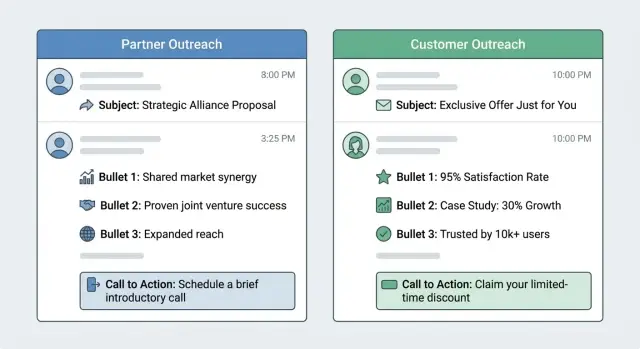
Why partner emails fail when they sound like sales emails
Partner outreach fails for one simple reason: the email is written like a buyer pitch. The sender talks about features, pricing, and why their product is better, then asks for a call as if the other person is shopping.
A potential partner isn’t trying to buy. They’re deciding whether aligning with you helps or hurts their reputation, their relationships, and their time.
When you misframe the email, you damage three things fast:
- Trust: It feels like you’re trying to sell through them, not build with them.
- Positioning: You come off like a vendor chasing leads, not someone with a real partner motion.
- Future access: Even if they ignore you today, you may have burned your easiest path to their audience later.
Here’s a common example. You email an agency owner and pitch your outbound tool with a long list of deliverability features. They read it and think, “They want me to become a reseller,” or worse, “They’re going to spam my clients.” Even if your tool is solid (say you handle warm-up, DNS setup, and reply classification like LeadTrain does), the framing makes it feel like you want a quick purchase, not a safe collaboration.
This is for founders, SDRs, growth leads, and BD folks who send a lot of cold email and want replies that are actually useful. The goal is to help the reader pick the right angle and the right ask.
If you remember one line, make it this: partner outreach vs customer outreach is about different risks. Buyers fear wasting money. Partners fear hurting their credibility.
Write to the risk in front of you, and you’ll stop getting “not a fit” from people who were never a buyer in the first place.
Quick definitions: what counts as a customer vs a partner
A customer decides to pay you because your product solves their problem better than the alternatives.
A partner helps you reach, serve, or retain customers (and you help them do the same), even if they never buy for themselves.
That single difference changes everything: incentives.
Customer outreach is mostly about revenue and risk. The person reading your email is thinking, “Will this work for me, and is it worth the money and effort?” They care about outcomes, pricing fit, time to value, and proof you can deliver.
Partner outreach is mostly about reach, credibility, and long-term upside. The person reading your email is thinking, “Will this make my offer stronger, help my audience, or open a new channel without hurting my reputation?” They care about brand fit, mutual value, and how the collaboration will actually run.
Common partner types (so you can tailor the message to the relationship, not a buyer pitch): integration partners, agencies or consultants, affiliates and creators, co-marketing partners, and resellers or channel partners.
Example: If you’re using a platform like LeadTrain to run outreach, a “customer” email might offer a quick demo to see if cold email can book meetings for their team. A “partner” email might propose an agency workflow where you support their client campaigns and they introduce you when cold email becomes a need. Same tool, different relationship, different definition of success.
Framing: what each email is really about
A customer email is about a purchase decision. A partner email is about a shared bet.
A customer email works when it stays focused on the prospect’s problem and the cost of doing nothing. You’re saying: “Here’s what’s broken, here’s what it costs you, here’s how we fix it, and here’s why you can trust us.” The flow is usually:
- The problem you noticed
- The impact (time, money, risk)
- Your solution in one sentence
- Proof it works (results, brand, quick story)
- A clear next step (usually a short call)
Partner framing flips the center of gravity. It’s not “buy my tool.” It’s “we both serve the same people, and we can help them faster together.” The email should read like a small, low-risk collaboration with a clear outcome:
- The shared audience you both already reach
- The shared outcome (what improves for them)
- One simple collaboration idea
- Proof you won’t waste their time (credibility, fit)
- A lightweight next step (15 minutes, or a single test)
You can still mention your product, but it should be supporting detail, not the headline. For example: “We run outbound for SaaS teams using LeadTrain for setup and reply sorting, and we’re seeing X. I think this could pair well with how you do Y.”
If you’re accidentally writing a buyer pitch to a potential ally, it usually shows up as feature dumps (multi-step sequences, A/B tests, inbox rotation), pricing or discount talk, aggressive demo language, or big claims with no shared goal.
Proof: what partners need to believe vs what buyers need
The fastest way to miss is to show the wrong kind of proof.
Buyers ask, “Will this solve my problem and is it worth the money?” Partners ask, “Will this make me look smart to my audience, and will it move the needle for both of us?”
Customer proof is about outcomes. A buyer relaxes when they see numbers, a clear before-and-after, and a believable path to ROI: a short case story, a quote, or a metric like “reduced time to X by 30%.” If you sell to teams, proof the product is easy to adopt (setup time, support load) also matters.
Partner proof is about fit and reach. A partner needs to trust that your audience overlaps with theirs, that you can contribute to distribution, and that you’re easy to work with.
A quick way to keep it straight:
- Buyer proof: results, ROI, testimonials, specific numbers
- Partner proof: audience match, channel strength, past co-marketing, partner references
- Buyer risk: “I waste money”
- Partner risk: “I waste reputation and time”
If you have little proof yet, don’t inflate claims. Offer a small pilot with a clear scope. Example: “Let’s run one co-hosted webinar and one email swap. If we don’t hit 50 signups, we stop.” You can also use a credible constraint: “We’re early, so we’re only taking 2 partners this quarter and we’ll do the work on assets.”
Confidence comes from being specific, not loud. Replace big promises with verifiable details: who the offer is for, what you’ll promote, what you can provide (content, landing page, email copy), and how you’ll measure success.
If you use a platform like LeadTrain to run outreach, keep partner proof handy in a short “partner kit” note you can paste into emails: an audience snapshot, one or two past collabs, and the exact distribution you can commit to. That reads as prepared, not pushy.
The ask: different calls to action for allies vs buyers
A customer email can ask for a decision. A partner email usually can’t.
Customer asks are about evaluating a product: a quick demo, a trial, a pricing call, or a clear decision window. The subtext is “should you purchase this?” That works when the person has the problem and the budget.
Partner asks are about exploring fit: “is there a way we can help each other?” The first step should be low effort and low risk, because the value isn’t proven yet and the relationship isn’t built.
Partner-friendly asks that don’t demand commitment:
- A 15-minute intro call to compare audiences and see if there’s overlap
- A small test: “Let’s send 2 referrals each and track what happens for 30 days”
- A content swap (guest post, webinar, or newsletter mention) if it’s truly useful to both lists
- A referral loop: agree on who’s a fit, how to introduce, and how to follow up
- An integration chat, even if it starts as “is this worth exploring?”
Notice what’s missing: no “sign this partner agreement,” no “commit to a quarterly target,” no “send me your client list.” Those are second or third asks.
A simple example: if you’re reaching out to an agency, don’t ask them to “buy seats.” Ask to compare notes on deliverability and see if a pilot makes sense for one client. If you’re using an all-in-one platform like LeadTrain, the ask can be even lighter: “Want to see how we set up domains, warm-up, and sequences in one place, then decide if a small referral test is worth it?”
How to write a partner outreach email (step by step)
A good partner note is built for cooperation, not conversion. Keep that difference in mind and the execution gets much easier.
Step-by-step structure
-
Pick the relationship type first. Say what you’re proposing in plain words: referral, integration, co-marketing, or reseller. This avoids the vague “let’s partner” message.
-
Write a one-line shared audience statement. Make it specific enough that they can quickly say, “Yes, that’s our people.” Example: “You help boutique accounting firms win new clients; we help them book more qualified calls from outbound.”
-
Propose one small pilot with a single success metric. Keep it easy to try and easy to measure. Good metrics include intros made, demos booked, reply-rate improvement, or revenue from 1-2 referred deals. Avoid multi-month commitments in the first email.
-
Be clear about what you’ll do vs what you need. Partners want to understand the workload and the risk without having to ask.
If you’ll provide the assets, say it: draft copy, a short partner blurb, a simple landing page, tracking, and support for their team. If you need something, ask cleanly: an intro to the right person, a mention in their newsletter, or 15 minutes to confirm the offer and terms.
- Close with an easy next step. Offer two time options or a simple yes/no. Example: “Open to a 2-week pilot where we each send one co-branded email and track meetings booked? If yes, are you free Tue 11:00 or Thu 2:00?”
If you send partner emails at scale, keep the pilot and metric in the first line of your follow-up too. Tools like LeadTrain can help you run multi-step sequences without losing track of who’s a partner lead vs a buyer lead.
Example scenario: pitching an agency partnership the right way
Imagine LeadTrain (a cold email platform) reaching out to a small outbound agency. The agency already serves the same ICP: B2B founders and sales teams that want more booked meetings.
The mistake is treating the agency like a buyer. That puts them in the wrong frame. They aren’t shopping for a tool, they’re protecting their reputation with clients.
The "bad" version (sounds like a customer pitch)
It usually:
- Leads with product features and pricing
- Pushes for a demo as if they’re the end user
- Claims big results with no context (“10x replies”)
- Asks them to “switch tools” with no clear upside for their business
Even if the tool is solid, the agency hears: more work, more risk, unclear reward.
A better version (shared audience, tiny pilot, clear roles)
Start with the overlap: you both win when the agency’s clients get replies and meetings. Then make the first step small and low-risk.
Example subject line: Partnership idea for your outbound clients (small pilot)
What the message should sound like: You work with B2B teams doing cold email. LeadTrain helps teams handle domains, mailboxes, warm-up, and reply sorting in one place, so campaigns are easier to run and deliverability stays steady.
Instead of asking them to buy, propose a simple pilot: 1-2 client accounts for 30 days. You provide onboarding and deliverability setup. They keep control of strategy and copy. If it works, you talk about a referral fee or a packaged offer they can resell.
Spell out roles in plain language:
- Agency: targeting, messaging, and day-to-day campaign decisions
- You: infrastructure setup, warm-up, and support if inbox health drops
- Shared goal: prove stable inbox placement and reply handling on a real client
Short CTA: If you have one client who’s starting outreach this month, reply “pilot” and I’ll send a 2-sentence plan and suggested next steps.
Common traps that turn partners away
Partner conversations die fast when the email sounds like a buyer pitch. You’re not asking them to buy, you’re asking them to collaborate.
A quick gut check: read your first paragraph and ask, “Does this make their world better, or does it only explain my product?”
The traps that most often push potential allies into “ignore” mode:
- Leading with features, plans, or pricing like you’re trying to close a deal
- Asking for a big commitment right away (referral agreement, co-marketing plan, full demo on email one)
- Being fuzzy on value (“we can help you make more revenue”) without a clear path
- Pretending it’s “just networking” when the real goal is referrals
- Making the next step hard, so they have to do work to say yes
A simple example: you’re emailing a small agency about a partnership around a cold email platform like LeadTrain. If your message starts with “we consolidate domains, mailboxes, warm-up, and sequences,” the agency hears “tool vendor.” If you instead say, “We can help you add outbound as a packaged service for your clients, and we’ll handle the setup work that usually eats your team’s time,” it reads like a partner fit.
Keep your first ask small and specific. Offer one clear option that takes 10-15 minutes, like a quick call to see if your audiences overlap, or a swap of two or three client profiles you both serve well. When the “yes” is easy, you earn the right to talk about bigger commitments later.
A quick checklist before you hit send
Read the email once with one question in mind: would a partner feel like you’re trying to team up, or like you’re trying to sell to them?
Start with your first paragraph. It should name the overlap in plain language, like “we both work with B2B SaaS founders who need more demos” or “we both care about improving deliverability so campaigns don’t burn domains.” If the opening is mostly your product, pricing, or feature language, it’ll read like a buyer pitch.
Then check your ask. The best partnership CTAs are low-friction and easy to say yes to, such as a 15-minute fit check or a small pilot with a clear start and stop. If your CTA asks for commitment (reseller terms, revenue share, “become a partner”), you’re skipping steps.
Make sure you offer something concrete first. That can be a draft co-marketing idea, an intro to one relevant contact, a short asset they can reuse, or a specific segment of leads you can send their way. Even “I can write the first version of the webinar outline” signals you’ll do work, not just request it.
Proof needs to match the partner’s risk. Customer wins can help, but partners also want to know: will this make them look good, will it protect their reputation, and can it reach the right people. Mention distribution you can bring (audience, newsletter, community), credible references, or a quick example of a similar collaboration.
Finally, imagine your email being forwarded internally. If it would feel awkward in front of a VP, legal, or a partnerships lead, tighten it.
- Does the opening clearly state the shared audience or shared outcome?
- Is the CTA a low-friction next step (fit check or pilot), not a big commitment?
- Do you offer something concrete first, not just “let’s partner”?
- Is your proof partner-relevant, not only customer results?
- Would the email be safe to forward without edits?
If you run outbound at scale, keep partner outreach separate from customer acquisition campaigns so the language, proof, and follow-ups don’t drift back into sales mode.
Measuring results and tuning follow-ups
If you treat partner outreach and customer outreach the same in reporting, you’ll optimize the wrong thing. A partner thread can be a win even if it never becomes a direct sale.
For partner outreach, success is about momentum and access. You’re looking for signs the person is willing to put their name next to yours:
- Positive reply rate (yes, curious, send details)
- Introductions to the right stakeholder
- Pilot starts (one shared webinar, one co-sell test, one referral test)
- Time to first meaningful next step (not just “sounds good”)
- Drop-offs by step (who says yes, then disappears)
Customer outreach is tighter and more numeric. The goal is booked time and revenue movement. Track meeting rate, show-up rate, conversion to qualified opportunity, and pipeline created per 100 contacts. Also watch unsubscribes and spam complaints, because buyers punish pushy follow-ups faster than partners.
The fastest way to ruin your numbers is mixing sequences. Keep partner prospects in their own list, their own tags, and their own follow-up templates so they never get buyer language like “pricing,” “discount,” or “ready to sign.” If you use a tool that classifies replies, make sure “interested” for partners means “open to explore a partnership,” not “wants a demo.”
A simple, respectful cadence works better than a long chase:
- Day 1: short opener with a specific partnership angle
- Day 4: one-sentence bump with a concrete option (intro or 15-minute fit check)
- Day 10: add proof that reduces risk (small result, credible client, or pilot idea)
- Day 18: polite close-out with an easy “not now” reply
When you tune follow-ups, change one thing at a time: the ask (intro vs quick call), the proof (case story vs pilot plan), or the audience (founder vs partnerships lead). That way you learn what actually moves the conversation forward.
Next steps: split your outreach motion and stay organized
Split partner outreach and customer outreach into two separate tracks. Different goal, different proof, different ask. When those get mixed, your email feels off even if the writing is good.
Start by creating two templates you can reuse. Keep the first 3-4 lines similar (why them, why now), then change the CTA:
- Customer template CTA: a short call or a quick question that leads to a buying conversation
- Partner template CTA: a small pilot, an intro swap, or a co-marketing test with clear next steps
Build a small partner list on purpose. Pick 20 ideal partners, not 200 “maybes.” For each partner type, define a pilot offer that’s easy to say yes to. Example: “You send 2 clients who need outbound, we’ll handle setup and share outcomes in 14 days,” or “Let’s co-write one short guide and each email it to our list.”
Email hygiene matters more for partner outreach than people think, because partners judge you on professionalism. Before you hit send, make sure your basics are covered: your sending domain is authenticated (SPF, DKIM, DMARC), mailboxes are warmed up, and you’re not blasting from a brand new inbox.
Finally, get organized so follow-ups don’t get messy. Track partner replies separately from customer replies, and label outcomes like “interested,” “not now,” and “needs intro.” If you want a single place to manage the operational parts of cold email, LeadTrain (leadtrain.app) combines domains, mailboxes, warm-up, multi-step sequences, and AI-powered reply classification, so your attention stays on the partnership conversation instead of inbox sorting.
FAQ
Why do partner emails fail when they sound like sales emails?
A partner is deciding whether working with you will help or hurt their reputation, relationships, and time. If your email reads like a product pitch, they assume you want to sell through them or create risk for their audience.
Lead with the shared audience and a small, low-risk collaboration idea instead of features and pricing.
What’s the simplest way to tell a customer from a partner?
A customer pays because your product solves their problem better than alternatives. A partner helps you reach, serve, or retain customers, even if they never buy your product themselves.
That difference changes what they care about: buyers want ROI and ease of adoption, partners want credibility, fit, and a clear way the collaboration runs.
What is partner outreach really about compared to customer outreach?
Customer outreach is about a purchase decision. Partner outreach is about a shared bet on a channel, audience, or workflow.
If your next step is “book a demo to evaluate pricing,” it’s customer framing. If your next step is “let’s test one referral swap or co-marketing asset,” it’s partner framing.
How should the structure of a partner email differ from a customer email?
For customers, lead with the problem, impact, your one-sentence solution, and a clear evaluation step. Keep it focused on outcomes and time-to-value.
For partners, lead with the overlap in audience, propose one small pilot, and be explicit about roles so they can see the workload and the risk upfront.
What kind of proof do partners need that buyers don’t?
Buyers need outcome proof: specific results, believable before-and-after, and why implementation won’t be painful.
Partners need fit proof: audience overlap, how you’ll help them look good to their audience, and signs you’re easy to work with (clear plan, assets, and a measurable pilot).
What’s a good first “ask” in a partner outreach email?
Keep it lightweight and low-commitment. A good default is a 15-minute fit check or a small pilot with a clear start and stop.
Avoid asking for agreements, targets, or access to their clients in the first message; earn that later after a small win.
What are the biggest red flags that turn potential partners away?
Talking about pricing, discounts, or “switching tools” too early. Dumping product features without tying them to a partner outcome.
Also, vague language like “let’s partner” with no concrete pilot makes it feel like hidden work and unclear upside.
What if I don’t have strong partner proof yet?
Offer a small pilot with one success metric and do more of the work yourself. Be specific about what you’ll provide, what you need from them, and what happens if it doesn’t work.
Specificity builds confidence faster than big claims, especially when you’re early.
How do I keep partner outreach from getting mixed with customer acquisition sequences?
Separate them by goal, language, and success metrics. Partner sequences should avoid buyer language like “pricing,” “discount,” or “ready to sign,” and should optimize for momentum like intros, pilots, or stakeholder handoffs.
If you use a platform with reply classification, make sure “interested” means “open to exploring a partnership,” not “wants a demo.”
How can I mention LeadTrain without turning the email into a product pitch?
Mention it briefly as supporting detail, not the headline. Use it to reduce perceived workload or risk, such as simplifying domain setup, warm-up, and reply sorting so the partner’s team doesn’t get buried in ops.
For example, you can say you run outreach with LeadTrain to keep deliverability and reply handling organized, then bring the conversation back to the pilot and shared outcome.