Outreach for Different Seniority Levels: Execs to ICs
Outreach for different seniority levels needs different tone, proof, and asks. Learn how to write emails that fit execs, managers, and ICs.
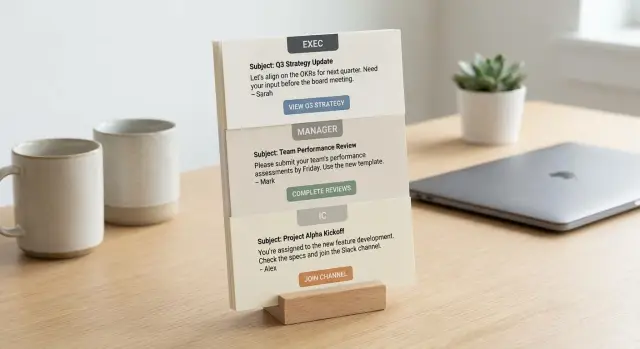
Why seniority changes what works in outreach
One-size-fits-all outreach gets ignored because it treats everyone like they wake up with the same problems. They don't.
A VP skimming email between meetings wants a fast reason to care and a low-effort next step. A manager wants to know how it will affect their team and workload. An individual contributor (IC) wants to know if it will make their day easier or create more hassle.
Seniority changes what people optimize for:
- Executives optimize for outcomes, risk, and focus.
- Managers optimize for delivery, tradeoffs, and buy-in.
- ICs optimize for clarity, time, and whether the idea is actually usable.
You usually don't need a new offer for each level. You need a new framing. Keep the same core value, then adjust three things: language, proof, and the ask.
Language shifts by level: execs want plain business impact, managers want practical constraints, and ICs want specifics. Proof shifts too: execs trust signals and results, managers trust process and examples, and ICs trust details and steps. The ask should match what they can say yes to quickly: a short call for execs, a working session or pilot for managers, and a quick test or question for ICs.
Example: you sell a tool that helps teams run cold email without juggling multiple tools. The exec version leads with fewer meetings wasted and better pipeline quality. The manager version leads with less manual sorting of replies and fewer deliverability fires. The IC version leads with faster setup, fewer tabs, and clear next actions.
If you're using an all-in-one platform like LeadTrain, it's easier to keep your emails outcome-first because domains, mailboxes, warm-up, sequences, and reply classification sit in one place instead of being scattered across multiple tools.
A quick map of execs, managers, and ICs
Outreach works when you match what the person is paid to care about. Same offer, different lens: execs think in outcomes and risk, managers think in targets and tradeoffs, and ICs think in today's work and friction.
Execs (VP, C-level, founder) live in time pressure. They want a clear business outcome, a fast read on risk, and a reason this matters now. Keep it short and make the "so what" obvious. Your ask should feel low-effort, like a quick yes/no or a short call with a specific agenda.
Managers (team lead, head of, director) get judged on hitting goals with limited people and budget. They care about process, how change will affect the team, and what they'd need to do to make it work. They respond well to practical details: rollout, ownership, and what breaks.
ICs (specialist, analyst, SDR, engineer) care about their workload. They want to know: will this make my day easier, or add another tool and more steps? Speak in concrete tasks and common pain points.
You can often guess level from title and context. "VP", "Chief", "Founder", and "GM" usually means exec. "Director", "Head of", and "Manager" usually means manager. "Specialist", "Analyst", "Rep", and "Coordinator" usually means IC. Org context matters too: "of Sales" vs "Sales Ops" vs "Sales Development" hints at scope.
Language that fits execs
Execs read like triage. If your first line doesn't signal a clear business outcome, they move on. The biggest shift is simple: you're not selling features, you're selling a result worth their attention.
Keep the message tight and plain. Two to four sentences is plenty before the ask. Use confident words, fewer adjectives, and skip the long setup about who you are.
Lead with one outcome tied to money, time, or risk. Examples:
- "Cut the time SDRs spend sorting replies"
- "Increase booked meetings without adding headcount"
If you mention deliverability or compliance, frame it as risk reduction, not a product tour.
What sounds executive is mostly what you leave out: tool lists, buzzwords, and five competing metrics. Choose one clear noun (meetings, pipeline, reply rate) and one believable claim with a boundary (timeframe, segment, or condition).
A simple pattern that works: outcome + why now + low-friction next step.
"Noticed you're hiring SDRs. Teams often lose hours each week to inbox sorting and deliverability issues. We built LeadTrain to keep outbound email deliverable and auto-classify replies so reps focus on real conversations. Open to a 10 minute call Tuesday, or should I send a 3-line summary first?"
Language that fits managers
Managers sit in the middle: they care about outcomes, but they get judged on execution. Strong manager messaging shows you understand the goal they own and the messy reality of getting anything adopted.
Start by naming a measurable target that sounds like their world: pipeline coverage, speed to first meeting, lead response time, rep capacity, or follow-up SLAs. Keep it concrete. "Reduce no-shows by 15%" lands better than "improve efficiency."
Then acknowledge the operational side without making it heavy. One sentence of empathy lowers resistance: "I know anything touching outbound needs buy-in from reps and a safe rollout."
Offer a practical path instead of a big promise. Managers like pilots with a simple timeline: two reps, two weeks, one segment, then compare reply rate and meetings booked. If you mention a platform, tie it to what they manage: fewer tools, warm-up handled automatically, and replies categorized so the team can move faster.
For the CTA, respect the calendar and make it easy to say yes without committing to a project. Examples: "Open to a quick 12-minute call to see if a small pilot makes sense?" or "If you're the wrong owner, who runs outbound ops for your team?"
Language that fits ICs
ICs live in the work. Your message should sound like you understand the steps they repeat every day and the small things that waste time.
Start with a pain they feel, not a company goal: copying data between tools, chasing missing info, fixing avoidable mistakes, or dealing with messy handoffs. Make it specific enough that they can picture it happening this morning.
Keep the tone peer-to-peer. Skip big claims. ICs trust detail, not vision.
A simple pattern:
- Name the exact annoying moment
- Show one day-to-day change
- Offer a small, low-risk next step
- Give them an easy out
Example (to an SDR): "Noticed many SDRs lose 30-45 minutes a day sorting replies and tagging outcomes. If replies were auto-labeled as interested / not now / OOO, would that save you time or just add noise?" (You can keep this tool-agnostic even if your product does it.)
One caution: don't ask ICs to sell it internally on the first email. Ask for feedback, not a champion.
What counts as proof at each level
Proof isn't one thing. The best proof matches what the reader is paid to care about.
Exec proof is a credible signal that outcomes are likely and risk is low. They don't need every step. They want to know it's real, safe, and worth attention.
Manager proof is about rollout. They need to picture the work, the timeline, and how their team fits in.
IC proof is detail. They want to see how it works in the messy real world: edge cases, what happens when something breaks, and what they actually do differently.
Practical formats that usually land:
- Exec: one-line outcome plus a credibility signal (recognizable customer type, compliant setup, deliverability protections).
- Manager: a simple plan (week 1 setup, week 2 pilot, who owns what) plus team impact.
- IC: a workflow example (before vs after) plus concrete artifacts (sample sequence, reply categories, setup steps).
Numbers help, but only if they sound earned. Skip big percentages with no context. Use ranges, time boxes, and clear conditions.
A safer way to write it:
- Use before/after time ("cut sorting replies from ~30 min/day to ~10") instead of heroic revenue claims.
- Use a range ("typically 1-2 weeks") instead of a perfect number.
- Name the condition ("after warm-up is complete") so it doesn't feel made up.
If you don't have brand-name social proof, tell a short case story: one team, one problem, what changed, and one measurable result.
Step-by-step: rewrite one outreach message for three levels
Start with one message and reshape it instead of writing from scratch.
- Write the core value in one sentence.
Example: "We help B2B teams book more qualified demos by fixing deliverability and follow-up."
- Pick one benefit per level.
- Exec: predictable pipeline without adding headcount.
- Manager: higher reply rates and a cleaner follow-up process.
- IC: fewer manual tasks and clearer next steps on every reply.
- Pick one proof point that matches what they trust.
Exec: business outcome (meetings booked, cycle time). Manager: process metric (time saved per rep, reply handling). IC: practical detail (fewer bounces, fewer "who owns this?" threads).
- Choose the ask and keep it small.
Execs get a 10-minute fit check. Managers get a short workflow walkthrough. ICs get a quick question they can answer in 30 seconds.
Here’s the same offer rewritten three ways (keep each under 120 words):
Exec: "If pipeline is a priority this quarter, I can share how teams improve inbox placement and follow-up so more outbound turns into meetings. Open to a 10 min fit check next week?"
Manager: "Noticed your team does outbound. We're seeing better reply rates when deliverability and sequencing are set up end-to-end. Want a 15 min look at what your current process might be missing?"
IC: "Quick question - are you seeing bounces or lots of untagged replies? If yes, I can share a simple setup that keeps emails landing and sorts replies automatically. Worth a 2-question check?"
Finally, create two variants and A/B test one change at a time (proof point or ask). If you run campaigns in LeadTrain, you can test variants and have replies auto-labeled (interested, not interested, out-of-office) so you can see what wording actually moves people.
Choosing the right ask and CTA
Your call to action should match what the person can actually say yes to quickly.
- Exec: 10 to 15 minute fit check, or "who owns this?" so they can delegate.
- Manager: short working session to map rollout, constraints, and KPIs.
- IC: one quick question, a request for feedback, or a 5 minute walkthrough to sanity-check effort and impact.
Options can help, but only if they feel like a clear choice. Keep it to two paths and make one the default: "Worth a 12-minute fit check next week, or should I send this to the person who runs outbound?"
Keep the CTA consistent across a sequence. If email #1 asks for a meeting, email #2 shouldn't suddenly ask for pricing, a referral, and a demo.
Example: one offer, three messages
Same product, different reader. Here’s a simple scenario: you’re pitching LeadTrain, an all-in-one cold email platform (domains, mailboxes, warm-up, sequences, reply classification) to a sales org.
VP Sales: outcomes + risk
Subject: More meetings, fewer deliverability fires

Hi {{FirstName}},

If outbound is a key channel for you, the two things that usually cap results are inbox placement and rep time.

LeadTrain combines domains + mailboxes, warm-up, sequences, and reply classification so teams can launch campaigns fast while protecting sender reputation (separate sending infrastructure per org).

Worth a 12-minute call to see if this could raise booked meetings without adding headcount?

- {{YourName}}
Follow-up: keep it calm and specific. Send one short note with a single metric you can improve (deliverability, reply handling time), then close the loop.
Sales Manager: process + adoption
Subject: Less time managing outbound tools

Hi {{FirstName}},

Quick question: how many tools do your SDRs touch to run one sequence today?

LeadTrain puts domains, warm-up, multi-step sequences, and reply sorting in one place, so reps spend less time on setup and you get cleaner reporting on what’s working.

If I send 3 screenshots of the workflow, can you tell me if it fits how your team runs outbound?

- {{YourName}}
Follow-up: offer something useful (a workflow breakdown, a sample sequence structure) and ask for feedback, not a meeting.
SDR: daily workflow + less busywork
Subject: Fewer steps to launch a sequence

Hey {{FirstName}},

If you hate bouncing between tools to set up sending, warm-up, and sequences, LeadTrain keeps it together and auto-sorts replies (interested, not interested, OOO, bounce).

Want me to share a ready-to-copy 3-step sequence you can run this week?

- {{YourName}}
Follow-up: be quick. One line, one offer (sequence copy, subject line test), then stop.
Common mistakes that hurt replies
The fastest way to lose a reply is to start with your product features instead of their outcome. "We have AI, dashboards, and integrations" forces the reader to connect the dots. A better opener is the result you help someone get, in plain numbers or time saved.
Another quiet reply killer is using the same proof for everyone. Execs care about business impact and risk. Managers want proof it works in their workflow. ICs want proof it won't waste their day. When your proof doesn't match their level, it reads like a template even if you personalized it.
Asking for too much time too soon is also common. A 30 minute call with a multi-step agenda is a big ask from a cold email. Make the first step small and easy.
Over-personalizing can backfire when it's irrelevant. Mentioning a random podcast quote or a team photo can feel creepy or off-topic. Use one detail only if it supports the reason you're reaching out.
Watch your "homework" asks. "Can you introduce me to the right person?" or "Can you send me your vendor list?" sounds like you want them to do your job.
Before you send, check three things: lead with one outcome, use role-matched proof, and keep the first ask small.
Quick checklist before you hit send
Read the email once like a busy stranger. If you can't get the point in 10 seconds, they won't either.
Start with the first line. It should be about their goal or problem, not your product or how "excited" you are. If you can drop the first line into any email and it still fits, it's too generic.
Then look at your proof. Make it easy to believe at a glance: one specific result, a recognizable customer type, or a clear before/after.
Finally, check the ask. One action, clearly stated. If it feels like work, replies drop fast.
Use this checklist:
- First line: names a goal, priority, or trigger that matters to them
- Proof: one concrete detail that feels credible
- Ask: one simple next step with a clear time or format
- Skimmability: short sentences and plenty of white space
- Follow-up: adds new value (a data point, a quick idea, a relevant example), not "just checking in"
If you're sending at scale, keeping everything in one place helps. LeadTrain, for example, combines sequences with reply classification so follow-ups stay consistent and you can see which messages are actually driving interested replies.
Next steps: turn this into a repeatable outreach system
Stop rewriting from scratch. Keep one offer, then keep three versions of the message on hand: exec, manager, and IC. Your job is to swap the language, proof, and ask, not the entire idea.
Build a small message kit:
- One consistent offer (what you do and who it helps)
- Three intros (exec, manager, IC)
- Three proof lines (a result, a credible signal, or a clear example)
- Three asks (meet, quick alignment check, or "who owns this?")
- One follow-up line you can repeat without sounding pushy
Test one change at a time. Keep it simple: subject lines, one proof sentence, or the CTA. Give each test enough sends to matter, and keep notes on what you changed so you don't guess later.
Don't rely on one email. Use a short multi-step sequence so busy people can miss the first message and still see your offer later. Each step should add one new angle, not just "bumping this."
Finally, track replies by type so you can learn what works for each level: interested, not now, not the right person, out-of-office, unsubscribe/negative. If you want fewer moving parts, LeadTrain can handle domains, mailbox warm-up, multi-step sequences, and reply classification in one place, so you spend more time testing messages and less time managing tools.
FAQ
Do I really need different outreach for execs, managers, and ICs?
Use the same core value, then change three things: language, proof, and the ask. Keep the offer consistent so your campaign stays coherent, but make it sound like it fits what that person is responsible for.
What does each seniority level usually care about?
Executives care most about outcomes, risk, and focus. Managers care about delivery, tradeoffs, and team adoption. ICs care about day-to-day friction, clarity, and whether it actually makes their work easier.
How should I write cold emails to executives?
Lead with one business outcome tied to money, time, or risk, and make the “so what” obvious in the first line. Keep it short, skip feature lists, and ask for a low-effort next step like a quick fit check.
How should I message managers without sounding like a generic pitch?
Name a measurable target they own, then acknowledge the reality of rollout without making it feel heavy. Offer a simple pilot path and a small CTA that doesn’t force them to commit to a big project right away.
What works best when reaching out to individual contributors (ICs)?
Start with a specific annoyance they feel in their workflow, then describe one concrete change that would save time or reduce mistakes. Ask a quick question they can answer fast, and don’t push them to champion it internally on the first email.
What kind of proof should I use for each level?
Exec proof is a credible signal that the outcome is likely and the risk is low. Manager proof is a clear plan for rollout and ownership. IC proof is workflow detail, including what happens in messy edge cases.
How do I rewrite one message into three versions without starting over?
Write one sentence that captures the core value, then pick one benefit per level and one proof line that matches what they trust. Change the ask to fit their time: a short call for execs, a pilot/workflow session for managers, and a quick question for ICs.
What’s the best CTA for execs vs managers vs ICs?
Make the first ask small and easy to say yes to. Execs respond to a 10–15 minute fit check or a simple yes/no, managers respond to a short working session or pilot idea, and ICs respond to a quick question or a fast walkthrough.
What are the most common mistakes that hurt reply rates?
Starting with features instead of outcomes, using the same proof for everyone, and asking for too much time too soon are common reply killers. Over-personalizing irrelevant details and asking the reader to do “homework” also reduces replies.
How does an all-in-one platform like LeadTrain change the outreach story?
If you’re selling something like LeadTrain, you can keep your message outcome-first because the workflow is unified: domains, mailboxes, warm-up, sequences, and reply classification in one place. That makes it easier to frame the value differently for each level without changing the product story.