Outbound for SMB vs mid-market: adjust promise, proof, ask
Outbound for SMB vs mid-market needs different promises: adjust proof, timelines, and your ask so prospects know what to expect and say yes.
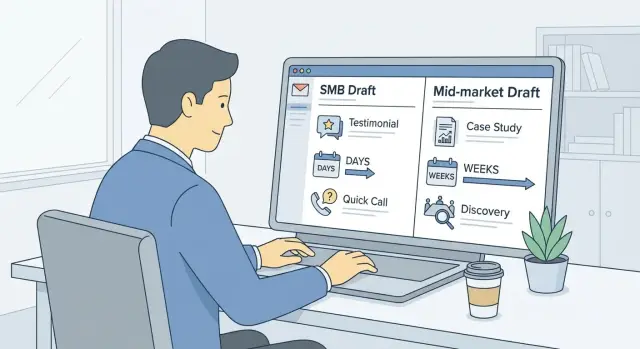
Why your outbound needs a different promise by segment
A message that books calls with a five-person company can fall flat with a 500-person one. Not because your offer got worse, but because the buyer is protecting different things: time, reputation, budget, and internal attention.
When you use the same pitch across segments, you often miss the real fear behind the polite silence. SMB prospects usually want to avoid wasted hours and tools that add work. Mid-market prospects tend to worry about risk: choosing the wrong vendor, triggering a messy rollout, creating a security concern, or starting a project that drags on and makes them look careless.
That’s why the difference between SMB and mid-market outbound is often not your product. It’s your promise. The promise is what you claim will happen, how fast, and how much effort it takes on their side.
Three levers should change as the segment changes:
- Promise: the outcome and timeline you commit to
- Proof: the kind of evidence that feels believable to that buyer
- Ask: the meeting request and what you want them to do next
A simple example: you sell a tool that helps teams run cold email campaigns.
For an SMB owner, “Get your first campaign live this week without hiring an ops person” can be compelling because it reduces work and gets them moving. For a mid-market head of sales, the same line can sound naive. Their next thought is, “What about deliverability, permissions, and multiple reps sending at once?” A better promise for mid-market is closer to: “Launch a pilot with clear guardrails, deliverability controls, and reporting your team can trust.”
Nothing about the category changed. Only the packaging.
- SMB version: speed and simplicity
- Mid-market version: control and safety
If you use a platform like LeadTrain, this is where you highlight different angles of the same capability. An SMB might care that domains, mailboxes, and warm-up are handled in one place. A mid-market team may care more that their sending reputation is isolated and replies are categorized automatically so reps aren’t sorting inboxes.
SMB vs mid-market: the practical differences that matter
When people say “SMB” or “mid-market,” they often mean headcount. For outbound, a better definition is complexity: how many people must agree, how much change your product causes, and how much risk they feel.
An SMB target is usually a small group where one person can decide, pay, and start quickly. Mid-market is where the same problem exists, but decisions spread across roles (ops, IT, finance, legal, security), and even “trying it” can create work for multiple teams.
Buying motion: speed vs coordination
In SMB, the buying motion is typically straightforward: one owner or manager feels the pain, wants fast relief, and can approve a card purchase. They care about what improves this week and whether setup is painless.
In mid-market, the motion is: a champion likes the idea, then needs buy-in. Your message has to help them sell it internally, not just say “book a call.” That’s the core shift.
Setup effort, integrations, and approvals
What changes isn’t only budget. It’s the number of steps between “yes” and “live.”
An SMB team might start a cold email campaign in an afternoon if the tool handles domains, DNS, and warm-up. A mid-market team may still want that speed, but they’ll ask about permissions, deliverability controls, reporting, and how the tool fits with existing systems.
A concrete scenario:
- A 12-person agency can connect new domains and mailboxes and start sending in LeadTrain with minimal back-and-forth.
- A 250-person services firm may want the same unified setup, but will also ask who owns the sending reputation, how replies are triaged for multiple SDRs, and what data can be exported to their CRM.
If you want a quick segment check before you write, ask yourself:
- Who signs off: one buyer or a group across functions?
- What must change: just a workflow or multiple tools and teams?
- What must be proven: “it works” or “it is safe and controllable”?
- How they pay: card today or procurement and terms?
- What could go wrong: low personal risk or visible org-wide risk?
If your answers skew toward group sign-off, more change, and higher risk, write for mid-market. If they skew toward speed, simplicity, and one owner, keep it tight and focused on fast outcomes.
How to shape your promise for SMB vs mid-market
Your promise is the short answer to: “Why should I care right now?” The right answer changes with the buyer’s reality.
For SMB, the promise should feel fast and low-effort. They’re usually juggling too much and want a clear win without changing how the whole team works.
For mid-market, the promise should feel controlled and predictable. More people will be affected, more questions will be asked, and “sounds good” won’t survive internal scrutiny.
Promises that land (and ones that get ignored)
A useful rule: promise a near-term result, not a long-term transformation.
- Too big (often ignored): “We’ll double your pipeline in 30 days.”
- SMB-friendly: “Add 10-15 qualified replies a month without hiring or changing your CRM.”
- Mid-market-friendly: “Create a repeatable outbound motion with clear reply categories, bounce control, and weekly reporting the team can trust.”
- Too vague (ignored): “Improve deliverability and engagement.”
- Better (specific): “Reduce spam placement by warming new mailboxes and enforcing SPF/DKIM/DMARC before sending at scale.”
The mid-market version bakes in risk control. It signals you understand what breaks when volume and stakeholders increase.
Keep it specific without overcommitting
Specific doesn’t mean guaranteeing a number you can’t control. It means anchoring your promise to what you do control: the inputs, the process, and the timeline.
For SMB, tie the promise to simple setup and a quick first campaign:
“we can get your first sequence running this week, using a small, safe send volume, so you see real replies before you invest more time.”
For mid-market, add boundaries and governance:
“we’ll start with one segment and one offer, run A/B tests for two weeks, then scale only after deliverability and reply quality hit agreed targets.”
Tools can support this framing. For example, a platform like LeadTrain can bundle domains, authentication, warm-up, and reply classification so your promise stays focused on outcomes, not a long setup project.
Proof that feels credible in each segment
Proof isn’t just “results.” It’s the kind of evidence that feels believable to the person reading your email.
SMB proof: quick, simple, easy to trust
SMB buyers want reassurance that you’re real, setup isn’t a headache, and the upside shows up fast. Lightweight proof works best when it’s specific but not overbuilt.
A short testimonial line can be enough if it includes context. “Helped us book demos” is vague. “Booked 7 qualified calls in 3 weeks without hiring an SDR” is clearer. Simple numbers are fine, but keep them tied to a timeframe and a starting point.
Example: “One small agency used LeadTrain to get domains and mailboxes set up, warmed up, and running a sequence in the same week. They saw replies in the first few days and booked meetings from the first campaign.” That’s believable because it focuses on speed and basic outcomes, not a giant ROI claim.
Mid-market proof: show the shape of a real rollout
Mid-market readers will ask, silently: Who else had to approve this? How long did it take? What broke? What changed after week two?
They trust proof that looks like a mini case study, even inside one paragraph. Instead of only quoting an output number, include the process and constraints: stakeholders (sales ops, IT, compliance), volume, ramp-up time, and how you handled deliverability and reply management.
Credible mid-market proof often includes one or two “boring” details: pilot length, how many reps were involved, what the handoff looked like after replies came in, and what was measured.
If you don’t have segment-specific proof yet, create it the honest way: run a small pilot, measure it, and be clear about what it proves. You can also use proof adjacent to results (time saved, fewer tools, fewer manual steps, cleaner reply categorization), as long as you describe it plainly.
A simple checklist to keep proof from sounding like marketing copy:
- Use numbers with a timeframe (avoid “massive” or “unprecedented”).
- Add one constraint (team size, volume, or approval steps).
- Name what you actually did (pilot, warm-up period, A/B test), not just outcomes.
- Admit scope: “pilot with 3 reps” beats pretending it was company-wide.
- Prefer quotes that sound like humans, not slogans.
Implementation expectations: what changes with complexity
Implementation is part of your message, even if you never say the word. People read your outbound and quietly ask: “If I say yes, what happens next, and how painful is it?”
For SMB, the fastest path wins. Promise outcomes in days, not quarters. Keep the setup story short and focus on what they can do without waiting on other teams.
For SMB, the expectations are usually simple:
- Timeline: “You can be live this week.”
- Owner: “One person can run it.”
- Effort: “A few inputs, then you send.”
- Risk: “You can stop anytime.”
- First win: “You’ll see replies quickly.”
For mid-market, speed still matters, but coordination matters more. Don’t pretend it’s “instant” if it isn’t. A believable promise names phases and owners so it feels controlled, not chaotic.
A clean mid-market rollout often reads like:
- Phase 1 (pilot): a small list, one team, clear success metric
- Phase 2 (rollout): more reps, templates, reporting
- Phase 3 (scale): deliverability guardrails, QA, ongoing optimization
When complexity rises, people worry about integrations, security, and procurement. You can address these without sounding complicated by using plain language and offering options.
Good, simple lines include:
- “If you want, we can start without integrations and still get value.”
- “If you do need systems connected, we’ll confirm what you use and who owns access.”
- “Security review is normal. Tell me what your team needs and we’ll match it.”
- “Procurement can take time. We can run a short pilot while paperwork moves.”
A concrete example: with LeadTrain, an SMB might only care that domains, mailboxes, warm-up, and sequences are handled in one place so they can launch fast. A mid-market team may ask who owns DNS, how reply classification fits their process, and what the pilot looks like before they expand to more senders.
The ask: meeting framing that matches the buying motion
Your meeting ask should match how the buyer actually decides. The fastest way to lose replies is to ask for the wrong kind of meeting.
For SMB, you’re usually talking to a single decision maker who also feels the pain daily. The goal is a quick fit check, not a heavy discovery. Keep it short, specific, and easy to say yes to.
For mid-market, the person who replies is often not the only decision maker. They may need to pull in RevOps, IT, or a sales manager. Your ask should make room for that reality: a short discovery call with the right roles, focused on requirements and constraints. Pushing a demo too early can feel like work they didn’t agree to.
A practical pattern is a two-step next move: first confirm fit, then schedule a deeper session only if it makes sense. That protects their time and makes your process feel reasonable.
Meeting asks that tend to get more yeses:
- SMB: "Open to a 10 minute fit check to see if this is even relevant for you?"
- SMB: "If I ask 3 quick questions, I can tell you in 10 minutes whether it is worth testing. Up for that?"
- Mid-market: "Could we do a 20 minute discovery to confirm requirements and who else should be involved?"
- Mid-market: "If this is on your roadmap, who owns deliverability and tooling on your side? Happy to do a quick discovery with them included."
- Either: "If it is not a fit, we will end the call at 10 minutes. Does Tuesday or Wednesday work?"
One more tip: define the outcome, not the format. Instead of “Can I show you a demo?”, anchor on what they’ll get: “By the end, we’ll know if your team could launch safely in a week or if there are blockers.” If you use a platform like LeadTrain, that outcome can be concrete (domains, mailboxes, warm-up, and reply sorting), but your ask should still be about their decision process, not your features.
Step-by-step: rewrite one outbound message for each segment
If your copy is getting polite replies but few meetings, the issue is often mismatch: your promise, proof, and ask don’t fit the buyer’s complexity.
A 5-step rewrite that forces clarity
- Pick one segment first and write one outcome in plain words (what improves, by how much, and for whom).
- Add one constraint so the right people lean in (and the wrong people self-select out).
- Choose proof that matches their risk level (a quick win for SMB, a safer pattern for mid-market).
- Set an honest timeline and effort (what you need from them, and how long until they see something).
- Write a low-pressure ask, then prewrite two follow-ups that add value instead of pushing.
Now apply the same offer to two segments.
Example offer: “Improve reply rates from cold email without increasing send volume.”
SMB version (simple, fast, low effort):
Subject: quick win on replies?

Hey {{FirstName}} - noticed you’re targeting {{ICP}}.

If you’re sending under 2k cold emails/week, we can usually lift replies by tightening your first 2 steps (subject + first line) and cleaning targeting.

Recent example: a small services team got +22% replies in 10 days without raising volume.

Open to a 12-minute call? If it’s not a fit, I’ll share the two edits I’d try first.
Mid-market version (risk-aware, clearer scope, more stakeholders):
Subject: reducing “noise” in outbound replies

Hi {{FirstName}} - quick question: who owns outbound quality for {{Company}} (copy, deliverability, and reply handling)?

For teams running multiple sequences at once, the fastest win is consistency: one messaging hypothesis per segment, plus a way to separate “interested” from bounces, OOO, and polite no’s.

We’ve seen teams improve meeting rates in 4-6 weeks when they combine tighter segmentation with disciplined follow-up.

Would a 20-minute working session next week be useful? If yes, I’ll come with 2 test variants and a simple tracking sheet.
Between sends, use your sequence tool to keep follow-ups consistent (LeadTrain’s reply classification helps you avoid chasing bounces or out-of-office replies).
Follow-up ideas that stay low-pressure:
- “Should I close the loop, or is there someone else who owns this?”
- “If now’s not a priority, when do you usually revisit outbound experiments?”
Realistic example: one offer, two versions of the outreach
Same offer: you help companies book more qualified meetings using cold email, and you can set it up end to end (domains, mailboxes, warm-up, sequences, reply sorting) in a tool like LeadTrain.
Target A is a local services SMB (owner-operator). Target B is a regional operations team (more stakeholders, more risk).
SMB version (local services company, owner is the buyer)
Subject: 10-15 extra jobs/month for {Company}?

Hi {FirstName} - quick one.

If you want a predictable way to book more {service} jobs, I can set up a simple cold email campaign that targets homeowners in {City}.

Most owners see replies in 7-10 days once inboxes are warmed up. Happy to share 2-3 real subject lines and the exact list filters we use.

Worth a 10-minute call? If yes, it can just be you.
The subject is about an outcome. The first two sentences are direct and local. Proof is light but specific (what you’ll show). The timeline is short because the setup is simple. The ask is small, and the attendee list is one person.
Mid-market version (regional ops team, multiple decision makers)
Subject: New pipeline channel for {Region} (low lift for ops)

Hi {FirstName} - reaching out because you oversee {function} across multiple locations.

We set up cold email as a controlled pipeline channel for regional teams: separate sending domains, warmed mailboxes, and a sequence that routes replies into clear buckets (interested, not interested, OOO, bounce).

Typical rollout is 2-3 weeks: week 1 domain and mailbox setup, week 2 warm-up and copy tests, week 3 first controlled launch with caps and weekly reporting.

Open to a 20-minute scoping call? Ideally you plus someone from sales ops or whoever owns lead routing.
Here the subject reduces risk and signals control. The opener shows you understand complexity. Proof shifts from “here are examples” to “here is the process and guardrails.” The timeline includes steps. The ask is longer, and you request the right people so the call can lead to a real decision.
Common mistakes when moving upmarket or downmarket
The easiest way to waste a good list is to keep the same message and just swap company names. Segment outbound breaks when the tone, proof, and ask don’t match how the buyer actually buys.
Mistakes that show up most often:
- Treating mid-market like SMB: pushing urgency (“last chance”, “quick win”) when their timeline includes reviews, stakeholders, and risk checks.
- Overpromising to get replies: big outcome claims without clear conditions, then the first call feels like a walk-back.
- Asking for the wrong first step: leading with a demo when they really need a short fit check.
- Using the same cadence for everyone: identical sequence length and follow-up rhythm, even though mid-market often needs fewer, higher-quality touches and SMB may need faster, simpler nudges.
- Forgetting role-based worries: a VP cares about pipeline, finance cares about cost and risk, and IT or ops cares about setup, compliance, and deliverability.
A small example: you email a 30-person agency and a 700-person services firm with the same line, “We can triple meetings in 14 days. Want a demo?” The agency owner might reply quickly, but the bigger firm will often ignore it. It sounds risky and salesy, and it skips the internal questions they’ll need to answer later.
A better pattern is to match your claim to the buyer’s comfort level.
- For SMB, keep the promise narrow and immediate: one clear problem, one clear next step.
- For mid-market, keep the promise realistic and make the process feel safe: how long it takes, what resources are needed, and what proof you can show.
If deliverability or setup is a common objection, address it in plain words. For example, platforms like LeadTrain reduce the tool pile and handle things like domain setup, authentication, and warm-up in one place, which helps when someone asks, “Who owns this and how much work is it?” The goal isn’t to brag. It’s to remove friction before it becomes a silent no.
Quick checklist and next steps
Before you hit send, do a quick fit check between your message and how the company actually buys. Segment outreach breaks down most often because the promise sounds too big (for SMB) or too casual (for mid-market).
Use this checklist to spot mismatched language:
- Promise: Is the outcome sized right? SMB wants a fast, clear win; mid-market wants fewer surprises and clearer scope.
- Proof: Does your proof match their risk? SMB trusts a simple result; mid-market wants specific examples (similar team size, same systems, same process).
- Implementation expectations: Did you say who does what? Mid-market expects steps, owners, and timelines. SMB expects “we can set this up quickly” without heavy lift.
- The ask: Is the meeting framed correctly? SMB says yes to a short “see if this helps” call; mid-market responds better to an agenda and who should attend.
- Language: Do you sound like their world? Words like “quick setup” can feel right for SMB and suspicious for mid-market.
Next, test without creating chaos. Keep the offer the same, and change only what needs to change by segment.
A simple A/B plan that stays clean:
- Split by segment first: one sequence for SMB, one for mid-market.
- Change one variable per test: start with the promise or the ask, not both.
- Set a small sample rule: wait until each version has enough sends and replies to be meaningful.
- Use the same sending setup: same number of steps, same cadence, same sender identity rules.
- Write down your hypothesis: “Mid-market will reply more when the email includes timeline + owners.”
If you want faster iteration, a platform like LeadTrain (leadtrain.app) helps you keep SMB and mid-market sequences separate, warm up mailboxes so deliverability stays steady, and auto-classify replies (interested, not interested, out-of-office, bounce, unsubscribe). That way you spend less time sorting inbox noise and more time improving the parts that actually move reply rates.
Next step: pick one offer, write two versions (SMB and mid-market), and run one clean test this week. Keep the winner, then test the next variable.
FAQ
What’s the first thing I should change when I switch from SMB to mid-market outbound?
Default to changing your promise first. SMB buyers want speed and low effort, while mid-market buyers want control and fewer surprises. If you don’t adjust the promise, your proof and meeting ask usually won’t land either.
Why does the same cold email pitch work for a small company but fail for a bigger one?
Because the buyer is protecting different things. SMB often worries about wasted time and added work, so “fast and simple” feels safe. Mid-market worries about rollout risk, deliverability, and internal scrutiny, so “guardrails and predictable execution” feels safer.
How do I tell whether a prospect is SMB or mid-market for outbound messaging?
Treat it as complexity, not headcount. If one person can decide and start quickly, you’re closer to SMB. If decisions require coordination across roles like ops, IT, finance, legal, or security, you’re in mid-market territory even if the company isn’t huge.
What does a strong SMB promise sound like in cold email?
A good SMB promise is a near-term win with minimal setup on their side, like getting a first campaign live quickly and safely. Keep it narrow, concrete, and tied to effort you control, not a huge outcome you can’t guarantee. If it sounds like a big transformation, it’ll often get ignored.
What does a strong mid-market promise sound like in cold email?
A good mid-market promise describes a controlled pilot, clear boundaries, and what will be measured. Mention deliverability controls, reply handling, and reporting so it feels safe to test without creating a mess. The goal is to make the rollout sound predictable, not instant.
What kind of proof should I use for SMB vs mid-market?
Use proof that matches their risk. SMB proof can be a simple, specific win with a timeframe, like “replies in the first few days” or “calls booked in 3 weeks.” Mid-market proof should include a bit of process, like pilot length, number of reps, and what was controlled (deliverability, reply categories, reporting).
How do I stay specific without overpromising results?
Keep it specific without betting the company on a number. Anchor your claim to inputs and timeline you control, like warm-up, authentication, a pilot scope, and A/B tests. You can state what’s typical, but avoid hard guarantees about pipeline or revenue.
How should I talk about implementation expectations in outbound?
For SMB, describe the fastest path and make it feel like one person can run it with low commitment. For mid-market, name phases and owners so it feels coordinated, like pilot first and scale later. People are silently asking “what happens after yes,” so answer that in plain language.
What’s the best meeting ask for SMB prospects?
Ask for a short fit check, like 10–12 minutes, and make it easy to say yes. Focus on whether it’s relevant and what quick next step you’d test. Avoid pushing a full demo as the first move unless they ask for it.
What’s the best meeting ask for mid-market prospects?
Ask for a short discovery focused on requirements and who else should join, like sales ops or whoever owns deliverability and lead routing. Make room for internal coordination instead of assuming one person can greenlight everything. A two-step approach works well: confirm fit first, then go deeper if it’s worth it.