Outbound messaging for skeptical buyers: candor and easy no
Outbound messaging for skeptical buyers works best when you are candid, set clear constraints, and offer an easy no. Use these patterns and examples.
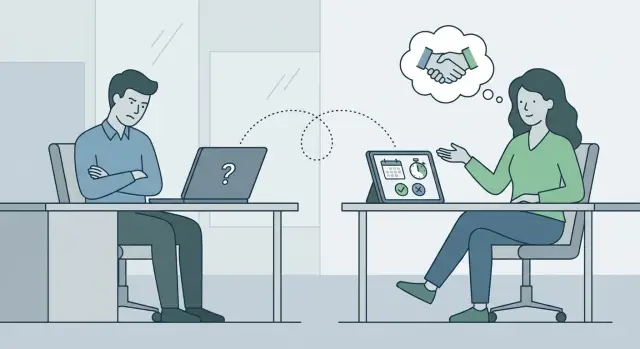
Why skeptical buyers push back on outbound messages
Skeptical buyers aren’t being difficult. They’re protecting three things: their time, their attention, and their reputation. Replying to the wrong email can pull them into a long thread, a meeting they didn’t want, or a tool that creates more work than it saves.
They’re also managing risk. Buying is rarely a solo decision. A bad choice can trigger security reviews, budget questions, outages, or internal pushback. So when a stranger shows up with a promise, their default response is to look for the catch.
Most outbound triggers the same alarm bells because it looks and sounds like everything else. Typical red flags are vague claims (“we help teams grow”), pressure (“quick call this week?”) before any reason to care, hype that hides the details, missing context (why them, why now), and long emails that make the reader do homework.
Trust in a single message isn’t “full trust.” It’s a small, practical signal: clarity and respect. Clarity means the reader can tell what you do, who it’s for, and what you’re asking in 10 seconds. Respect means you keep it short, don’t assume they’re interested, and make it safe to say no.
A quick example: if you email an operations lead with “improve efficiency,” it sounds like guessing. If you say, “I noticed you’re hiring SDRs. When teams scale, reply handling starts eating time. We built a way to auto-sort replies into interested, not interested, bounce, and unsubscribe,” they can judge the idea without feeling pushed.
Sometimes outbound is simply the wrong channel. If your offer needs heavy education, a long security review, or a big behavior change, cold outreach often creates resistance. Warmer paths work better: ask for an intro, share a short resource in a place they already learn, or build a simple inbound page that answers the first few objections.
Pattern 1: Candor that lowers defenses
Candor means saying the quiet part out loud. You name what the reader is already thinking: you’re a stranger, they’re busy, and most outreach is vague. That honesty drops the tension because it signals you’re not trying to trap them.
Candor also removes guesswork. The reader can quickly decide whether it’s worth a reply.
A few candid lines that tend to work:
- “You don’t know me, so I’ll keep this short.”
- “I might be wrong, but it looks like your team is hiring SDRs.”
- “If this isn’t a priority, just say ‘no’ and I’ll close the loop.”
- “I’m not sure this fits, so I’m asking one simple question.”
- “Most tools claim they save time. I’ll tell you exactly what we do, then you can ignore this if it’s not relevant.”
You can acknowledge uncertainty without sounding weak by being specific about what you know and what you don’t. Anchor your guess to a visible signal (a job post, a new product page, a recent announcement), then ask one small question. You’re not begging for a call. You’re checking your aim.
What to avoid: fake humility and long apologies. “Sorry to bother you” and “I know you’re extremely busy” take up space and can sound needy. Also skip big claims you can’t support in one email. Candor works best when it’s brief, clear, and followed by a simple next step.
Pattern 2: Constraints that make the message easy to read
Constraints are small, clear boundaries you set in the message: how long it will take to read, what you are (and aren’t) asking for, who it’s for, and why you picked them. Those boundaries reduce the “what am I getting pulled into?” feeling.
A good constraint signals two things at once: respect for their time and confidence in your point. If you can’t explain your ask in one or two lines, a skeptical reader assumes the real cost is hidden.
Simple constraint templates you can copy
Use one of these, then get to your specific reason for reaching out:
- Time box: “30 seconds: quick question about your onboarding flow.”
- Scope: “Not trying to sell you a platform, just checking if this is a priority in Q1.”
- Audience: “This is only relevant if you manage outbound deliverability or reply handling.”
- Intent: “If I’m off, tell me and I’ll close the loop.”
- Relevance check: “Worth a 10 minute chat, or should I stop here?”
After the constraint, make one concrete point. Example: “I noticed your team is hiring SDRs. When teams scale, reply triage becomes a time sink. If that’s true for you, I can share what we’ve seen work.”
Where to place the constraint
Placement changes how it feels:
- Subject line: best for a time box (“15 seconds?”).
- First sentence: best for scope and intent (“Not a pitch…”).
- CTA: best for the relevance check (“If not, reply ‘no’ and I’ll step back.”).
Pattern 3: Offer an easy no (and mean it)
Skeptical buyers hate feeling trapped in a conversation. An “easy no” is a simple, respectful way to opt out that doesn’t punish them for saying no. It often increases replies because it lowers the social risk of responding. People who are curious can answer, and people who aren’t can exit without friction.
Make opting out feel normal and final. Treat it like a preference, not a failure.
Opt-out lines that usually read as respectful:
- “If this isn’t relevant, reply ‘no’ and I’ll close the loop.”
- “If you’re not the right person, tell me who owns this and I’ll reach out once.”
- “Not a priority this quarter? Say the word and I’ll stop.”
- “If you’d rather not get notes like this, reply ‘opt out’ and I’ll remove you.”
What makes it sound passive-aggressive is guilt or bait. Avoid lines like “No worries if you’re too busy” or “I guess this isn’t important to you.” And don’t pretend you want a no if you plan to keep pushing.
When to use it: include the easy no in the first email if the topic is sensitive, the buyer is likely to be defensive, or you’re emailing roles that get hammered (ops, finance, IT). In follow-ups, keep it shorter and more direct because you’ve already asked once.
A simple outbound message structure for skeptical readers
Skeptical readers decide fast. Your job is to make the email feel safe to read: specific, honest, and quick.
Start with a subject line that’s neutral and concrete. Avoid hype and vague promises. Examples: “Quick question about renewals at <Company>” or “Idea to cut ticket backlog by 10-15%.” If you can’t say what the email is about in plain words, the subject will look like a trap.
Open with two lines that act like a relevance check. Name who you think they are, and why you picked them. Keep it simple: “Not sure if you own onboarding ops. If you do, I noticed…” You’re not pretending you already have a relationship.
Then follow a short structure the reader can scan:
- Observation: one real detail (site, job post, announcement, review)
- Why it matters: one sentence on cost or risk
- Option: one simple way to test an improvement
- Proof: one small anchor (a pattern you see, a quick example, a believable result)
- Ask: one low-effort next step
Example to a skeptical ops lead:
“Saw you’re hiring two support reps and still list 24-hour response time. That often means the queue is growing faster than headcount. If helpful, I can share a 3-step triage template we use to reduce repeat tickets. Worth sending it over?”
Close with an easy no, and mean it. One line is enough: “If this isn’t a priority, reply ‘no’ and I’ll close the loop.” It gives them control.
Step-by-step: Write a candid outreach email in 20 minutes
Skeptical readers don’t reward polishing. They reward clarity. This method keeps you honest and keeps the ask small.
A 20-minute timer
Set a timer and write in one pass. Don’t edit yet.
- Minutes 0-4: Pick one narrow person and one clear problem. Example: “Ops manager at a 30-200 person SaaS team dealing with slow onboarding because of manual handoffs.”
- Minutes 4-8: Write 3 honest reasons you might not be a fit. Real limits, not fake humility: “If you already have a dedicated outbound ops person,” “If you need a fully custom CRM build,” “If you can’t change your sending domains right now.”
- Minutes 8-12: Add one constraint to reduce pressure. “Not asking you to switch tools. Just want to confirm if this is even on your list this quarter.”
- Minutes 12-15: Add an easy-no line that sounds respectful. “If cold email isn’t a priority, reply ‘no’ and I won’t follow up.”
- Minutes 15-20: Create two versions for a quick A/B test. Change only one element (subject line or first sentence). Keep everything else the same.
Now add follow-ups. Keep them calm and useful. Two is usually enough: one that adds a proof point (a specific result, a short example, or a common pattern), and one that adds something they can verify fast (a checklist, a common mistake, a quick deliverability note).
How to be specific without sounding salesy
Specificity is what makes a cold email feel like a normal note, not a pitch. Describe a situation they recognize, then offer a small next step.
Replace broad claims (“we help teams grow”) with a simple before-and-after. Before: what’s happening now that wastes time or creates risk. After: what changes in their day if it works. Keep it grounded in a workflow, not a slogan.
One detail that can be checked goes a long way: a metric, a timeframe, or a step in the process. For example: “cutting reply sorting from 30 minutes a day to 5,” or “keeping it to a 10 minute review,” or “moving from five tools to one place for domains, mailboxes, warm-up, and sequences.” One concrete detail is enough.
It also helps to name a constraint you’re working within, but only if it’s true:
- Timing: “If this isn’t a Q1 project, I can follow up next month.”
- Budget: “If you already have a tool paid through the year, no worries.”
- Tooling: “If you’re locked into your current stack, I can share the approach without switching tools.”
- Scope: “This is just about improving deliverability, not changing your whole outbound process.”
Keep personalization simple: one observation, not flattery. “Noticed you’re hiring SDRs” or “saw you run multi-step sequences” is enough.
A line that stays specific:
“If you’re spending time sorting ‘interested’ vs ‘not interested’ replies by hand, would it help if those were auto-labeled so your team only opens the ones worth a response?”
Common mistakes that trigger skepticism
Skeptical buyers aren’t looking for the perfect pitch. They’re scanning for signals that you’ll waste their time, trap them in a meeting, or exaggerate.
Over-promising is a fast way to lose them. “Guaranteed,” “always,” “double your pipeline,” or “we can solve this in a week” reads like you haven’t seen their reality. Trade certainty for specificity: what you do, who it’s for, and the smallest believable outcome.
Another mistake is hiding the ask until the end, then making it huge. If your message builds suspense and then drops “Can we book 30 minutes this week?”, it feels like a bait-and-switch. Put a small, clear ask early.
Urgency and guilt backfire. “Bumping this” and “Just following up” can sound like they owe you a reply. Fake deadlines (“Ends Friday”) read as pressure.
Forcing a call is another classic. Many buyers want information first: a 2-sentence summary, a quick example, or what you’d check in their situation. Offer a low-effort path:
- “Want a 3-bullet outline first, or should I disappear?”
- “If this is relevant, reply with 1 and I’ll send the details.”
- “If not, tell me ‘no’ and I’ll close the loop.”
Finally, follow-up spam burns trust. Too frequent, too similar, and with no new detail looks automated and self-serving. If you follow up, add one new piece: a clearer example, a narrower use case, or a smaller next step.
Quick checklist before you hit send
The goal isn’t to sound clever. The goal is to be understood fast, and to make the next step feel low-risk.
The 10-second scan test
Skim your email like you’re busy and mildly annoyed. If you don’t get the point instantly, rewrite the first two lines.
- Can someone understand why you wrote in 10 seconds (who you are, why them, why now)?
- Is there exactly one clear ask (one time, one action), not three options?
- Did you include one constraint that makes the request feel small (time, scope, or a single use case)?
A simple bridge sentence often helps: “If it’s easier, I can keep it to two questions over email.”
Tone and friction checks
Skeptical readers look for hidden pressure. Remove anything that feels like a trap.
- Did you offer an easy no that sounds genuine (and would you actually honor it)?
- Did you delete hype words and vague outcomes (like “transform,” “amazing results,” “increase efficiency”)?
- Is it short enough to respect their attention (often 120-160 words unless you truly need more)?
Do one more pass where every sentence has to earn its place. If a line doesn’t add proof, context, or a clear next step, cut it.
Example: Reaching a skeptical operations lead
An operations lead has been burned before: a vendor promised “quick wins,” the rollout dragged on, and the team ate the cleanup. Now they ignore most outreach because it all sounds the same.
Here’s a bad version and why it fails. It opens with big claims, asks for 30 minutes, and hides the real ask behind buzzwords. The reader feels trapped: “If I reply, I’ll get pushed into a demo.” That’s exactly what you want to avoid.
A better version uses candor, a tight constraint, and an easy no.
Subject: Quick question (if this isn’t relevant, say “no”)

Hi Maya - I’m reaching out cold.

I’m guessing you get a lot of ops tooling pitches. If reducing manual follow-ups isn’t a priority, feel free to reply “no” and I won’t follow up.

If it is: do you have any workflow today where requests come in (email or form) and someone has to chase updates across teams?

If you reply with one sentence about what you track, I can send back 2-3 specific ways teams handle it (no deck).

Thanks,
Alex
What replies should you expect?
- Yes: “We do this, it’s messy. What are those 2-3 ways?”
- No: “Not interested.”
- Not now: “Maybe next quarter.”
- Questions: “What do you mean by chase updates?” or “Who else uses this?”
- Forward: “Talk to my analyst.”
When you get “Not interested,” protect goodwill. Thank them, confirm you’ll stop, and give a small exit ramp that doesn’t restart the pitch:
“I hear you, thanks for replying. I’ll close the loop on my side. If it helps later, what category is this in for you: already solved, not a priority, or wrong person?”
If they answer, you learn. If they don’t, you still leave a clean impression.
Next steps: run a small test and iterate
Pick a small, honest test before you scale. Ten accounts is enough to learn, and small enough that a weak angle won’t waste your week. Choose one message angle only (for example, “reduce manual reporting time” or “stop missing handoffs”), and keep everything else the same so you can tell what caused the result.
Keep follow-ups respectful. Two to three touches is plenty, spaced over about 7-10 days. Your first message is your best shot. Follow-ups should add one new detail, not repeat the pitch.
A lightweight way to run the test:
- Select 10 accounts that share one clear trait (same role, same problem, same industry)
- Send one version of the email (no A/B yet)
- Schedule 2 short follow-ups with one new data point or question
- Track replies by type, not just “positive” or “negative”
- Rewrite only one part at a time (subject line, opening, or CTA)
When you track replies, focus on what the reader is telling you about your message:
- Interested: your problem and ask match
- Not interested: angle is wrong or timing is off
- Out-of-office: timing noise, not necessarily a bad list
- Bounce: list quality or domain setup issue
- Unsubscribe: targeting or tone missed the mark
Tighten wording based on real responses, not gut feel. If “not interested” replies say “we already have a process,” acknowledge that in the next version and ask a smaller question. If you get bounces, fix deliverability before you change copy.
If you want this to become more repeatable without juggling a pile of tools, LeadTrain (leadtrain.app) pulls domains, mailboxes, warm-up, sequences, and reply classification into one place, which makes it easier to keep promises like “easy no” clean and consistent.
FAQ
Why do skeptical buyers push back on cold outbound emails?
Skeptical buyers are protecting their time, attention, and reputation. A reply can turn into a long thread, a meeting, or a tool evaluation they never wanted.
They’re also managing internal risk, so vague promises and pressure tactics look like hidden cost.
What does “candor” mean in an outbound message?
Candor is naming what the reader is already thinking: you’re a stranger, they’re busy, and most outreach is vague. That honesty lowers defenses because it doesn’t feel like a trap.
Keep it short and immediately follow it with a simple relevance check or question.
How do I write a subject line that doesn’t feel like a trap?
Use a neutral, concrete subject that matches the body. It should say what the email is about in plain words and avoid hype.
If you can’t summarize the point clearly, the subject will feel like clickbait and trigger suspicion.
What are “constraints,” and why do they make emails easier to read?
A constraint is a clear boundary that reduces perceived commitment, such as how long it’ll take, what you’re not asking for, or who it’s relevant to. It helps the reader feel in control.
Put the constraint early so they don’t have to wonder where the message is going.
How do I offer an “easy no” without sounding passive-aggressive?
Add a one-line opt-out that sounds final and respectful, and be willing to honor it. This reduces the social risk of replying, so more people respond honestly.
Avoid guilt or sarcasm, because that makes the “easy no” feel fake.
How personal should personalization be in a cold email?
Use one real observation and connect it to one specific problem. A job post, a new team hire, a product change, or a visible workflow clue is usually enough.
Don’t overdo it with flattery or multiple facts; one relevant detail beats five generic ones.
What’s a good call-to-action for skeptical readers?
Default to a small ask that can be answered in one sentence, like confirming whether a problem exists. If you ask for a meeting immediately, it can feel like a bait-and-switch.
If interest is real, a call becomes the buyer’s idea, not your pressure.
How many follow-ups should I send, and what should they say?
Two to three touches over about a week is usually enough if each follow-up adds something new. Repeating the same pitch reads like automation and makes people defensive.
A good follow-up adds a concrete example, a quick verification point, or a narrower question.
How do I run a simple A/B test on outbound copy?
Keep the first version simple and change only one element between versions, such as the subject line or first sentence. If you change multiple things at once, you won’t know what caused the difference.
Start with a small sample so you learn fast without burning a big list.
When is outbound the wrong channel, and what can help if I still need to do it?
If your offer requires heavy education, long security reviews, or major behavior change, cold outreach often creates resistance. In that case, aim for warmer paths like intros or lightweight resources where the buyer already learns.
If you do outbound at scale, tools like LeadTrain can help by keeping domains, mailboxes, warm-up, sequences, and reply classification in one place so your deliverability and reply handling stay consistent as you test messages.