Outbound for marketplaces: build supply and demand in parallel
Outbound for marketplaces can grow both sides of your platform when you run separate lists, offers, and sequences for supply and demand.
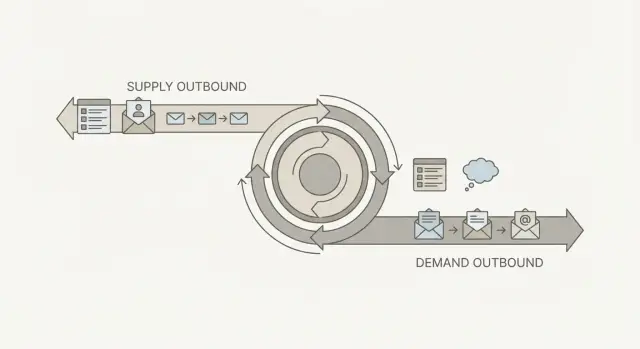
Why marketplaces need two outbound tracks
Marketplaces aren't like regular products. You're building two groups at once: the people who provide value (supply) and the people who want it (demand). If one side grows faster, the whole system can stall.
Too much demand with weak supply leads to missed expectations, complaints, and refunds. Too much supply with weak demand leads to churn and bad word of mouth.
Outbound works best as two separate tracks, not one blended campaign.
Treating supply and demand as “separate lanes” means different lead lists, different offers, and different sequences. Your supply list might be providers, creators, hosts, or sellers. Your demand list might be buyers, teams, or companies who have the problem right now.
When you mix the lanes, both sides feel misunderstood. A provider doesn't care about “get access to top talent” if they're worried about getting paid and staying busy. A buyer doesn't care about “join our community of experts” if they need a clear outcome, price range, and timeline. Mixed messaging also creates messy data: replies are harder to sort, follow-ups get inconsistent, and you can't tell which side is the real bottleneck.
A quick sanity check: could someone read your email and instantly know whether it's meant for a provider or a buyer? If the answer is “maybe,” your lanes aren't separate enough.
Success in the first 30 to 60 days usually looks like this: you have two clean lists with clear rules, each side has a single core promise that matches their reality, replies are easy to categorize, and you can say which side is limiting growth based on reply rates and booked conversations.
If you're using a cold email tool like LeadTrain, separate lanes are also easier to run day to day: different sequences, different mailboxes when needed, and clearer reply classification so supply replies don't get treated like demand leads (or the other way around).
Clarify supply vs demand personas before you send anything
Outbound only works for a marketplace when each side feels like you built this for them. Before you write a single email, split your thinking into two tracks: supply (the people who provide the value) and demand (the people who pay for it or use it).
Name each persona in plain language. Avoid titles that hide the real role. “Independent HVAC techs in Dallas” is better than “home services providers.” “Property managers with 50 to 300 units” is better than “real estate professionals.”
Write each side’s job to be done in one sentence. Keep it practical and measurable.
- Supply job: “Help me get steady, high-quality jobs without chasing leads or cutting my rates.”
- Demand job: “Help me get a reliable provider fast, with clear pricing and less risk.”
Then list the objections you’ll hear early. These aren't “nice to address later” concerns. They decide whether you get a reply.
On the supply side, expect things like: “I already have enough work,” “your leads will be low quality,” and “you’ll take a big fee or control my customer relationships.” On the demand side, it's often: “I can find this myself,” “how do I know they’re good,” and “this will take more time than it saves.”
Now decide what proof each side needs to trust you. Proof isn't a feature list. It's a reason to believe your promise.
For supply, trust usually comes from clarity and fairness: the fee structure, what a lead looks like, how payouts work, and whether they can decline jobs. A small case story helps too, even if it’s from a pilot (for example, “3 jobs in 2 weeks, average ticket $450”).
For demand, trust is usually about reducing risk: vetting steps, response times, guarantees, and social proof. If you don't have reviews yet, use process proof: background checks, identity verification, clear dispute rules, and a simple quality standard.
Example: in a local caregiving marketplace, your supply persona might be “licensed caregivers who want part-time shifts within 10 miles,” while your demand persona might be “adult children arranging care for a parent after a hospital stay.” Those are different fears, different language, and different decisions. Your outbound should reflect that.
Once you have these personas, messaging gets simpler. One email can talk about “filled shifts and predictable pay,” while the other talks about “safe care this week and fewer no-shows.” Different promise, different proof, same marketplace.
Choose the market wedge and your starting ratio
A marketplace only feels simple once it’s already liquid. Early on, you win by being specific. The fastest path is a narrow wedge: one clear supply niche and one clear demand niche that naturally fit.
Pick a wedge that can say “yes” fast
“Everyone” isn't a niche. Choose a slice where both sides have a repeatable problem and a reason to respond to a cold email.
Instead of “a services marketplace,” start with “licensed electricians in Austin” (supply) and “property managers with 50 to 200 units” (demand). Each side is easy to identify, and the match is obvious.
Your first-win offer should be narrow. It's not your full vision. It's the smallest promise you can reliably deliver in 7 to 14 days.
- Supply first win: “Get your first 2 paid jobs this month, we handle the scheduling.”
- Demand first win: “We can send 3 pre-vetted electricians who can start this week.”
- Proof first win: “We’ll personally coordinate the first booking so it’s low effort for you.”
Set a starting ratio (and decide how to rebalance)
Pick a simple ratio so you don’t drift. Many teams start supply-heavy (like 3 suppliers for 1 buyer) because it’s hard to sell demand if you can’t fulfill quickly. In other markets, demand comes first (like 3 buyers for 1 supplier) when supply is scarce and you need guaranteed work to recruit providers.
Choose one ratio, run it for a week, then adjust based on reality.
If one side lags, rebalance with a clear playbook. Tighten the niche and lead with outcomes if demand is lagging. Raise the immediate benefit and lower the “yes” ask if supply is lagging. If fulfillment is breaking, pause new demand outreach until response time and match quality recover. If replies are high but conversions are low, your wedge is probably fine, but your first-win offer is too vague or too hard to deliver.
Build two separate lead lists that stay clean
A marketplace has two customers, so your data has to reflect that. Treat your supply list and demand list like two different products: different sources, different fields, different quality rules. If you mix them, your outreach gets vague fast.
Where to find leads on each side
For supply, start where people already advertise their work or availability: niche directories, creator and professional communities, job boards (people open to new gigs), competitor marketplaces, and local meetups or industry events.
For demand, start where teams already buy solutions: companies in your target niche, member lists in industry groups, users of adjacent tools, and intent signals like recent hiring for the role your supply supports. If you're building a marketplace for video editors, supply can come from portfolios and creator groups, while demand can come from startups that just hired a content lead.
The fields you need (and why)
Keep core fields consistent (name, email, company, notes), but add side-specific fields so messaging stays sharp.
- Supply: specialty, years of experience, location/time zone, weekly capacity, portfolio style
- Demand: buyer role, team size, monthly volume, tools used today, trigger (hiring, launch, new funding)
Those fields become your segmentation later: who gets which promise, which proof, and which call to action.
Keeping lists clean and non-overlapping
Use separate tags or separate tables in your CRM so one contact can’t quietly live in both. Use one simple rule: a person is supply or demand based on what they do most days, not what they might buy someday.
A practical approach is to assign each record a single “side” plus a “secondary interest” note. If someone is both (for example, an agency that buys freelancers and also offers services), pick the side you're targeting first and keep the other as a later segment.
If you're using LeadTrain or any similar tool, keep separate audiences and sequences per side so imports, replies, and unsubscribes don't cross-contaminate reporting or messaging.
Message each side so they feel understood
If your email could be forwarded to the other side without sounding strange, it’s probably too generic. The fastest wins come from writing two messages that speak to two different jobs to be done.
Supply-side: make the offer feel safe and worth the switch
Supply prospects are thinking: “Will this waste my time, hurt my reputation, or pay less than my current setup?” Lead with earnings and utilization, but keep it real. Explain what changes in their day, and what stays the same.
Strong supply proof is practical: payout terms, clear expectations, and how you prevent bad matches. If there are requirements (background check, insurance, response time), say them early. It signals you protect good providers.
Keep the supply call to action low effort and concrete. “Reply with your city and weekly availability” often works better than “Book a demo.”
Demand-side: lead with outcomes and risk reduction
Demand prospects are thinking: “Will this solve my problem fast, and can I trust it?” Start with the result they want (time saved, fewer no-shows, consistent quality), then reduce risk (replacement policy, vetted providers, support, simple billing).
Demand proof should look like their world: turnaround times, reliability stats, a short example of a similar buyer, or a policy that removes fear. Skip provider-focused details like sign-up steps or payouts. Buyers don’t care.
Keep CTAs aligned to each side. On supply, ask for availability, requirements, or a first paid job. On demand, ask for a brief description of the job, a quote range, or a small test order.
Example: in a home cleaning marketplace, supply emails can focus on filling empty weekday slots and clear cancellation rules. Demand emails can promise consistent cleaners, easy reschedules, and a replacement if someone cancels.
Step-by-step: set up parallel outbound lanes
Treat supply and demand as two lanes, not one big campaign with a few tweaks. Different promises, different objections, different next steps.
1) Create two campaigns (and separate sending identities when needed)
Set up two distinct campaigns in your cold email tool: one for supply, one for demand. If both sides are in the same industry, consider separate domains and mailboxes so replies and reputation stay clean.
If you're using LeadTrain, you can keep domains, mailboxes, warm-up, and sequences in one place, which helps when you're running two lanes at once.
2) Write a short sequence for each side (3 to 5 emails)
Keep the structure similar, but change the content so each side feels seen. A practical sequence usually includes an intro (who you help and the specific problem), a follow-up with one easy question, a proof email with a small result or example, a short bump, and a polite close.
For supply, the core promise is earning potential and steady work. For demand, it’s speed, quality, and lower risk.
3) Stagger sends so you can handle replies and onboarding
Don’t blast both lanes at full volume on day one. Start supply on Monday and demand on Wednesday (or vice versa), then ramp up over 1 to 2 weeks.
This gives you time to respond fast, fix your pitch, and improve onboarding before your inbox fills up. It also prevents a common failure: winning interest on both sides but dropping the ball because you can’t follow through.
4) Set a simple handoff from reply to next action
Decide what happens after a positive reply, and keep it consistent. For example: supply replies go to a short intake form and a 10-minute screen; demand replies go to a quick call or a request form.
Use clear labels so nothing gets lost. If your tool can auto-classify replies (interested, not interested, out-of-office, bounce, unsubscribe), route “interested” into one next step and keep the rest out of your way.
Metrics that tell you which side is the bottleneck
You’re not asking one question. You’re asking two: “Can I recruit enough supply?” and “Can I bring in enough demand to keep supply busy?” The bottleneck is the side where people drop off earliest, not the side that feels loudest.
Track a full funnel per side
Track the same funnel stages for both sides, but define the last step (activation) differently.
- Reply rate: Are your targets engaging at all?
- Positive rate: Of replies, how many are open to the idea (not just polite)?
- Meeting rate: How many positives turn into a scheduled call?
- Activation rate: Supply = first listing created or onboarding completed. Demand = first purchase, booking, or trial started.
- Time to activation: Days from first reply to “live” behavior.
If supply has strong reply and meeting rates but weak activation, onboarding or your trust story is the problem. If demand meetings happen but activation is slow, your offer, pricing, or “why now” isn't clear.
Leading indicators help you spot health early. Supply is healthy when prospects ask about requirements, fees, and how soon they can start, then complete setup quickly. Demand is healthy when prospects talk about urgency, volume, and decision process, and you see short time-to-first-transaction.
“Interested but not now” also means different things. On supply, it often signals timing (busy season, licensing, switching costs). On demand, it often signals priority (budget cycle, “we can live with the current option”). Treat the first with a future start date and a simple onboarding path. Treat the second with a stronger trigger, like a limited pilot or a specific use case.
Know when to slow one lane
Sometimes the best move is to pause one side for a week so you don’t create a bad first experience.
Pause demand if buyers complain about availability, response time, or quality. Pause supply if providers sign up but get no jobs in the first 2 to 3 weeks. Slow the side where churn rises after onboarding, or where “positive” replies rarely become activation.
Common mistakes when doing outbound for a marketplace
The fastest way to waste time is to treat outbound for marketplaces like a normal B2B funnel. You’re recruiting two groups that want different outcomes, fear different risks, and need different proof.
1) One generic pitch for both sides
A single “We’re a new platform, join us” email sounds vague to everyone. Supply cares about time, payouts, and bad customers. Demand cares about quality, speed, and trust. If you can’t name the top two worries for the person reading, your email will feel like spam.
A simple check: if you can swap “contractor” with “customer” and the email still makes sense, it’s too generic.
2) Mixing supply and demand in one list or one sequence
This happens more than teams admit. Someone exports a big list of “people in the industry” and blasts one sequence. The result is messy replies, unsubscribes, and no learning. Keep two lists, two sequences, and two dashboards so you can see which side is responding, and why.
3) Overpromising liquidity before it exists
Nothing kills trust faster than claiming “jobs every day” or “hundreds of vetted pros” when you have neither. Early on, your honest promise is usually smaller: a short pilot, a limited set of leads, or a guided onboarding.
If you’re building a home cleaning marketplace, don’t tell cleaners they’ll be fully booked next week. Offer a “founding cleaner” pilot with a clear cap (like 3 to 5 requests) and faster payouts in exchange for feedback.
4) Pushing a call when the right next step is a low-friction trial
Marketplaces often need one small action first: a profile, a quote, a sample request, a first booking. If you ask for a 30-minute call too early, busy people will bounce.
Good next steps tend to be a quick eligibility check for supply, a quote request or single job post for demand, or a short “is this you?” reply that qualifies them without pressure.
5) Ignoring deliverability basics and burning your domain
If your emails land in spam, none of the above matters. New teams often send too much, too fast, from a fresh domain with weak setup. Use proper authentication (SPF, DKIM, DMARC), warm up mailboxes, and keep volume steady. Platforms like LeadTrain bundle domain setup, automatic DNS and authentication, and warm-up so you don’t have to piece it together across multiple tools.
Example: building a services marketplace with parallel outbound
Picture a B2B services marketplace where the supply side is small agencies and the demand side is early-stage startups. The goal is to create the first few successful matches fast, without making either side feel like they’re waiting around.
Treat this as two separate outbound motions. On the supply side, you're recruiting partners. On the demand side, you're offering a specific outcome.
In week 1, keep targets tight. Recruit 20 quality providers with a clear minimum bar (for example: proven case studies in one niche, a defined package, and the ability to start within 2 weeks). Be direct about who you serve, what types of projects you will send, and what you won’t send.
In parallel, reach out to 100 target buyers with a single outcome offer, not a generic pitch. For example: “Need 10 qualified demo requests in 30 days” or “Launch paid search without hiring in-house.” If a buyer replies “maybe later,” that’s still useful. You just learned something about timing, budget, or priorities.
While you match the first deals, keep both sides warm with simple, honest updates. Tell agencies what buyer demand you’re seeing this week. Tell startups what supply is already vetted and available. A light touch works best:
- Supply: “We have 3 startups looking for X. Are you open to a quick fit check this week?”
- Demand: “We vetted 5 agencies that specialize in X. Want 2 options with price ranges?”
After week 2, change things based on replies, not guesses. If agencies hesitate, increase clarity by sharing the minimum project size and a sample brief. If buyers ask “what do you actually do,” tighten the outcome and add one concrete example. If responses are high but calls are low, shorten the first call to 10 minutes and make the next step obvious. If one niche is pulling, narrow the list and pause everything else.
Quick checklist and next steps
Before you hit send, make sure supply and demand feel like two different conversations, not one generic blast. A small setup miss (like no warm-up or a messy list) can hide good messaging.
Quick checks before launch
- Domain and authentication are done (SPF, DKIM, DMARC), and you’re sending from a real-looking inbox.
- Mailboxes are warmed up and you’re starting at low volume.
- Each list has the right fields (at minimum: first name, company, role, city/region, and one “reason it’s a fit” note).
- You have two clear offers: one for supply, one for demand.
- You have two different CTAs: supply invites a short onboarding chat; demand invites a quick buyer call or pilot.
Simple operating rhythm
Treat this like a daily habit.
Send a consistent volume per lane, review replies twice a day, tag outcomes (interested, not interested, out-of-office, bounce, unsubscribe), and respond quickly to real conversations. Each week, rebalance your ratio, refresh both lists, and update one piece of proof plus one objection handler in each lane.
If you want to keep everything in one place, LeadTrain is built for running cold email end to end (domains, mailboxes, warm-up, sequences, and AI-powered reply classification). That makes it easier to keep supply and demand organized while you focus on what matters early: getting enough quality conversations on both sides to find the bottleneck.
FAQ
Do I really need two separate outbound campaigns for a marketplace?
Run two tracks when the audience, promise, proof, and next step are meaningfully different. In a marketplace, providers care about pay, workload, and fairness, while buyers care about speed, quality, and risk reduction. Separate tracks keep messaging sharp and make it easier to see which side is limiting growth.
How can I tell if my supply and demand messaging is too mixed?
A clean split is when someone can read the first two lines and instantly know whether it’s for a provider or a buyer. If the email could be forwarded to the other side without sounding weird, it’s too generic. Use different offers and different questions in the call to action for each side.
What’s the best way to pick my initial niche (wedge) for outbound?
Start with a narrow wedge where both sides can say “yes” quickly, and make the first promise something you can deliver in 7–14 days. Pick one specific supply niche and one specific buyer niche that naturally match, then avoid expanding until you can repeatedly activate both sides. Early focus usually beats broad reach.
Should I start supply-first or demand-first, and what ratio should I use?
Pick a simple default ratio and stick to it for a week so you can learn. Many marketplaces start supply-heavy so buyers get fast fulfillment, but if supply is scarce you may need demand first to offer guaranteed work. Rebalance based on activation, not just reply volume.
How do I keep my supply and demand lead lists clean and non-overlapping?
Treat them like two different products with different fields and quality rules. Give every contact a single “side” (supply or demand) and keep any edge cases as a note, not a second identity. If you let people sit in both lists, your reporting and follow-ups get confusing fast.
What should the call to action be for supply emails vs demand emails?
Use a low-friction ask that matches the side’s reality. For supply, a simple reply like availability, location, and specialty often beats asking for a demo. For demand, ask for a short description of the job, timeline, and budget range so you can propose a fast next step.
How long should my outbound sequences be for each side?
Keep each lane to 3–5 emails with one clear promise and one clear question per message. Mirror the structure across lanes, but change the content: supply emails should clarify pay, fit, and how work is assigned, while demand emails should lead with outcomes and how you reduce risk. Don’t cram both stories into one sequence.
Which metrics tell me whether supply or demand is the bottleneck?
Track a full funnel per side, especially activation and time to activation. Supply activation might be onboarding completed or a listing created, while demand activation is a first booking or purchase. The bottleneck is where prospects drop off earliest, even if the other side is louder in your inbox.
When should I pause one lane so I don’t damage the marketplace?
Pause demand if buyers complain about availability, response time, or match quality, because that creates a bad first experience. Pause supply if providers sign up but don’t get work within 2–3 weeks, because that causes churn and negative word of mouth. Protect the side you’ve already won by keeping expectations and fulfillment aligned.
How can LeadTrain help me run parallel outbound lanes without chaos?
Keep supply and demand in separate campaigns with separate sequences so replies don’t get mixed, and use clear labeling for next steps. LeadTrain helps by keeping domains, mailboxes, warm-up, sequences, and AI-powered reply classification in one place, so “interested” responses can be routed correctly and deliverability basics don’t get skipped. If both lanes run at once, staggering sends also makes it easier to respond quickly.