Outbound for long sales cycles: using micro-commitments
Outbound for long sales cycles works best when you use micro-commitments: small, clear asks that keep momentum without pushing for a big decision too early.
Why long sales cycles lose momentum
Long sales cycles stall for a simple reason: interest isn't the same as progress. A buyer can like your idea, then get pulled into a fire drill, a budget review, or a higher priority. Days turn into weeks, and the deal cools down without anyone saying "no." This is common in outbound, where you aren't starting with an active project.
Momentum looks like visible movement, not friendly replies. In email, it's a clear next step with a date, a named owner, or a promised action ("I'll review this Thursday," "Looping in Alex," "Send the security doc"). In calls, it's agreement on what happens next and who needs to be involved. If nothing changes after each touch, you don't have momentum, you have politeness.
Vague follow-ups like "just checking in" feel easy to send, but they create work for the buyer. They have to decide what to do, what to say, and whether it's worth the time right now. With multiple stakeholders, that small effort multiplies, and the safest choice becomes doing nothing.
Micro-commitments solve this by reducing decision fatigue. Instead of asking for "thoughts," you ask for one small action that keeps things moving.
Examples of micro-commitments:
- A simple yes/no to confirm priority ("Is X still the priority for Q1?")
- Clarify ownership ("Who owns approvals for this?")
- Share one specific item ("Can you send your vendor security checklist?")
- A time-boxed review ("Can you skim this one-pager by Friday?")
- Loop in one stakeholder ("Can you CC the person who runs RevOps?")
A practical example: when a prospect says, "Looks interesting, we'll review," the next email works better when you offer two clear paths. "Should I send a one-page summary for your team, or is it better to schedule a 10-minute handoff to the decision owner?"
What micro-commitments are (and aren't)
A micro-commitment is a small "yes" that moves a deal forward. It's not "close the deal" energy. It's a low-effort step that helps you confirm fit, reduce uncertainty, or bring the right person into the conversation.
These small steps matter in outbound because people are busy and buying is rarely a one-person decision. A clear ask gives the prospect something they can do right now, even if the full decision is weeks away.
Micro-commitment vs. next meeting vs. decision
A "next meeting" can be a micro-commitment, but only if it has a purpose.
- Too vague: "Can we meet next week?"
- Clear and smaller: "Can we do 15 minutes so I can confirm whether X is a blocker?"
A decision is the opposite of a micro-commitment. Asking for approval, pricing sign-off, or a full rollout too early forces internal work before they're ready. That usually creates silence.
Easy yes-type asks tend to fall into a few buckets: confirm one detail (team size, tool stack, timeline), share one artifact (a report, screenshot, policy), point you to the owner (who signs, who runs the process), pick a preference (Option A vs. B), or approve a tiny next step (pilot scope, one success metric).
What makes these work is effort and risk. The best micro-commitments take under two minutes, avoid legal or budget talk, and don't require the prospect to persuade other people yet.
When micro-commitments aren't appropriate
If the person is clearly uninterested, repeatedly unsubscribes, or your outreach is based on a bad assumption, don't keep "small asking" them.
Also avoid micro-commitments that hide a bigger agenda. If your real goal is a demo, say so. A small ask should build trust, not feel like a trick.
Instead of pushing for a call, a clean micro-commitment can be: "Worth confirming: do you handle outbound deliverability in-house, or does someone else own it?" One reply can unlock the next step.
Micro-commitments that reliably keep momentum
In a long buying process, progress rarely looks like a big "yes." It looks like a series of small "sure, I can do that" moments.
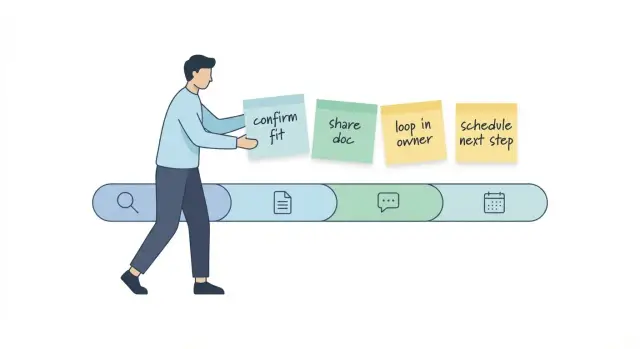
Five micro-commitments that consistently work:
- Confirm fit (one requirement): Ask a single yes/no question to decide whether it's worth continuing. "Do you need this to work with Salesforce, or is HubSpot the system?"
- Share a one-page doc: Offer something easy to scan, not a full deck. "Want a 1-page overview with pricing ranges and rollout steps?"
- Loop in the owner: Make it easy to bring the right person in. "Who owns final sign-off - finance, RevOps, or the VP Sales?"
- Pick a date: Replace "follow up next week" with a clear window. "If I send the summary today, can we do 15 minutes Tue or Wed to decide if it's worth a deeper look?"
- Name the risk: Invite honest objections early. "What would stop this from getting approved - budget timing, security review, or something else?"
A quick test: a micro-commitment should be answerable in one reply. If it requires a meeting, a long explanation, or internal research, it's not micro.
A simple sequence that works in many deals: confirm one requirement, send a short ROI note, then ask who else needs to see it. You learn where the deal is actually stuck before you burn weeks on vague follow-ups.
How to choose the right small ask
The best micro-commitment is the one your buyer can do right now, without starting a new internal project.
A strong small ask has a few consistent traits:
- One action only
- Tiny effort (a couple minutes or less)
- Clear and concrete
- Tied to their goal
- Easy to answer
Be specific about what "done" looks like. "Can you share details?" is vague. "Could you reply with your current tool and contract end month by Thursday?" is easy to complete and easy for you to act on.
Match the ask to where they are:
- Early: confirm fit and ownership
- Mid: request one doc, screenshot, or a quick intro to the process owner
- Late: clarify decision path and timing
Pre-framed options make replies effortless. A few patterns you can adapt:
- "Which is closer: A) you already have a tool, or B) you're building a process from scratch?"
- "Should I send a 1-page overview or a 3-bullet summary you can forward?"
- "Is it better to loop in the person who owns deliverability, or the person who owns pipeline targets?"
- "Do you want to aim for Tue 11:00 or Thu 2:00 for a 10-minute check?"
If you're using a platform like LeadTrain, you can save these asks as short templates and A/B test wording. The tool helps, but the habit matters more: one small, valuable next step at a time.
Step-by-step: build a micro-commitment sequence
A micro-commitment sequence is a plan for earning the next small "yes" when the big decision is still weeks away.
1) Start with roles, not titles
List the roles you must win over. Most deals have:
- A champion (cares and will push it)
- An owner (can approve budget or process)
- A user (feels the day-to-day pain)
If you only have one contact, your first micro-commitment can be as simple as: "Who besides you will care about this?"
2) Pick a few small asks per stage
Think in stages: confirm fit, align on success, validate with a user, loop in the owner, agree on next step. For each stage, choose actions that are easy to say yes to.
Reliable options: confirm one detail (use case, volume, timing), share one doc or screenshot of the current process, introduce the right person (owner or user), pick between two options for the next step, or approve a short recap they can forward internally.
3) Write two versions: direct and soft
For each ask, create two versions.
- Direct (when engagement is high): "Can you loop in your ops owner this week?"
- Soft (when it's quiet): "If it makes sense, who owns ops on your side?"
4) Set timing and a stop rule
Decide your follow-up rhythm before you send anything (for example: 2 days, then 4, then 7). Also set a stop rule like "three tries without a reply, then pause for 30 days." That protects your time and keeps your tone respectful.
5) Track and refine weekly
Log which asks get replies and which lead to introductions. If you're using LeadTrain, AI-powered reply classification can quickly separate "interested" from "not now" so you spend less time sorting threads and more time improving the asks that move deals.
Example: after a positive first reply, your next three micro-commitments could be: confirm one metric, ask for a 2-minute screenshot, then request an intro to the budget owner with a short recap they can forward.
Where micro-commitments fit in a typical sequence
Micro-commitments work best when they match the buyer's current attention level. The goal isn't to win early. It's to keep motion with a next step that feels easy.
A practical sequence usually rotates between value and a small ask:
- First touch: one concrete question that confirms fit ("Do you handle vendor evaluation for X, or is that someone else?")
- After mild interest: offer a short doc or 3-bullet summary instead of pushing a meeting
- After they read it: ask who else should be involved so you don't get stuck with a single contact
- If they go quiet: ask for a simple direction (yes/no), or "should I close the loop for now?"
- After a call: write the next step down with a date so it's a shared plan, not a vague promise
After any call, lock it in: "Confirming: you'll review with [name] by Thursday, and we'll reconnect Friday at 11:00." If you use LeadTrain, reply classification (interested, out-of-office, bounce, unsubscribe) helps you match the next micro-commitment to what actually happened.
Mistakes that kill micro-commitments
Micro-commitments work because they feel easy to say yes to. They stop working when your email feels like a grab bag of requests, or when the "small ask" is a hidden pitch.
Common mistakes, and the fix:
- Multiple asks in one email: If you ask them to review pricing, introduce you to legal, and book time, they'll do none. Pick one action that takes under two minutes.
- Asking for a meeting every time: A meeting isn't micro by default. Rotate smaller steps (confirm fit, share one data point, loop in the right owner) until a meeting makes sense.
- Making the ask about you: "Can you help me?" adds pressure. Try "Worth ruling this out?" or "Should I speak with whoever owns X?"
- Sending long docs: A 12-page deck is homework. Send a short, decision-ready note: 3 bullets on problem, approach, and what you need to confirm.
- Chasing the wrong person: If you never confirm ownership, you can follow up for weeks with someone who can't say yes. Ask directly who owns the decision or runs the process.
Example: you're selling a security tool and your champion replies, "Sounds interesting." Instead of attaching a full deck and asking for a 30-minute call, ask one question: "Do you own this, or is it handled by IT security?" If it's handled by someone else, your next micro-commitment is a simple intro.
If you're using LeadTrain, it also helps to track which single ask you sent last so you don't fall into the pattern of repeating the same meeting request in every step.
A quick checklist before you hit send
Before you send a message, do a 30-second check.
- Can you write the ask as a single sentence?
- Does it take less than two minutes to do?
- Is there a clear time box ("today," "by Thursday," or two time options)?
- Does it match their role (champion vs. manager vs. finance vs. security)?
- Do you know what you'll ask next if they say yes?
Example: a director replies, "Sounds interesting." Your next micro-commitment could be: "Are you the right person for onboarding approvals, or should I send this to someone else?" If they name an owner, the next ask is ready: "Perfect. Can you intro me, or should I email them directly and CC you?"
If you're using a tool that supports multi-step sequences and reply classification like LeadTrain, this gets easier because you can plan the next micro-commitment in advance and route replies based on intent.
Example: keeping a 90-day deal moving with small asks
Picture a mid-market buying team with three stakeholders: a sales manager who feels the pain, an ops lead who owns the process, and finance who checks risk and spend. Your goal isn't a perfect call right away. It's steady progress with small, clear yes-or-no steps.
A 90-day path might look like this:
- Week 1 (confirm fit): "If you had to pick one must-have, is it A or B?" Example: "Do reps need to log activity in the CRM automatically, or is reporting the bigger issue?"
- Week 2 (share a 1-pager, ask for the owner): Send a one-page overview and ask: "Who owns this workflow end-to-end? Should I send this to the ops owner, or is that you?"
- Week 3 (loop in finance with criteria): "When finance reviews tools like this, what two things matter most: security, contract terms, ROI, or something else?"
- Week 4 (time-box a decision date): "If the fit is there, can we choose by next Friday whether to run a 14-day pilot?"
If one stakeholder disappears, don't send "just checking in." Use a rescue ask that reduces effort: "Did this move to someone else, or should we pause until next month?" If someone stays engaged, you can ask them to forward one sentence: "Can you loop in finance with this question: what criteria do you need to approve a pilot?"
The pattern stays the same: one message, one micro-commitment, and a clear next step.
How to handle stalls without sounding pushy
Stalls are normal. The goal isn't to chase harder, it's to remove uncertainty and offer an easy next step.
A common stall sounds like: "Sure, send info." If you send a doc with no follow-up, you'll likely disappear into a crowded inbox. Reply with one simple choice: "Happy to. Should I send a one-pager, or would a 10-minute call be more useful?"
Another signal is repeated reschedules or replies that arrive days later with no substance. Treat this as prioritization, not politeness. Reset calmly with one question: "Before I send anything else, who else needs to weigh in and what's the step after this?"
If they keep avoiding owner, budget, or approval details, don't corner them. Make it safe to be honest. A clean "close the loop" option lowers pressure and often gets a real answer.
Low-pressure lines that work:
- "If this isn't a focus this quarter, tell me and I'll stop following up."
- "Is there a deadline you're working toward, or is this a 'when we have time' item?"
- "Who would own this internally if you decided to move forward?"
- "What would you need to see to feel comfortable taking the next step?"
- "If the timing is wrong, should we reconnect in 30 days or close it out?"
Example: a prospect asks for pricing, then goes quiet. Instead of another nudge: "I can send a simple price range, but it varies by seats. Are you the owner for this, or should I include the person who signs off?" Even if they're not ready, you learn the real blocker.
If you're using LeadTrain, it helps to set one follow-up that asks for the decision process, and another that offers a clean exit. That keeps the tone respectful while protecting your time.
Next steps: make this repeatable
Micro-commitments work best when they stop being something you try and become your default. Fewer one-off follow-ups, more consistent small asks that move the deal forward.
Turn your best-performing asks into reusable templates. Keep the wording tight, and keep the decision easy (yes/no, pick A/B, confirm fit). Save a few versions for different stages, like early qualification vs. multi-stakeholder handoff.
To improve quickly, track which asks convert. You don't need a complicated dashboard. Simple tags in your CRM or spreadsheet are enough. Track the ask type (confirm fit, share doc, intro request, loop in owner, timeline check), the persona, the outcome (replied yes/no, no response, reschedule, stall), and the next step achieved (doc reviewed, intro made, meeting booked). Add the objection when it shows up: budget, priority, timing, security.
Once you can see patterns, keep sequences consistent across the team. Consistency doesn't mean identical copy. It means everyone uses the same structure (micro-commitment, reminder, close-the-loop) and the same naming so results are comparable.
If you want to reduce tool juggling, LeadTrain (leadtrain.app) brings domains, mailboxes, warm-up, multi-step sequences, and AI-powered reply classification into one platform. That can help you keep deliverability steady while you focus on the one thing that matters most here: choosing the next small ask that the buyer can actually do.
Run a short, controlled test before you scale it. Pick a tiny sample so you can read every thread, then iterate:
- Choose 5 target accounts you want this quarter
- Define 3 micro-commitments you'll rotate (early, mid, late)
- Run the same sequence for 2 weeks
- Review replies and tag outcomes
- Keep what works, rewrite what stalls, repeat
FAQ
What does “momentum” actually mean in a long sales cycle?
Momentum is visible movement, not friendly messages. You have momentum when each touch results in a clear next step like a named owner, a promised action, or a date.
Why do “just checking in” follow-ups usually get ignored?
Because it makes the buyer decide what you want, how urgent it is, and what to do next. That extra thinking often leads to no reply, especially when multiple stakeholders are involved.
What is a micro-commitment in outbound?
A micro-commitment is a small, low-effort “yes” that moves the deal forward, like confirming ownership or sharing one specific item. It should be answerable in a single reply and take under two minutes for them to do.
Is asking for a meeting a micro-commitment or not?
A meeting can be a micro-commitment only when it has a tight purpose and a small time box. If you ask for a meeting with no clear goal, it feels like work and often stalls.
How do I choose the right micro-commitment for a prospect?
Ask for one action that matches where they are right now, not what you want next. Early on, confirm fit or who owns the area; later, clarify the decision path or timing with one concrete question.
What’s a good micro-commitment to use after someone says “looks interesting”?
Offer two simple options so replying is effortless. For example, ask whether they prefer a one-page summary to forward internally or a short handoff call with the decision owner.
How do I avoid micro-commitments that feel like a trick?
Keep it honest and aligned with your real intent. If your goal is a demo, say so, and make the ask small and useful rather than pretending it’s “just a quick question.”
How do I handle a stall without sounding pushy?
Make it safe to say “not now” and give an easy exit. A simple question like whether you should pause until next month often gets a clearer answer than repeated nudges.
How often should I follow up, and when should I stop?
Use a preset rhythm and a stop rule so you don’t chase forever. A practical default is a few follow-ups with increasing gaps, then pausing outreach for a set period if there’s no response.
How can I make micro-commitments repeatable across my team?
Save your best-performing asks as templates and test small wording changes while keeping the same structure. Tools like LeadTrain can help you run multi-step sequences, protect deliverability with warm-up, and sort replies with AI classification so you focus on the next best ask.