Outbound email copy that survives internal forwarding
Learn how to write outbound email copy that survives internal forwarding so new readers understand the context fast, trust the message, and know what to do next.
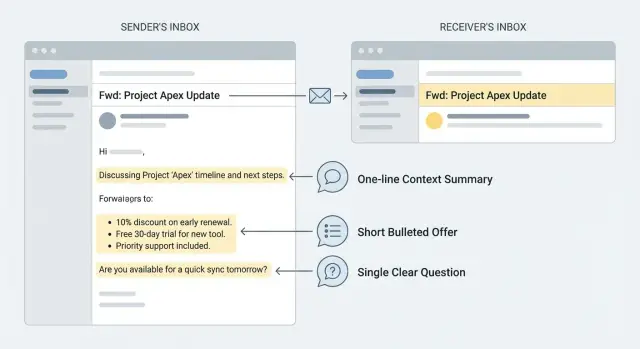
Why internal forwarding breaks your outbound email
Internal forwarding changes the job your email has to do. It stops being a direct note to one person and becomes a piece of internal evidence: “Is this worth our time?” The moment it gets forwarded, the reader is no longer the person you researched. They don’t share the same context, urgency, or patience.
The second reader is usually more skeptical. They didn’t choose to open your email. They were pulled in by a colleague, often with a one-word nudge like “Thoughts?” That puts them in caution mode: Is this legit? Do we need it? Is it a distraction?
Most forwards die because of missing context. Forwarding strips away the invisible parts of the conversation: why you reached out, what problem you solve, what you want next, and why responding is low effort. If any of that is unclear, the thread stalls.
Forwardable copy has a few traits. It makes sense to someone who’s never heard of you, states the problem in plain words, asks for one specific next step, avoids private-sounding references (“As we discussed”), and still works when skimmed on a phone.
If you write with forwarding in mind, you’re not just emailing a person. You’re writing a tiny brief that can move through a team without losing meaning.
Start by writing for two readers, not one
Your email has two audiences. The first is the person you hit send to. The second is whoever reads it after a forward: a manager, a teammate, procurement, IT, or an exec skimming it between meetings.
The primary reader decides, “Is this worth my time to reply?” The forwarded reader decides, “Is this safe and relevant, and do we look smart engaging?” If your message only works for the first person, it often falls apart the moment it’s shared.
They tend to care about different things. The first reader wants speed, a clear benefit, and a low-effort next step. The forwarded reader wants credibility, low risk (no spammy vibe, no compliance or security surprises), and a reasonable ask.
Pick one sentence you want repeated internally and write it so it can be copy-pasted into chat with no extra explanation. Example: “We help SaaS SDR teams book more qualified meetings by improving cold email deliverability and reply handling, without adding more tools.”
A simple test: if someone forwarded your email with no note, would the new reader understand the context in 10 seconds and feel comfortable replying or delegating it? If not, tighten your first two lines and make that repeatable sentence do the heavy lifting.
Make the subject and opening line self-explanatory
A forwarded email often arrives without its original framing. The subject gets truncated, the thread starts midstream, and the new reader has no idea who you are or why they should care.
Use a subject that stands alone. The best subjects name the topic and the outcome, not the relationship. A practical pattern is:
What it is + who it’s for + the result.
Keep it concrete. Use real nouns (“invoice approvals”, “new leads”, “demo requests”), not vague phrases (“quick question”, “idea”). Put the key detail first so it still makes sense on mobile.
Then make your opening line answer two questions immediately: why this company, and why now. One sentence is usually enough.
Example:
Subject: "Reduce no-shows for Acme’s demos"
Opening line: "Hi Jamie, I’m reaching out because Acme is running weekly demos, and we help teams reduce no-shows by tightening the reminder and follow-up emails."
Notice what it avoids: “As discussed” (nothing was discussed), “following up” (on what?), or “looping you in” (to what?). If the core topic is above the fold, the forwarder can pass it along without writing a new explanation.
Add just enough context for someone new
When your email gets forwarded, the new reader lands in the middle of a conversation. If they can’t tell who you are, why you’re writing, and what you want in the first few lines, they’ll ignore it.
Start with a plain-English intro that works out of context: your role, your company, and what you help with. Skip titles that need decoding and hype words. A forwarded email should read like a simple note, not a pitch deck.
Add one clear line for “why them.” Make it specific enough to feel real, but short enough that it doesn’t turn into a biography. If you use a niche acronym, define it once.
A reliable formula is three lines:
- Who you are and what you do
- Why them
- What you’re asking for
Example:
"I’m Maya, I run partnerships at NorthPeak. We help HR teams reduce no-shows for interviews using simple SMS reminders. I reached out because you lead talent ops at BrightWorks and you’re hiring for multiple roles right now. Is the right person to discuss this you, or someone else on your team?"
Use a structure that survives skimming
Forwarded emails get read in odd moments: between meetings, on a phone, or buried in a long thread. If your note needs careful reading, you’ll lose the handoff.
Start with a single line that explains the whole email. Think of it as the line someone can quote when they forward it.
TLDR: We help teams reduce manual reply sorting and book more qualified meetings by auto-labeling inbound responses.
Then keep the body simple: one idea per paragraph, 1 to 2 sentences each. A clean structure usually looks like this:
- Who you are and what you do (plain words)
- The specific problem you fix (not a big claim)
- One or two proof points (specific and checkable)
- A small, low-pressure next step
When you describe results, trade vague claims for details someone can repeat without feeling silly. “Better deliverability” is fuzzy. A concrete description of how the sending ramps up over time is easier to trust.
Do the same with numbers. Always add context: what the number measures, and over what time period. “12 meetings” means little unless it’s “12 booked meetings in 30 days from a 400-contact sequence.”
Write a CTA the forwarder is comfortable sending
A forwarded email often lands with someone who didn’t choose to read you. Your CTA has to feel safe for the person forwarding it and easy for the new reader to act on without extra context.
Keep the ask to one sentence that still makes sense if it gets pasted into a new thread. A good test: if the forwarder adds “Thoughts?” above your email, does your CTA stand on its own?
Two response paths help: one time-based option and one simple question-based option.
- Time option: “If it’s relevant, are you open to a 10-minute call Tue or Wed?”
- Question option: “If not, who owns this area and what should I send them?”
Avoid pressure language that makes the forwarder look pushy (“last chance”, “need an answer today”). The forwarder is protecting their internal reputation. Calm wording travels better: “open to”, “worth exploring”, “should I close the loop?”
Also say what happens after a yes, so the new reader doesn’t worry they’re agreeing to a long sales cycle. Keep it specific: “If you say yes, I’ll send 2 times and a 3-bullet outline, and you can decide if it’s worth going further.”
A step-by-step recipe for forwardable outbound copy
If your note might get shared in Slack or forwarded to a VP, write it so the next person can understand it in 10 seconds. Good forwardable copy reads like a tiny brief, not a personal chat.
Use this five-part block. Keep each line short and avoid pronouns like “this” or “that” without a clear noun.
- Name the problem in their language. One sentence that matches what they already complain about.
- State the outcome you deliver. What gets better, and for whom.
- Add one proof point, plus the meaning. A single fact and one clause explaining why it matters.
- Ask one clear question. Yes/no or either/or works well.
- Add a forwarding-friendly footer. One line that gives the forwarder permission and direction.
Example line: “We help SDR teams cut time spent sorting replies by auto-labeling interested, not interested, out-of-office, and bounces. Is your team handling that manually, or do you already have a system?”
Footer option: “If you’re not the right owner, who should I speak with about outbound reply handling?”
Example scenario: your email gets forwarded internally
A common path looks like this: you email the VP of Sales, they like the idea, and they forward it to the CFO or procurement. Your message is now being read by someone who doesn’t know you, doesn’t know why they were included, and doesn’t want homework.
Here’s an original email that often gets forwarded and then stalls:
Subject: Quick question

Hi Maya - are you open to a quick chat next week?
We help teams improve outbound results.

Can you do Tuesday?
When the VP forwards it, the new reader sees a context gap: Who is this? What’s being asked? Why does it matter to me?
Here’s a rewrite that holds up when someone else reads it cold:
Subject: Reduce tools + protect deliverability for outbound

Hi Maya - I’m Alex from LeadTrain.

Your VP Sales may have looped you in because this is about cost and risk, not just reply rates.

LeadTrain combines domains, mailboxes, warm-up, sequences, and reply classification in one place. That usually replaces 3-5 tools and keeps sending reputation isolated per team.

If it’s worth a look, who owns outbound tooling and approvals on your side - you or Procurement?
What changed is straightforward: it names the sender, explains why the CFO/procurement is included, states the business reason (cost and risk), keeps the solution in one tight paragraph, and asks a safe routing question instead of pushing for a meeting.
Build trust without forcing the reader to research
When an email gets forwarded, the new reader is silently asking two questions: who are you, and why now? Answer both early, in plain words.
Make it easy for the forwarder to handle “we already have a vendor” without starting a debate. One sentence is enough: “If you already use a tool, this usually comes up when deliverability or reply handling becomes a time drain.” It frames you as a fit for a specific pain, not a forced replacement.
Pricing is another trust trap. Avoid teasing a number that will be wrong, and skip vague lines like “it’s affordable.” Lower the risk instead: “If it’s relevant, I can share pricing ranges based on team size after one quick question.”
Write claims that can be repeated internally without embarrassment. Stick to: what you do in one sentence, the specific problem you remove, what changes in week one (measurable, not hype), and what you need from them to validate fit.
Common mistakes that make forwards fail
Most failed forwards boil down to one issue: the new reader has no idea what’s going on.
A common slip is writing like there’s shared history when there isn’t. “Following up on this” and “as discussed” turn into dead ends the moment your email hits someone who never saw the earlier thread.
Another mistake is piling on requests. If you ask for a call, a referral, a deck review, and a yes/no answer in one message, the forwarder has to decide what they’re endorsing. Most people choose the safest option: do nothing.
It also falls apart when you list features without meaning. “We do AI reply classification, warm-up, and DNS setup” might sound impressive, but a forwarded reader is thinking: what problem does this solve for me this week?
The patterns that break forwards most often:
- Hidden backstory: no one can tell why you’re reaching out in 10 seconds.
- Multiple CTAs: the forwarder isn’t sure what to pass along.
- Feature dumps: benefits are implied, not stated.
- Uncheckable proof: “Trusted by top brands” with nothing specific.
- Awkward urgency: “Need this today” makes forwarding feel risky.
Quick checklist before you hit send
Read your email as if it will be forwarded to someone who has never heard of you, your company, or the original thread.
The 60-second forward test
- Can a new person explain what you want after a 10-second skim (who you are, why you’re writing, what the next step is)?
- Is the offer understandable without earlier emails, calls, or extra context from the forwarder?
- Is there only one main ask, not competing options?
- Did you replace vague pronouns (“this”, “that”, “it”) with clear nouns (“the 15-minute call”, “your billing workflow”)?
- Would you feel comfortable forwarding it to your boss without adding an apology or extra explanation?
If you’re unsure, do one rewrite pass: replace every pronoun with the specific thing it points to, and cut any sentence that exists only to sound impressive.
A good sign you’re done: the email still makes sense when the subject line and first two sentences are screenshot and shared in a chat.
Next steps: test, iterate, and keep it consistent
Treat “forwardable” as something you can test, not a vibe you guess. Write a small set of versions, send them to similar prospects, and let replies tell you where people get confused once the email travels internally.
Create 2-3 variants that change only one thing at a time (usually the subject, the first sentence, or the CTA). Keep everything else stable so you know what caused the lift or the drop.
Consistency matters more than cleverness. If your subject, opening, and CTA swing wildly across steps, the forwarder has to re-explain you each time. Keep the core message steady, and use later steps to add one proof point or one small detail.
If you want one place to run outbound without juggling domains, mailboxes, warm-up, sequences, and reply classification, LeadTrain (leadtrain.app) is built for that kind of end-to-end workflow. The main benefit is keeping the operational setup out of your way so you can focus on tightening the message that survives the forward.
FAQ
Why do my outbound emails die after someone forwards them internally?
Write so it reads like a tiny brief, not a personal note. Assume the next reader has zero context, so your first lines should clearly say who you are, why you’re reaching out, and what you want next in plain language.
What’s the simplest test to know if my email is “forwardable”?
Aim to answer three things fast: who you are, what problem you fix, and the next step. If a new reader can’t get that in about 10 seconds, they’ll usually ignore it or ask the forwarder for context, which often never happens.
How should I write a subject line that still works after a forward?
Use a subject that stands alone: what it is, who it’s for, and the result. Skip vague subjects like “Quick question” because they become meaningless when the email lands mid-thread on someone else’s phone.
What should my opening line say when the email might be forwarded?
Make the first line explain “why this company, why now” in one sentence. Avoid phrases that assume prior context like “following up” or “as discussed,” because the forwarded reader wasn’t part of that earlier conversation.
How much context should I add for the person who receives the forward?
Include a plain-English intro that survives copy-paste: your name, your company, and what you help with. Add one short “why them” line that’s specific, then move straight to the ask so the new reader doesn’t have to hunt for the point.
What structure makes an email easier to skim in a forwarded thread?
Keep it skimmable: one idea per short paragraph, and put the most repeatable line near the top. A simple TL;DR sentence can help because it’s easy for someone to paste into chat without rewriting your pitch.
What’s the best CTA when I expect the email to be forwarded to a manager or procurement?
Ask for one safe next step that doesn’t force commitment, like a routing question or a quick yes/no. Make it easy for the forwarder to send without feeling pushy, and make it easy for the new reader to act on without extra explanation.
What’s a “repeatable sentence,” and how do I write one?
Write one sentence that you’d want quoted internally, and make it specific and jargon-free. It should explain the outcome and the audience clearly so it can travel through Slack or email without you in the room.
What are the most common mistakes that make forwarded emails fail?
Avoid hidden backstory, multiple asks, and feature dumps with no meaning. Forwarded readers care about safety, relevance, and effort, so unclear context, pressure language, or uncheckable claims usually stop the thread.
How do I improve forwardability over time without rewriting everything?
Create a few variants that change only one element at a time, usually the subject, first line, or CTA. Keep the core message consistent across steps so the internal forward doesn’t require the recipient to “re-explain” you each time.