Messaging framework for multiple stakeholders without confusion
Use a messaging framework for multiple stakeholders to keep one clear story while tailoring value by role, so teams avoid mixed signals and stalled deals.
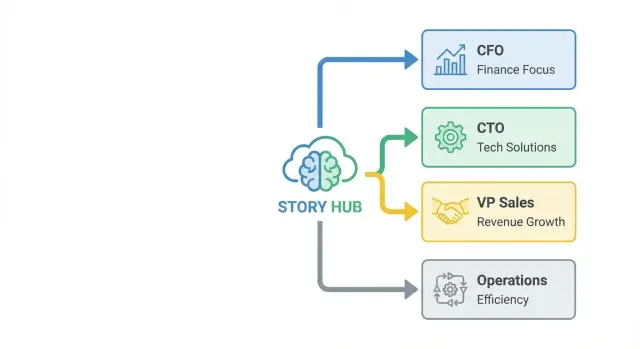
Why multi-stakeholder outreach gets confusing
Most B2B deals have more than one buyer. There's the person who feels the pain, the person who controls budget, and the person who worries about risk. As soon as you start talking to all of them, mixed messages can creep in.
It usually happens for two reasons: speed and handoffs. Teams move fast, grab whatever angle seems to work, and tweak the pitch from call to call. Then the prospect talks to an SDR, then an AE, then maybe a founder, and each person tells the story in their own words.
You can spot inconsistency in small places that add up. The problem changes ("time waste" in one email, "cost savings" in the next). The product description shifts (tool vs service vs platform). The promised outcome moves (more meetings vs fewer tools vs lower risk). Proof points don't match, and the next step feels random (demo, pilot, security review, all too early).
Buyers notice. When stories change, they assume you're either still figuring out who you help, or you're saying whatever each person wants to hear. Neither builds trust.
Inside an account, people also compare notes. A CFO asks the champion, "What did they tell you?" If the answers don't line up, the internal sale slows down because your champion now has to translate and defend your message.
A quick example: you email the Head of Sales about "more meetings," tell RevOps on a call it's "mainly deliverability," then reassure IT that it's "just a lightweight add-on." Even if all three are partly true, it can sound like three different products.
The goal is simple: one core story that doesn't change, with role-specific angles that highlight different benefits without rewriting the narrative. Done well, every email, call, and follow-up sounds consistent, even when the emphasis shifts.
If you run outbound at scale, consistency matters even more because prospects may see multiple touches across teammates. In LeadTrain, for example, sequences, warm-up, and replies live in one place, so it's easier for a team to share the same templates and proof points instead of reinventing the pitch in every thread.
Define the core story you will not change
Start by writing a core story that survives every edit. This isn't your whole pitch. It's the smallest true thing you can say about the problem you solve and the outcome you create.
A good test: if a CTO and a VP Sales both read it, they should agree on what you do, even if they care about different details.
The one sentence that stays the same
Write one sentence with three parts: who it's for, what pain it removes, and the measurable result. Keep it plain.
Example: "We help sales teams run cold email outreach reliably so more emails reach the inbox and reps spend less time on setup and sorting replies."
You can change emphasis by role later, but that sentence shouldn't change.
Proof points and differentiators you can repeat safely
Next, pick proof points that stay true in every conversation. These are capabilities or constraints you can stand behind every time, not big promises.
A simple way to keep this honest is to define four things up front:
- Proof points (unchanging): concrete capabilities you can repeat safely, like multi-step sequences, automated warm-up, and reply classification.
- Differentiators (repeatable): what you do differently that matters, like keeping domains, mailboxes, warm-up, and sequences in one place, or isolating each organization's sending reputation.
- Results you can mention: outcomes framed as intent rather than guarantees ("aim to improve inbox placement," not "guaranteed X% more meetings").
- Boundaries: tempting lines you won't use ("we replace your CRM," "we can't land in spam," "instant deliverability").
Once this core story is written, treat it like a guardrail. Every role-based message should connect back to it, even if you swap which examples you highlight.
Map the stakeholders and what each cares about
Confusion often starts when you treat "the company" like one person. A clean framework starts with a simple map: who is involved, what they protect, what they want to gain, and what they suspect you're not saying.
Most deals include some version of these roles:
- Economic buyer (budget owner): protects budget and ROI; worries you'll add a new ongoing expense.
- Champion or team lead (day-to-day owner): protects time and credibility; worries the rollout will be painful and make them look bad.
- Procurement or finance: protects terms and process; worries you'll push them into an awkward contract.
- IT or security: protects systems and reputation; worries you're hiding security gaps or deliverability risk.
- End users (operators): protect their routine; worry this becomes one more tool to maintain.
Each role has something to lose (time, risk, budget) and something to win (speed, revenue, control). Write that down before you write a single email. If you skip this step, you'll over-promise to one person and trigger alarms in another.
A practical way to uncover "what they think you're hiding" is to answer a few blunt questions for each role:
- What could go wrong if they say yes?
- What extra work lands on their team?
- What new risk shows up (security, deliverability, compliance, brand)?
- What cost might appear later (support, add-ons, headcount)?
- What happens if the project fails and people notice?
In outbound email tooling, a sales lead may want faster campaign setup and clearer replies. IT mostly wants proof you won't damage domain reputation or create deliverability problems. Same product, different fears.
Create role-based value angles (without changing the story)
Once your core story is set, translate it into value angles each stakeholder can recognize in 10 seconds. The trick is to change the emphasis, not the meaning.
Use a strict rule: one role gets one measurable outcome. If you give someone three outcomes, they'll pick none. For a CFO it might be reduced wasted spend. For a VP Sales it might be more qualified meetings. For RevOps it might be fewer tools to manage and cleaner reporting. Different angles, same underlying story.
A simple build process:
- Pick 1 outcome per role (money, time, risk, throughput, quality).
- Tie that outcome to the same mechanism in your core story (the thing you do differently).
- Choose 1 to 2 proof points that support the mechanism for that role.
- Write a one-sentence "reason to believe" that a stakeholder could repeat internally.
Keep proof points minimal and role-relevant. A CFO doesn't need a feature tour. They need something they can repeat, like "we replaced several tools with one" or "sending domains and authentication can be set up without a long IT back-and-forth." In LeadTrain terms, that could be automatic DNS and authentication setup (SPF/DKIM/DMARC), mailbox warm-up that protects sender reputation, and reply classification that reduces manual sorting. Pick only what supports the outcome.
To keep yourself honest, write each role angle in the same tight format:
- Outcome: what improves, and how you measure it (even a range).
- Why: one sentence connecting the outcome to your core story.
- Proof: one or two concrete facts.
If two roles end up with the same outcome, your angles are probably too generic. Change the measurement, not the story.
Build a simple messaging one-pager
A one-pager is the fastest way to keep a team consistent. It's not a brand book and it's not a pitch deck. It's one page you can drop into onboarding, review before writing, and use to spot drift.
For multi-stakeholder outreach, this becomes the single source of truth. People can tailor by role, but they shouldn't rewrite the story.
What to put on the page
Keep it tight and use approved wording, not rough notes. A strong one-pager usually includes:
- Core story (2 to 3 sentences): who it's for, what changes, and what outcome you drive.
- Message pillars (3 to 4): short headings with 1 to 2 approved sentences each.
- Proof and credibility (2 to 3 items): specific capabilities, a short "how it works" line, or a consistent result you can stand behind.
- Role cards: pains, desired outcome, proof to use, and the top objection for each stakeholder.
- Guardrails: a short list of "we do not say this" lines that create confusion or oversell.
Treat pillars like building blocks. If someone changes a pillar sentence, it should be a team decision.
Role cards do most of the work. In an outbound tool purchase, an SDR lead cares about time saved and reply handling, a sales manager cares about pipeline and reporting, and IT cares about risk and setup. Same story, different emphasis.
You can also keep a small swipe file with safe starting points (not scripts). For example: one or two subject lines, a couple openers by role, a consistent value line, a short objection reply, and one CTA.
If your team uses LeadTrain, keep proof lines factual, like consolidating domains, mailboxes, warm-up, sequences, and reply classification in one place. The goal is repeatable language, not clever language.
Step-by-step: write your framework in one afternoon
You don't need a week of workshops. You need a simple draft, a few firm choices, and one pass to remove contradictions.
-
Write the core story in five lines. Who you help, what pain you remove, how you do it, what changes after, and the one next step you want.
-
Turn that story into three message pillars. Pick three themes that stay true across roles, like less manual work, lower risk, and faster setup. These are reasons to care, not feature lists.
-
Draft three role-specific openers. Keep the story the same, but make the first sentence match what that person watches every day.
Examples:
- Sales leader: "Noticing teams lose hours each week juggling domains, mailboxes, and replies across tools."
- Ops or IT: "When outbound is split across tools, deliverability issues and setup work tend to land on your team."
- Finance: "When outbound needs several tools, costs and renewals quietly stack up."
-
Add proof and one next step. Proof can be a before/after, a specific behavior change, or a concrete capability. Then choose one clear action.
-
Do a consistency pass with the team. Read the core story and each role version out loud. If one version promises something different, fix it.
Timebox drafting and review so you end the afternoon with something usable. The goal is consistency, not perfection.
How to tailor emails by role without creating chaos
The fastest way to lose consistency is to write a separate story for every role. Keep one backbone and only swap the parts that need to match the reader's job.
Keep your sequence structure stable across roles so the team can review and improve it. For example: Email 1 is problem and promise, Email 2 is proof, Email 3 is a short bump, Email 4 is a focused example, Email 5 is a breakup.
What stays the same:
- The problem you solve (in plain words)
- The promise (what improves, and how you measure it)
- Your positioning (why you, and why now)
What changes are a few details that help each role say, "this is for me." Swap only three things:
- Opener: reference their world (risk, speed, cost, workload).
- Proof: pick evidence that matters to them (metrics, controls, workflow fit).
- CTA: ask for a next step that fits their authority (explore, validate, approve).
Multi-threading is where chaos usually starts. Set simple rules before you send: pick one thread owner per account, keep subject lines consistent within the account, stagger sends by 1 to 2 days, and when one person replies, pause the others and follow up with the same core story.
If you use LeadTrain, one practical approach is to keep a shared sequence template and create role variants that only change the opener, proof line, and CTA. That keeps personalization from turning into five uncontrolled versions.
Common mistakes that break consistency
The fastest way to lose a multi-threaded deal is to sound like three different companies. People forward emails and paste snippets into Slack. If your "one story" changes depending on who reads it, trust drops.
Common causes:
- Changing the promise by role. "Cut costs" to finance and "increase pipeline" to sales can work if both roll up to the same core promise. If one sounds like savings and the other sounds like a premium growth pitch, it feels like a pivot.
- Using metrics that conflict. "Fewer emails" from one rep, "more touches" from another, "higher personalization" from a third. If metrics pull in different directions, the plan sounds confused.
- Leading with features instead of outcomes. Feature lists drift because each sender remembers different details. Outcomes stay steady.
- Letting every rep rewrite the pitch. Minor edits are fine. Rewriting the why, the proof, and the ask means the account hears a new story every time someone new joins.
- Waiting too long to address objections. If security or deliverability concerns only show up after the first call, stakeholders fill the gap with assumptions.
Example: one SDR tells Head of Sales that LeadTrain can help teams launch campaigns quickly. Another tells IT it can buy domains and set up SPF/DKIM/DMARC behind the scenes. Both can be true, but if neither connects back to a shared promise (reliable outbound without tool sprawl), it sounds scattered.
A few fixes keep the framework consistent without turning it into a script: lock one sentence you won't change, choose 1 to 2 north-star metrics, standardize proof, and keep an objections line ready for finance and IT.
Quick checklist before you hit send
Before you message a group of stakeholders, do a 2-minute check:
- Can you summarize the story in one plain sentence?
- Would Finance, IT, and the end user all hear the same core promise?
- Do proof points match across versions, and can you back them up?
- Is the next step right for the person reading it?
- Could a teammate copy, paste, and use it as-is?
Then do one reality check: scan for any sentence that changes the "why" of your outreach. Tailoring should adjust emphasis, not invent a new reason to care.
Example: you're emailing a Director of Sales, a RevOps manager, and a founder. Your one-sentence story might be: "We help you run cold email end-to-end without juggling tools, so you book more meetings with less manual work." Sales gets more focus on meetings, RevOps gets more focus on control and deliverability, and the founder gets more focus on speed and fewer moving parts. Same promise, different angle.
Example: one account, three roles, one consistent story
Imagine you're selling an outbound email platform to a 120-person SaaS company. Three buyers are in the loop: the CFO, the CTO, and the Head of Sales. Your core story stays the same: "We help your team run outbound email reliably, without juggling a pile of tools, so you get more meetings with less busywork."
Now keep that story, but change the emphasis based on what each person is paid to care about.
Three role variants (same story, different emphasis)
CFO (cost, risk, predictability): Outbound should be a predictable channel, not a constant fire drill. Consolidating domains, mailboxes, warm-up, and sequencing in one place can reduce tool spend and lower the risk of deliverability problems turning into missed pipeline.
CTO (setup, reputation isolation): The goal is to take the messy parts off your plate: buying and configuring sending domains, automatic SPF/DKIM/DMARC setup, and warm-up that builds reputation gradually. With tenant-isolated sending infrastructure, your deliverability reputation stays yours rather than being shared with other customers.
Sales leader (speed, reply sorting, meetings): Reps lose time building follow-ups and sorting replies. Multi-step sequences, A/B tests, and AI reply classification can cut admin work so the team responds faster to interested leads and books more meetings.
Notice what didn't change: you're still selling reliability and less chaos. You just choose proof points that match the role.
To pressure-test your messaging, run role-based variants as separate sequences or A/B tests in LeadTrain. Keep audience quality and timing consistent, then compare outcomes using reply classification so you're measuring "interested" replies, not just total replies.
FAQ
What’s the simplest way to avoid mixed messages when emailing multiple stakeholders?
Treat it like one deal with one story, not five separate pitches. Keep a single core sentence about who you help, what pain you remove, and what changes after, then adjust only the emphasis (cost, risk, time, throughput) for each role.
How do I write a “core story” that doesn’t change by role?
Write one sentence with three parts: who it’s for, the pain you remove, and the measurable result. If a VP Sales and a CTO can both read it and agree on what you do, it’s stable enough to use everywhere.
What usually causes stakeholders to think we’re telling different stories?
Stop promising different end results to different people, and stop renaming what you sell (tool vs service vs platform) depending on the audience. Also align the next step; don’t ask one person for a pilot while asking another for a demo if you haven’t earned either.
What proof points are safe to repeat in every conversation?
Use proof points that stay true regardless of audience, like concrete capabilities and clear boundaries. For an outbound platform, that might be warm-up, multi-step sequences, or reply classification, plus a clear line on what you don’t claim (for example, no instant deliverability promises).
How do I figure out what each stakeholder actually cares about?
Start with what each role protects and fears: budget owners protect spend, IT protects risk and reputation, operators protect their routine and workload. Then pick one outcome for that role and tie it back to the same mechanism in your core story so it still sounds like the same product.
How do I tailor value by role without rewriting the pitch?
Pick one measurable outcome per role, connect it to the same “why” in your core story, then support it with one or two proof points that matter to that person. If you give three outcomes, the message gets fuzzy and harder for them to repeat internally.
What should be on a messaging one-pager for multi-stakeholder outreach?
Keep it to one page with approved wording: a short core story, a few message pillars, repeatable proof lines, role notes (pain, outcome, top objection), and a short list of lines you won’t use. The goal is consistency that people can copy into emails without “creative edits.”
How should my email sequence change by role in a multi-threaded account?
Use the same sequence structure for everyone and only swap three parts: the opener, the proof line, and the call to action. Also set account rules like one thread owner and pausing other touches when someone replies, so the account doesn’t get conflicting follow-ups.
How can LeadTrain help a team stay consistent across SDRs and AEs?
LeadTrain helps by keeping domains, mailboxes, warm-up, sequences, and replies in one place, so the team can share the same templates and proof lines. Features like automatic SPF/DKIM/DMARC setup, automated warm-up, and AI reply classification are easy to describe consistently because they map to clear outcomes: less setup work and less manual sorting.
What’s a quick consistency check before I hit send?
Read the one-sentence story and each role version out loud and listen for contradictions in the problem, the product label, the promised outcome, and the next step. If a stakeholder forwarded all your emails into one chat, they should still sound like one company with one plan.