Handling price replies: 3-5 line templates to keep momentum
Handling price replies with 3-5 line email templates that qualify budget, confirm fit, and suggest a clear next step without sounding pushy.
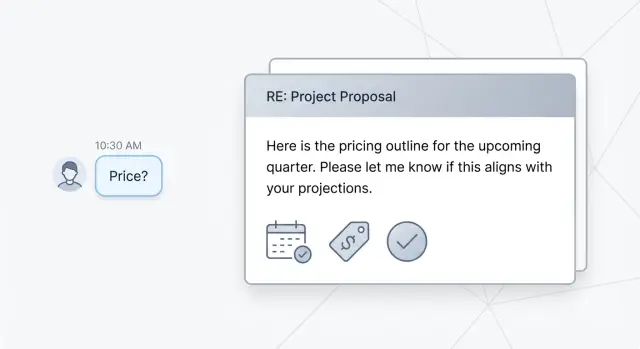
Why “Price?” replies can stall deals (and how to prevent it)
A one-word “Price?” reply looks like progress, but it can quietly kill momentum. It usually shows curiosity with uncertainty: they’re interested enough to respond, but not yet convinced you’re worth more time.
Most “Price?” replies translate to something like:
- “Give me a quick range so I know whether to keep talking.”
- “I don’t fully get what you do, so I’m using price to judge value.”
- “I’ve been burned before. Prove this is a fit before I invest effort.”
- “I’m comparing options and need something easy to share internally.”
The easy mistake is replying with a full price list, a long explanation, or sending people to a pricing page. That often stalls the thread because it shifts the work onto them. Now they have to read, interpret tiers, guess what applies, and decide alone. Many will postpone it and never come back.
A better goal is simple: keep the conversation moving while adding just enough context to make pricing meaningful. You want to confirm the problem you solve is the one they actually have, qualify budget without sounding defensive, and propose a next step that’s easy to say yes to.
That’s why short 3 to 5 line replies work. They respect the buyer’s time, give a useful range (or ask one fast question if you can’t), and end with a clear next step like “If that’s in range, want me to send 2 options?” or “Open to a 10-minute call so I can quote accurately?”
What people usually mean when they ask for price
When someone replies with a single word like “Price?”, it rarely means they’re ready to buy. It’s usually a shortcut. They’re trying to reduce risk: wasting time, looking uninformed, or getting pulled into a long sales process.
Most “Price?” replies fit a few common situations. They might be scanning vendors and want a quick range. They might be checking if you’re even in the right budget zone before a call. They might not be the decision-maker and need something simple to forward. Or they might be testing whether you’ll answer directly.
You can often tell which one it is by tone and timing:
- A fast “Price?” right after the first email is usually a ballpark check.
- “Can you send pricing and a deck?” often means “I need something to pass along.”
- “What’s your best price?” is often a transparency test or a sign they’ve had a bad experience.
An ops manager replying “Price?” at 7:30am often means: “If this is five figures, I’m out. If it’s reasonable, I’ll take the next step.” A founder replying “Price? monthly?” may be ready to move, but only if the fit is obvious.
Once you name the hidden intent, your next message gets easier: either share a simple range with one line of context, or ask one quick question so your price actually means something.
Decide first: give a range now or ask one question
A “Price?” reply isn’t a request for a rate card. It’s a quick sorting question. Before you type numbers, pick the path that keeps things moving: share a range now, or ask one question so the price has context.
When you can, give a range right away. A range sets expectations without boxing you into the wrong package. It also invites a simple “yes/no” reaction, which is easier than debating details over email.
Give a range when pricing doesn’t swing wildly, when you already have basic context (team size, scope, problem), or when you’d rather qualify fast than protect every detail.
Ask a qualifying question when price depends on one clear variable. Keep it to one question. Two questions can already feel like homework.
A useful rule: match your price detail to their detail. If they sent one vague word (“price?”), reply with one simple range and one next step. If they gave real context, you can give a tighter range and a clearer recommendation.
To avoid sounding evasive, don’t say “It depends” and stop. Lead with a quick answer, then add one fit check.
Example tone:
“Happy to share. Most teams land between X and Y, depending on A. Quick question: is this for 1 sender or a team? If you tell me that, I’ll point you to the right option.”
This is especially useful with outbound tools where cost varies by usage (for example, number of mailboxes or sending volume). One clean question keeps momentum and protects accuracy.
A simple 4-step structure for a 3 to 5 line reply
A “Price?” reply is good news. They didn’t ignore you, and they’re trying to place you in a mental bucket. Your job is to answer clearly, then regain control with one question and one next step.
A simple structure that fits in roughly 80 to 100 words:
- Answer directly with a range or starting point.
- Tie the number to a unit and outcome (per month, per seat, per project, and what that covers).
- Ask one simple scope or budget question.
- Offer one next step with two options so they can choose without thinking.
Keep each line doing one job. Skip feature dumps and long “it depends” paragraphs. If you truly can’t price yet, give a starting point and name the variable that changes it (seats, volume, usage), then ask the one question.
A 3 to 5 line template you can reuse:
Totally - pricing is usually $X-$Y per month, depending on [one variable].
That covers [clear unit/outcome] so you can [result they care about].
Are you closer to $A/month or $B/month for this?
If you want, we can do a 10-min call, or you can reply with [one detail] and I’ll confirm the exact number.
If you sell something like a cold email platform (domains, mailboxes, warm-up, sequences), that “one variable” is often number of mailboxes. If you sell a service, it’s usually scope or timeline. Either way: answer, anchor, ask, propose.
Templates: when you can give a price range
Speed matters more than perfect detail. Share a credible range, tie it to one simple assumption, and end with one clear next step.
Copy-and-paste templates
1) Range + one scope question
Totally - for most teams like yours, it’s usually $X-$Y/month.
That assumes ~[N users/mailboxes] and [one main use case].
Quick check: about how many [users/mailboxes/seats] would you need?
If you tell me that, I can narrow it to a tighter number.
2) Starting price + quick fit check
Pricing starts at $X/month, and most customers land between $Y-$Z.
It mainly depends on [volume/seats/mailboxes] and how many sequences you run.
Are you trying to book meetings for one offer, or multiple offers?
If you reply with that, I’ll point you to the right tier.
3) Anchor to a common package + what changes price
A common setup is $X/month for [package name], which covers [simple inclusions].
Price goes up mostly with (1) [seats/mailboxes] and (2) [monthly volume].
If you’re around [assumption], you’d likely be near $Y/month.
Want the “good fit” version or the “minimum to start” version?
4) If you truly cannot price yet (ask 2 specifics, max)
I can share a range, but I need two details so I don’t mislead you.
1) Roughly how many [users/mailboxes]?
2) About how many emails per day/week?
Reply with those two numbers and I’ll send the exact range + best option.
Keep numbers simple. Avoid attaching a full price sheet. The goal is to earn the next reply, not finish the deal in one message.
Templates: when you need a quick qualifying answer first
When someone replies “price?” early, they’re often checking ballpark or trying to avoid a long back-and-forth. A fast qualifying question keeps momentum and helps you avoid anchoring the wrong number.
Template 1: Ask for a budget bracket (quick, friendly)
“Happy to share pricing. To point you to the right option, what range did you have in mind? For example: under $200/mo, $200 to $500/mo, $500 to $1k/mo, or $1k+/mo. If you’re not sure, tell me what outcome you want and I’ll suggest a fit.”
Template 2: “Is this for you?” + forwardable blurb
“Quick check: are you the one deciding, or should I send something you can forward? Here’s a blurb you can paste: ‘We help teams run outbound emails with better deliverability and less manual work. Pricing depends on # mailboxes and volume.’ If you tell me who owns this, I’ll send the right details.”
Template 3: Qualify by volume and timeline (avoids wrong quote)
“Price depends mostly on usage. Roughly how many mailboxes and how many emails/day are you planning? And are you trying to launch this week, this month, or later? With that, I can reply with a clean range and the next step.”
Template 4: Procurement-style request (quote-ready)
“Sure, I can put together a quote. Can you confirm: company name, billing country, # users, # sending mailboxes, and expected monthly send volume? If you have a required format (PO, annual terms), tell me and I’ll match it. Once I have that, I’ll send a formal quote and a quick option to review it together.”
Confirm fit fast so price has context
When someone replies “Price?”, they’re often asking, “Is this even for me?” If you confirm fit in one quick step, your number stops feeling random and starts feeling fair.
Two easy ways to do this without turning it into a full discovery call:
- A “range” question: “Roughly how many seats or inboxes would this cover?”
- A “use case” question: “What are you trying to achieve in the next 30 days: book meetings, revive an old list, or test a new offer?”
Keep it light. You’re not trying to diagnose everything, just place them into the right bracket.
A fast way to help people self-qualify is naming your best-fit customer in one line:
“Best fit is teams doing consistent outbound (for example 500 to 5,000 emails per month) who need reliable deliverability and clear reply handling.”
Also say it when you’re not a match. It builds trust and saves time:
“If you only send a few one-off emails each month, you probably don’t need this and a simpler tool will be cheaper.”
If it still seems promising, offer a low-friction path forward: start smaller (1 to 2 inboxes and expand later), run a short pilot with a clear target, or send two options by email.
Example scenario: a realistic “Price?” thread that books a call
Here’s a simple thread you can copy. Notice how you answer the question, qualify lightly, and move to a next step without getting defensive.
Prospect (reply):
Price?
You (reply, 3 to 5 lines):
Happy to share. Most teams land between $300-$1,200/mo, depending on seats and sending volume.
Quick question so I don’t misquote it: how many users will send, and about how many emails/day?
If you tell me those two numbers, I’ll confirm the right range.
Prospect (reply):
Likely 3 users. Around 150-200 emails/day total. Budget is about $800/mo if it’s a good fit.
You (reply, 3 to 5 lines):
That helps - you’re in the right ballpark.
To confirm fit: are you mainly trying to book demos for one offer, or do you have multiple ICPs and campaigns?
If it’s one offer, we can keep setup simple and get moving fast.
Prospect (reply):
One offer. Targeting founders at small agencies.
You (reply, 3 to 5 lines):
Great - that’s straightforward.
Want to do a 10-minute call to confirm the exact plan and timeline, or I can send 2 options by email (good/better) based on 3 users and 200/day?
Common mistakes that lose momentum
Most “Price?” replies signal interest, not negotiation. Momentum gets lost when your response adds friction or creates homework.
One common trap is sending a long pricing story, a big table, or a PDF. The prospect asked a quick question and gets a project. Keep it readable in the email body and save the details for after you confirm fit.
Another thread-killer is turning your reply into an interview. If you ask six questions before giving any useful number, people feel trapped and stop responding. Ask one simple qualifier, then give a range tied to a clear assumption.
Tone matters. If you sound evasive (“it depends”) or defensive (“what’s your budget?”), the prospect assumes you’re expensive or difficult. Calm, direct, and helpful wins.
A few patterns that stall deals:
- Dropping a number with no context. Add one sentence on what drives it.
- Writing a wall of text. Keep it to 3 to 5 lines and one clear ask.
- Dodging the question. Even if you can’t quote exactly, give a bracket and say what you need to confirm.
- Forgetting the next step. End with a choice: answer one question, pick a time to talk, or confirm one detail.
A good price reply ends with direction: “If you tell me X, I’ll confirm the right tier and send the best option.”
Quick checklist before you hit send
Read your draft once like a prospect skimming on a phone. If they have to hunt for the number or the point, you’ll lose them.
A tight pre-send check:
- Open with the direct answer (range, starting price, or bracket).
- If variables matter, name one or two (seats, volume, scope), then keep moving.
- Ask one deciding question (two only if you truly must).
- Suggest one concrete next step and make it the default.
- If you’re proposing a call, offer two specific time options.
Then trim. Cut rambling greetings, extra context they didn’t ask for, and filler like “happy to...” if it doesn’t add anything. If it’s longer than 3 to 5 lines on desktop, it’ll look like a wall of text on mobile.
Final gut check: does your message give them a number, a reason it makes sense, and a simple choice for what happens next?
Next steps: turn “Price?” replies into a repeatable workflow
You get better at “Price?” replies when you stop writing every response from scratch. Treat it like a known fork in your process: reply fast, qualify lightly, then propose one clear next step.
Save your best 2 to 3 replies as snippets. Name them by situation (for example, “range + fit check” and “one question first”). You’ll stay consistent even when you’re busy.
To make sure these messages don’t get missed, use a simple tracking habit: tag every “price” message the same way, then review them once or twice a day until the thread is resolved.
A simple workflow that holds up:
- Reply the same day with either a range or one qualifying question.
- Add one fit check (team size, volume, or goal), not a full discovery.
- Offer two next steps: a quick call or a short email with exact numbers.
- Keep a clear boundary: “Share one detail and I’ll confirm the right option.”
- Close with a single question.
If you want this to take less manual effort, it helps to use a platform that keeps the operational pieces in one place. LeadTrain (leadtrain.app) combines sending domains and mailboxes, warm-up, multi-step sequences, and AI-powered reply classification, so messages like “Price?” can be categorized and handled quickly without juggling multiple tools.
FAQ
What does a one-word “Price?” reply usually mean?
Treat it as a quick sorting question, not a buying signal. Reply fast with either a simple range or one qualifying question, then end with an easy next step so the thread keeps moving.
Why is sending a full price sheet or pricing page a bad move?
Because it creates homework for them. They have to interpret tiers, guess what applies, and decide alone, which often leads to “I’ll look later” and the thread dies.
Should I give a price range immediately or ask a question first?
Default to a ballpark range when pricing is fairly predictable and you want a quick yes/no reaction. Ask one question when a single variable (like seats, mailboxes, or volume) changes the price enough that a range could mislead them.
What’s a good structure for a 3–5 line reply to “Price?”
Keep it to 3–5 short lines: give a range or starting point, state what it covers in plain terms, ask one simple qualifier, and offer one clear next step. The goal is to earn the next reply, not close in one email.
How do I avoid sounding evasive when I need more info?
Answer first with a bracket, then ask one detail that narrows it. For example, give a monthly range and ask how many senders or mailboxes they need; once they reply, confirm the tighter number and propose a quick call or two options by email.
How do I qualify budget without sounding pushy?
Ask a bracket question that feels easy to answer and doesn’t put them on the defensive. A simple “Are you aiming for under X, around Y, or above Z per month?” works better than pushing for an exact budget number.
What if they’re not the decision-maker and just want something to forward?
Give them a short, forwardable summary that includes the unit and the main price driver. That way they can pass it along internally without rewriting it, and you still control the framing.
How can I confirm fit quickly so pricing has context?
Use one fit check so the number feels fair, like asking what they’re trying to achieve in the next 30 days or how many inboxes will send. If it’s not a fit, say so quickly and suggest a simpler path so you don’t waste each other’s time.
What are the most common mistakes that kill momentum after “Price?”
Don’t dump features, don’t ask a long list of questions, and don’t drop a number with zero context. Also don’t end without direction; you want a single question or a simple choice that makes replying effortless.
How can I make handling “Price?” replies repeatable for my team?
Use a system that tags and routes “price” replies so they’re answered the same day with consistent snippets. LeadTrain can help here by keeping outreach, warm-up, sequences, and AI reply classification in one place, so pricing threads don’t get lost and you can respond with the right template fast.