Founder vs SDR outreach in month one: what to delegate
Founder vs SDR outreach: a practical month-one task split to keep messaging authentic while building enough volume, with clear handoffs and simple checks.
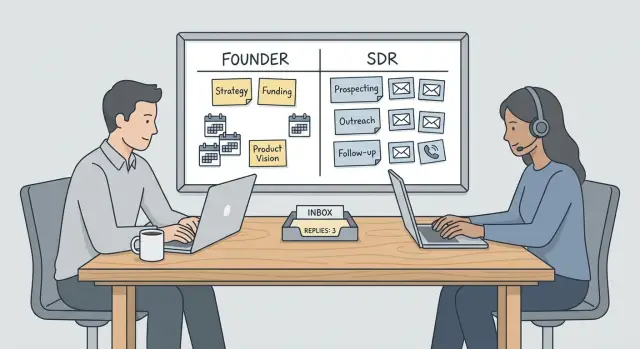
The problem in month one: authenticity vs volume
Month one is messy because everything is new at once. You’re still learning who responds, what they care about, and what your offer sounds like in plain words. At the same time, you’re trying to hit a number (meetings, replies, pipeline) with limited hours.
That’s why founder vs SDR outreach often turns into a tug of war. Founders want messages that feel real and specific. SDRs want enough volume to learn fast and keep the calendar moving.
Authentic outreach doesn’t mean writing a personal essay for every prospect. It means your message matches reality: who you are, why you’re reaching out, what problem you solve, and what you’re asking for next. It also means you can answer follow-up questions without backtracking.
Authenticity is not random personalization that looks clever but has nothing to do with your product. It’s not “friendly” fluff that hides the point. Prospects can feel that quickly, and it often produces polite replies that go nowhere.
If you push volume too early, you usually pay for it twice. First, you burn good leads with the wrong pitch before you have proof it works. Second, you create inbox problems (bounces, spam flags, low-quality replies) that make future sending harder.
A clean goal for month one is to build a repeatable process that still produces real conversations. If you can reliably get positive replies from a specific buyer, learn which objections repeat, and book a few meetings you can actually run well, you’ve earned the right to scale.
Set the goal and constraints before you split tasks
Outreach breaks down when you split work before you agree on what “good” looks like. The fastest way to keep both authenticity and volume is to define a simple scorecard first, then assign tasks that drive that scorecard.
Start with three outcomes and keep them separate:
- Meetings: the obvious one.
- Learnings: which message gets replies, which segment cares, which objections repeat.
- Pipeline: real conversations that can turn into deals, even if they don’t book this week.
Next, define your ICP in plain words. Skip fancy labels and write one sentence a new SDR can understand: who you want, why now, and what pain is urgent. “VP Sales at a 20-100 person SaaS team hiring SDRs, because they need pipeline this quarter and they’re tired of low reply rates” beats “mid-market revenue leaders.”
Then pick one offer and one call to action. Month one isn’t the time for three different pitches in one inbox. Choose a single “why talk to us” angle and one simple next step. Keep the ask small: a 15-minute call, a quick yes/no question, or permission to send a short deck. If you change the offer every few days, you’ll never know what worked.
Finally, set a realistic weekly time budget for each person. This constraint prevents over-promising volume and under-delivering on follow-up.
A simple set of constraints that keeps you honest
Write these down and use them to decide what to delegate:
- Founder time per week (for example: 90 minutes total, split across three short blocks)
- SDR time per week (for example: 6-10 hours for prospecting, sending, and follow-up)
- Max number of new contacts per day (based on your email setup and capacity to reply)
- Response-time target for interested leads
- One weekly review slot (30 minutes to look at replies and update messaging)
Do this upfront and delegation gets easier: anything that doesn’t require founder judgment moves to the SDR, and anything tied to positioning and learning stays close to the founder.
What the founder should keep in month one
Month one is when your outreach tone gets set for months. The founder’s job is to protect the truth: why someone should care, what you actually solve, and what you won’t promise.
Keep the “discovery inputs” close
The founder should be the main source of raw customer language. Pull phrases from real calls, DMs, and emails, not polished marketing copy.
Capture lines prospects repeat right before they buy, what they worry about, and what they compare you to. You’re looking for simple, reusable phrasing like “we tried X, but it took too long” or “this needs finance approval.”
Own message approval early
Even if an SDR drafts emails, the founder should approve early versions of the core pieces:
- First-touch email and one follow-up (tone and promise)
- The “why you” paragraph (proof and specifics)
- The call to action (how big the ask is)
- The top objection replies (short, honest answers)
Once you see consistent positive signals (real replies, not just opens), move to weekly review instead of line-by-line approval.
Handle the relationship moments
Some replies are too important to delegate in month one. The founder should personally take:
- “This is interesting, but I’m not sure it fits” (high intent, needs nuance)
- “We’re evaluating options, send more details” (timing and next steps matter)
- Any referral to a decision-maker (first impression matters)
An SDR can tee up drafts, but the founder should send the final message so it reads like a real person, not a queue.
Do weekly quality control
Set one 30-minute block each week to review a small sample: what was sent, the best and worst replies, and where prospects got confused.
Look for one fix you can make immediately. Remove a vague claim, tighten the ask, or swap in a customer phrase you heard that week.
What an SDR should own from day one
In month one, the SDR’s job is to protect the founder’s time while keeping outreach consistent. Think of the SDR as the owner of volume and order, and the founder as the owner of voice and high-stakes conversations.
The SDR should fully own prospecting. That means building the first lead list, cleaning it, and keeping it usable. A messy list creates fake learnings: you think your message is weak, but you’re really emailing the wrong people or bad addresses.
A practical prospecting loop is straightforward: build a focused list from one ICP and one use case, remove duplicates and obvious non-fits, verify basics (size, location, industry), and add a couple of tags (persona, pain, trigger) for filtering.
Personalization research can also sit with the SDR, but it needs guardrails. The goal is light, repeatable patterns, not deep detective work. Pick two or three cues (recent funding, new job post, tech stack mention) and turn them into one sentence that sounds human.
Campaign operations is where an SDR adds the most leverage early. They schedule sends, manage follow-ups, track results daily, and keep experiments tidy. If you run A/B tests, only change one variable at a time.
Finally, inbox hygiene. The SDR should do first-pass reply handling: tagging, routing, and clearing noise so the founder only sees what needs founder attention. A simple rule works well: SDR handles bounces, out-of-office, and basic objections; founder handles interested replies and nuanced questions.
Shared responsibilities: deliverability and campaign hygiene
Deliverability is the shared foundation. If your emails land in spam, it doesn’t matter how good the message is.
Start with a clear split on setup work. Domains and mailboxes can be handled by the SDR (or the most ops-minded person), while the founder approves naming and sender identity so it matches the brand. Warm-up should run continuously in the background and ramp slowly.
For ongoing hygiene, keep the split clear:
- SDR: setup work, warm-up, watching bounce rate and unsubscribes
- Founder: sender identity, voice, and risk level (how fast to ramp)
- Both: review spam signals, agree on a pause rule, keep list quality high
Message work is shared too. The founder writes (or heavily edits) the base message once: promise, positioning, tone. The SDR can create safe variations (industry line, role-based opener) as long as they don’t change the core claim.
Monitoring should be routine and boring. Watch bounces, sudden drops in opens, and the mix of replies. If you categorize replies (interested, not interested, out-of-office, bounce, unsubscribe), review it together twice a week so you catch problems early.
Pause sending when something looks off:
- Bounce rate jumps or keeps rising
- Spam complaints, or a wave of “stop spamming me” replies
- Reply mix turns into mostly out-of-office and bounces (bad timing or bad data)
- A new domain or mailbox was added without warm-up
A short pause is cheaper than burning a domain.
A simple step-by-step task split for the first 30 days
Month one is about learning fast without burning trust. Keep the founder in charge of what gets said and why, and let the SDR run the process that turns it into consistent outreach.
Days 1-7: Build the “truth” and run a tiny pilot
Start with a plan you can actually review every day.
- Founder sets the offer and writes the first draft. One clear problem, one clear outcome, one simple ask. Also decide the “no-go” claims so the SDR never has to guess.
- SDR prepares a small, clean lead batch and launches a pilot. One segment, a few dozen leads, one short sequence. The SDR owns list quality and the mechanics of sending.
A practical rule: if the founder can’t read the draft and say, “Yes, I’d send this from my own inbox,” it’s not ready.
Days 8-21: Review replies daily and change one thing at a time
These two weeks are about feedback loops, not volume. Do a quick daily review together (15 minutes is enough) and keep roles clear:
- Founder: reads a sample of replies, updates positioning, writes or approves lines that require judgment (pricing hints, constraints, credibility).
- SDR: tags replies, notes patterns, applies edits to subject lines, first lines, and follow-ups.
When you test, test one variable. Keep the offer the same and try two first sentences. Or keep the message the same and change the CTA from “Worth a chat?” to “Open to a 10-minute fit check?”
Days 22-30: Increase volume only after signals look stable
Before you send more, make sure signals look healthy: consistent opens, a steady trickle of human replies, low bounces, and few spam complaints. If any wobble, pause the ramp and fix targeting or copy first.
Common mistakes that break authenticity or volume
The month-one trap is trying to get perfect authenticity and high volume on day one. You usually end up with neither: the message drifts, deliverability suffers, and good replies get buried.
One mistake is the founder writing every email from scratch. It feels personal, but it turns outreach into a nightly writing session, and quality swings based on energy. Prospects also notice inconsistency when the value prop changes from email to email.
Another common failure is letting an SDR adjust the offer or positioning without tight alignment. Small changes like swapping the target persona, changing the promise, or adding new features can quietly break what made the message believable. The founder steps back in to “fix it,” and the cycle repeats.
A few authenticity-killers that also slow you down:
- Over-personalizing until every email becomes a one-off with no repeatable structure
- Mixing tones across steps (friendly first email, aggressive follow-up, then formal breakup email)
- Chasing clever lines instead of a clear reason to reply
Volume breaks in a different way. Teams scale sending before the basics are stable: domain setup, SPF/DKIM/DMARC, and a warm-up period. When you ramp too fast, inbox placement drops, and the team responds by blasting even more, which makes it worse.
Reply handling is another place where both authenticity and volume fail. If all replies get treated the same, you miss high-intent moments. “Interested, can you share pricing?” shouldn’t sit in the same pile as “Not now” or “Out of office.” Even at low volume, slow response times make your outreach feel automated.
To keep things stable, agree on what cannot change and what can.
Non-negotiables: ICP, core pain, one clear offer, and the founder-approved voice.
Flexible: subject lines, opener style, and small proof points.
Example scenario: B2B startup with one founder and one SDR
A two-person team is trying to book demos for a new B2B tool. The founder knows the problem best, but also has product and fundraising on their plate. The SDR can keep activity steady, but needs guardrails so the outreach still sounds real.
The first week, the founder takes the first 20 real conversations end to end. Not 20 polished pitches, 20 learning loops: which titles answer, what objections show up, what proof people ask for. The founder writes the first version of the opening email and the most important follow-up using language that matches how they talk on calls.
Once those conversations create a clear pattern, the SDR runs a daily send plan with light personalization. Light means one sentence that proves the email isn’t sprayed: a role-relevant trigger or a specific line about the company. Everything else stays consistent so results are measurable.
A clean handoff rule keeps speed without losing authenticity:
- SDR handles replies first and tags them by intent.
- Founder steps in within two hours when a reply asks product-fit questions, pricing, security, or a custom workflow.
- SDR books the meeting when interest is clear and the next step is simply scheduling.
- Founder takes the meeting when the account is high-value or the buyer is senior.
The weekly review stays short. Founder and SDR look at 10-15 recent threads and decide what to change: one subject line, one proof point, one qualification question. They prune the lead list (wrong personas waste volume) and pause anything that creates confusion or negative replies.
Quick checklist before you scale outreach
Before you add more leads or ask an SDR to send more, make sure the basics are solid. Most “volume problems” in month one are really setup or consistency problems.
Deliverability and routing checks
If emails aren’t landing in inboxes, better copy won’t save you.
- Confirm SPF, DKIM, and DMARC are set up for every sending domain.
- Make sure each mailbox is warmed up and daily volume increases gradually.
- Verify reply routing is clear so interested, not interested, out-of-office, bounce, and unsubscribe don’t get mixed.
Message consistency checks
Scaling works when your sequence says one clear thing and asks for one simple next step.
- Keep one offer across the sequence and one primary CTA.
- Keep a weekly review cadence to update targeting and tighten wording.
A practical weekly review: the SDR brings a small batch of real replies (good, bad, confusing). The founder rewrites only the parts that affect positioning and tone. Then the SDR updates the sequence and keeps volume consistent.
If you can say “yes” to every item above, you’re ready to scale. If not, fix the weakest point first. It’s usually faster than pushing more volume and hoping it works.
Next steps: make the split repeatable
Month one is where founder vs SDR outreach either becomes a habit or turns into constant rework. The goal is simple: write down a small system that keeps the founder’s voice while letting the SDR run the engine.
Start with a one-page “delegation rules” doc. Keep it plain: who owns each task, what “done” means, and what the handoff looks like. Add a couple of examples, like how to route an “interested” reply vs a “not now” reply, and how quickly the SDR should flag edge cases.
Make improvement measurable by picking one metric per week. Don’t chase five numbers at once. Rotate focus: one week reply rate, the next meetings booked, then bounces or unsubscribes. When a metric moves, write down what changed so you can repeat it.
Protect authenticity with a short weekly founder review. Not a long meeting, just a check on three things: the message still sounds like a real person, targeting hasn’t drifted, and replies are handled the way you want.
If ops work is slowing you down (domains, mailboxes, warm-up, sequences, and sorting replies across tools), keeping it in one place can help. LeadTrain (leadtrain.app) is built to consolidate domains, mailboxes, warm-up, multi-step sequences, and AI-powered reply classification so a founder and SDR can spend more time on conversations and less time on setup and inbox triage.
FAQ
What’s the right founder vs SDR split in month one?
In month one, default to keeping the founder responsible for the core promise and tone, and let the SDR run the repeatable process. You’re trying to learn what works without burning trust or inbox reputation, so clarity and consistency beat raw volume.
What should we measure in month one besides meetings?
Pick three outcomes and keep them separate: meetings booked, learnings you can act on, and pipeline that could turn into deals later. This keeps you from chasing vanity activity and helps you delegate work that supports the one goal you’re focused on this week.
Which outreach tasks must the founder keep early?
The founder should own the offer, the core first-touch message, at least one key follow-up, and the wording for top objections early on. The founder should also personally handle high-intent replies where nuance matters, so the conversation stays truthful and confident.
What should the SDR own from day one?
The SDR should own prospecting, list cleanliness, campaign scheduling, follow-up execution, and first-pass inbox sorting. This protects founder time and prevents “fake learnings” caused by bad data, inconsistent sending, or missed follow-ups.
How do we personalize without turning every email into a one-off?
Don’t treat personalization as a creative writing exercise; keep it tied to a real reason you’re reaching out. Use one simple, repeatable cue that supports your claim, and avoid clever lines that don’t connect to your product or the prospect’s likely pain.
What are the minimum deliverability steps before scaling volume?
Set SPF, DKIM, and DMARC correctly for every sending domain, warm up mailboxes slowly, and keep daily volume within what you can reply to. If inbox placement drops, fix setup and list quality before you increase sends, because blasting more usually makes it worse.
How should we run A/B tests in month one?
Start with a small pilot list and change only one variable at a time, like the first line or the CTA, while keeping the offer constant. This makes results interpretable so you can confidently keep what works instead of constantly rewriting everything.
How do we handle replies without missing high-intent leads?
Use a simple routing rule: the SDR handles bounces, out-of-office, unsubscribes, and basic objections, while the founder takes interested replies and fit/pricing/security questions. The key is speed—fast, human replies make your outreach feel real and prevent good leads from cooling off.
When should we pause sending during month one?
Pause when bounce rates spike, spam complaints appear, opens suddenly drop, or reply quality shifts toward angry messages and noise. A short pause to fix targeting, data quality, or sending setup is cheaper than damaging a domain or mailbox you’ll need later.
When does an all-in-one tool like LeadTrain make sense for a founder and SDR?
Use it when ops work is slowing you down, like buying/configuring domains, setting up mailboxes, warming up, running sequences, and sorting replies. A unified tool like LeadTrain can reduce tool-switching and help teams keep campaigns consistent while still routing important conversations to the founder.