Follow-up plan after a no: use timing signals to rebook
Build a follow-up plan after a no using renewal dates, hiring changes, and budget cycles, with simple steps, message ideas, and a quick checklist.
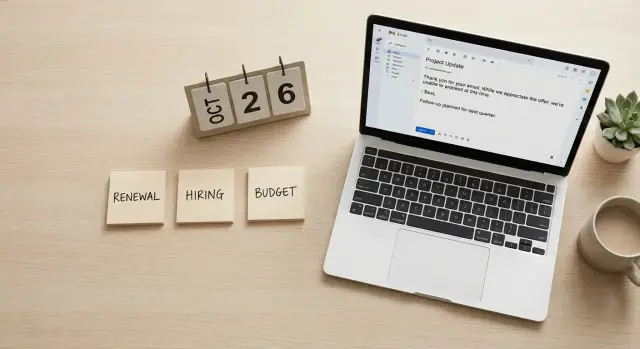
When a ‘no’ really means ‘not now’
A lot of “no” replies aren’t a rejection of you or your offer. They’re a rejection of the timing. Someone is busy, locked into a contract, waiting on budget approval, or simply not ready to change anything this month.
A follow-up plan after a no should treat that reply as information, not a dead end. The goal is to learn what would need to change for the answer to change.
A timing signal is any real-world event that makes your message relevant again. It’s a trigger you can watch for, like a contract renewal window, a new hire starting, a budget reset, a product launch, or a new initiative being announced.
Respectful follow-up isn’t pressure. It’s the opposite: you stop pushing now, and you ask for permission to reconnect when it will actually help. That keeps you from sending random “just checking in” notes that feel spammy.
After a “not now,” you’re trying to capture three things: the blocker (what’s stopping this today), the trigger (what changes later), and a check-in point you both agree on.
A simple example: an SDR hears “We’re covered until our renewal in September.” The best next step isn’t a pitch. It’s: “Got it. Want me to reach out 45 days before renewal, so you have time to compare options?”
Capture the reason and the next trigger
A “no” is only useful if you know what kind of “no” it is. Most aren’t rejection. They’re timing problems: budget is locked, priorities shifted, a vendor contract is still active, or the team is too busy to take on something new.
When you hear “not now,” don’t guess. Ask one calm question that’s easy to answer:
“Totally fair. What would need to change for this to be worth revisiting - timing, budget, a contract ending, or something else?”
That does two jobs: it captures the real reason (not the polite one), and it points to a trigger you can track. If they answer “we’re tied up until Q3” or “our current contract renews in November,” you just got a window, not a dead end.
Write the basics down right away so your follow-up plan doesn’t rely on memory:
- Who said no (and whether they’re the decision-maker)
- The reason (in their words)
- The trigger (what changes, and when)
- Any constraints (budget cap, required feature, internal approval)
- The next agreed step (permission to check back, plus the month)
A quick tag system helps later. Keep it simple and use one main tag per no: Timing, Budget, Contract, Staffing, or Priority shift.
Example: you hear, “We like it, but we just hired two reps and onboarding is chaos.” Tag it Staffing, note “revisit after onboarding, mid-March,” and set a reminder.
Timing signals that can turn ‘no’ into ‘yes’
The easiest way to build a follow-up plan after a no is to anchor it to a real event on their side, not your calendar.
Signals worth tracking
A few triggers reliably reopen conversations because priorities can change fast:
- Contract renewal windows: Attention spikes 60-120 days before renewal (and again when notice periods kick in).
- Hiring and team changes: New roles, backfills, a new VP, or expansion often brings new targets and new processes.
- Budget cycles and resets: Planning season, quarterly refreshes, and end-of-quarter spend can create a short window for “nice to have” purchases.
- Org or market moves: Mergers, product launches, and new regions create new workflows and urgency.
- Operational pain spikes: If they mentioned missed pipeline, slow response times, or backlogs, the moment that pain gets worse is often when they’re open to change.
Don’t leave the timing vague. Get one concrete detail before you step away.
Example: a Head of Sales says no because they’re locked into another outbound tool. If you learn their contract renews in September and they need 30 days’ notice, your best re-entry is early July with a short note that respects that window.
Questions that uncover timing without pressure:
- “When do you typically review this - quarterly or around renewal?”
- “Are you tied to a contract, and if so, what’s the renewal month?”
- “Any hiring planned for the team this quarter?”
- “When do budgets usually get finalized?”
- “What would need to change for this to be worth revisiting?”
How to use signals without being creepy
Signals only help if the other person feels respected. The goal is to be relevant, not to prove you have “intel.”
The safest signals are the ones they gave you directly. If they said, “We’re locked into a vendor until Q3,” that’s your timing signal. It’s specific, and it came from them.
Generally safe sources:
- What they told you (timing, blockers, decision process)
- Your past notes (who attended, what mattered)
- Public company info (job posts, funding news, basic team changes)
- Your own campaign data (they replied, clicked, asked to pause)
- Clear business events (renewal month, annual budgeting)
What to avoid is anything that feels like surveillance or gets too personal. Even if it’s public, it can still read as unsettling when it’s too specific.
Skip things like:
- Mentioning exact activity (“saw you viewed...”)
- Personal details (family, location, non-work posts)
- Listing multiple “signals” at once to sound certain
- Guessing internal problems (“your pipeline must be struggling”)
- Adding urgency after they already said no
The simplest way to stay on the right side of this is to ask for permission while the conversation is still warm: “Mind if I check back in May, once budgeting opens?” If they say yes, you now have consent and a clear anchor.
Also, lock in something specific. “Next quarter” is easy to ignore. A month is easier to accept and easier for you to execute: “I’ll reach out the first week of May. If timing changes before then, just reply ‘pause’ and I’ll stop.”
Step-by-step: build your follow-up plan
A “no” is useful only if you turn it into a clear next action. A good follow-up plan after a no does two things: it respects the boundary, and it locks in the next moment when “yes” is more likely.
A simple 5-step process
-
Confirm you heard them. One calm line that restates the decision and the reason.
-
Ask one timing question. Not three. Pick the most likely trigger: renewal, budget window, or hiring plan.
-
Offer a specific check-in. Suggest one date or one week. If they accept, you’ve earned the follow-up.
-
Plan a few light touches before then. Two to four is plenty. Each touch should teach something small or make a decision easier.
-
Stop when they draw a line. If they say “not this year” or “please don’t follow up,” acknowledge it and close the loop.
Light touches that usually feel helpful:
- A one-sentence insight you noticed
- A short resource (checklist, sample email, 2-line framework)
- A quick risk-reducer (“Is security review a blocker, or just timing?”)
- A small update only if it matters (“We now support X, in case that was the gap”)
Simple follow-up timelines that fit each trigger
A follow-up plan after a no works best when it matches the reason they said no. Keep it light most of the time, then get more direct as the trigger gets close.
Three timelines to use
- Renewal-driven: Light touch every 6-8 weeks, then every 2 weeks starting 6-8 weeks before renewal.
- Budget-driven: Monthly in quiet months, then every 2-3 weeks in the 4-6 weeks before budgets reopen.
- Hiring-driven: Every 6-8 weeks until a hiring signal appears, then follow up within 7-10 days and again 2 weeks later.
Spacing is what keeps you from becoming noise. Most touches should feel like a helpful reminder, not a push.
What changes as you get closer to the trigger
Far from the trigger, stay low-pressure: one insight, one question, and an easy opt-out.
Near the trigger, get more specific: “Want to pencil 15 minutes next week to see if this is worth revisiting before renewal?” Reference what they told you last time so it feels earned.
Re-engage sooner only when something changes:
- They reply with a question or ask for pricing
- A major shift happens (new boss, new product launch, team change)
- You can tie your note to a real event (renewal date moved, budget unlocked)
- They start engaging again (replies, referrals)
- You have a concrete improvement since last time
Message templates you can adapt (without sounding salesy)
A good follow-up email is simple and easy to answer. A practical structure is: 1 line of context, 1 line naming the timing signal, 1 question, and 1 low-friction CTA.
Keep the earlier “no” short and respectful. One clause is enough. Don’t re-argue. You’re checking whether timing changed.
Low-pressure CTAs that feel natural:
- “Worth revisiting in March?”
- “Who owns renewals on your side?”
- “Want a 5-minute sanity check?”
- “Should I close the loop until Q2?”
- “Open to a quick update, or should I stop reaching out?”
Copy-and-paste templates
Subject: Quick timing check

Hi {{FirstName}} - last time we spoke, you said {{reason_for_no}}.

Noticed {{signal}} (e.g., hiring for SDRs / renewal window / new budget).

Has the timing changed, or is it still a “not now”?

If helpful, worth revisiting in {{month}}?
Subject: Who owns renewals?

Hi {{FirstName}} - you mentioned you were locked into {{current_tool}} until renewal.

Is renewal handled by you, or someone else?

If it’s you, do you want a quick 5-minute check to see if anything should be tested before renewal?
Subject: Should I pause?

Hi {{FirstName}} - totally fair that this wasn’t a priority then.

I saw {{signal}} and wanted to ask one quick question:
Is this worth reopening, or should I close the loop until {{quarter}}?

Either answer is helpful.
Proof points: when to add one (and when not to)
If the prospect already knows you, keep it clean and skip proof. Add one small proof point only when it reduces risk fast (deliverability, time saved, fewer tools). If they clearly said “no budget” or “no priority,” leave proof out and focus on timing.
Example: a contract renewal ‘no’ that becomes a warm conversation
A prospect replies, “Thanks, but we’re locked into our current provider until Q3.” This is a “not now,” and it’s ideal because the next decision window is predictable.
Right after the call or email, capture details while they’re fresh:
- Renewal month (and key dates, like procurement deadlines)
- Who owns the decision (and who influences it)
- Why they might switch (success criteria)
- What they dislike today (pain points or gaps)
- Permission level (did they invite a follow-up, or did you propose it?)
Then run a simple three-touch sequence that respects their calendar:
- Touch 1 (soon): “Totally makes sense. I’ve noted Q3. Want me to check back in early June so you’re not rushed?”
- Touch 2 (midway): “You mentioned reporting was a headache. Here are 3 questions teams use to compare providers before renewal.”
- Touch 3 (pre-renewal): “Are you already reviewing options for the Q3 renewal, or does that start next month? If it’s starting, who’s best to include?”
A good “yes” here is rarely “buy now.” It’s usually a small commitment: a 15-minute call to map requirements, an intro to the person running renewal, or a request to see a trial or sample plan.
Common mistakes that make ‘no’ permanent
Most “no” responses turn permanent because the follow-up feels careless, not because timing will never work. This is less about persistence and more about precision.
One common error is following up on autopilot. If someone said “not this quarter” and you email again next week, you signal you didn’t listen. The same happens when you send the exact same “just checking in” note again and again.
Another mistake is asking for a meeting every single time. When timing is wrong, a meeting is a big ask. A smaller step (one question, a quick confirmation, or permission to reach out at a specific time) keeps the door open.
Patterns that usually kill re-engagement:
- You reappear too fast, too often, with no new reason to talk
- Every message pushes a call instead of a tiny next step
- You ignore their reason and send generic updates that could go to anyone
- You never lock in the who and the when (owner, renewal month, budget cycle, hiring date)
- You keep emailing after an opt-out, unsubscribe, or clear “stop”
Example: a prospect says, “We just renewed with our current vendor.” If you respond with “Want to jump on a quick call anyway?” you’ll likely get silence. If you respond with “Got it. When does renewal come up again, and who owns that decision?” you can set a clean reminder.
Honor negative replies. If someone opts out, stop. If they say “reach out in May,” do that, and only that.
Quick checklist before you hit send
Before you send another follow-up, take two minutes to make sure your message is timely, simple, and easy to answer.
- Write the “no” in their words. If you can’t summarize it in one sentence, your next email will sound generic.
- Tie the next touch to a real window. Pick a month or quarter that matches a trigger.
- Confirm the right person (plus one backup). Decision-maker, user, procurement: know who’s who.
- Ask one clear question. Aim for a 10-second reply: yes/no, a date, or the right owner.
- Set a stop point. Decide how many attempts you’ll make around the trigger, then pause.
Schedule the next touch as soon as you get the “no,” while the timing is fresh.
Next steps: make this process repeatable
A follow-up plan after a no isn’t a one-off reminder. It’s a small system you can run every week so the right check-in happens when timing changes.
Start a re-engagement backlog: one line per person, with the trigger you’re waiting for and the date you’ll reach out.
Then batch it. Block 20 minutes once a week to review what’s due, send those messages, and move dates forward.
If you want to keep this organized across a team, having one place to manage domains, mailboxes, warm-up, sequences, and reply sorting can help. LeadTrain (leadtrain.app) is built for that kind of workflow, especially when you’re tracking “not now” leads by renewal, budget, or hiring signals.
Pick one habit to start today: choose one “no” you received this week, write down the most likely trigger, and set a check-in date. When that day arrives, send a short note that references what they said and asks if timing changed.
FAQ
What should I do right after someone replies “not now”?
Treat it as timing information, not a personal rejection. Reply once to confirm you heard them, ask what would need to change to revisit, and then agree on a specific month to check back so you’re not sending random “just checking in” notes.
What’s the best question to ask after a “no” without sounding pushy?
Ask one calm, easy question that gives them options. For example: “What would need to change for this to be worth revisiting—timing, budget, a contract ending, or something else?” That usually reveals the real blocker and the trigger you can follow.
What exactly is a “timing signal”?
A timing signal is a real event on their side that makes your message relevant again, like a contract renewal window, a budget reset, a new hire starting, or a new initiative. Your follow-up should be anchored to that event instead of your own calendar.
How do I turn a vague “maybe next quarter” into a real follow-up plan?
Push for one concrete detail and turn it into a date. If they say “Q3,” ask which month in Q3 they review it, and whether you should reach out a set number of days before that so they have time to compare options.
Is it okay to use hiring news or other public signals to follow up?
Yes, but do it with care and keep it simple. Use signals they told you directly first, and if you use public info like job posts or team changes, mention it lightly and focus on why you’re reaching out now, not on proving what you know.
How do I get permission to follow up so I don’t feel spammy?
Ask for permission while the conversation is still warm, and propose a specific check-in. A line like “Mind if I reach out the first week of May when budgeting opens?” makes the follow-up feel respectful and expected.
How often should I follow up after a “no”?
Fewer than you think. If there’s no new trigger, keep it quiet; one lightweight touch every 6–8 weeks is often enough, and then you can be a bit more direct in the 6–8 weeks leading up to a renewal or budget window.
What should I say in the follow-up email if timing might have changed?
Keep it small and easy to answer. A quick timing check, one helpful insight, or one question about who owns renewals works better than asking for a meeting every time, especially when they already said timing is the issue.
What are the biggest mistakes that turn “not now” into “never”?
Re-arguing the pitch, following up too soon, and sending generic “checking in” messages are the big ones. Another common mistake is ignoring a clear boundary; if they say “not this year” or “please stop,” close the loop and don’t keep nudging.
How can I keep track of “not now” leads so I actually follow up at the right time?
Log the reason in their words, the trigger you’re waiting for, the agreed check-in month, and who owns the decision. Tools like LeadTrain can help you keep those notes tied to sequences and automatically sort replies, so “not now” leads don’t get lost or mishandled.