Design partner outreach that turns feedback calls into paid pilots
Design partner outreach that turns feedback calls into paid pilots, with practical email templates and a simple agreement structure that reduces back-and-forth.
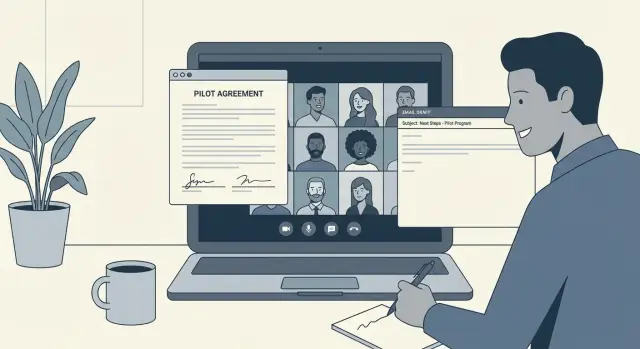
Why feedback calls rarely turn into paid pilots
A design partner is a real customer you build with, not just someone who shares opinions. They have a clear problem, budget (or a realistic path to budget), and enough urgency to try something new. In return for early access and influence, they agree to give structured feedback and help you validate results.
A design partner is not a friendly expert chat, a casual adviser, or someone looking for free consulting. If they can’t run the solution in day-to-day work (or can’t get approval to try), the conversation can still be useful, but it rarely becomes a paid pilot.
Most feedback calls stall after a “great chat” for one reason: there’s no next step that feels safe and specific. The call ends with vague goodwill, but no scope, timeline, price, or owner. A week later, everyone is back to their real priorities.
Other common stall points:
- The ask is too big (buy the full product) when they only want to test.
- The pilot is too fuzzy (no success metrics), so internal approval feels risky.
- You’re talking to people who like discussing problems but don’t own outcomes.
- The “pilot” is really unpaid implementation work, so it gets deprioritized.
A paid pilot makes sense when there’s real work involved and real value at stake. If you need setup, access, support, or meaningful time from your team, getting paid is reasonable. It also creates commitment on the customer side, which is often what turns a conversation into action.
Free feedback can be right when you’re very early, the product isn’t usable yet, or you’re testing direction. But once you can deliver a small, clear outcome in a short window (often 2 to 4 weeks), a paid pilot is usually the cleaner path.
Set up your pilot offer before you email anyone
If you start design partner outreach without a clear pilot offer, most replies will stay stuck at “happy to chat.” Do the prep first so your emails can point to something specific that feels low-risk and easy to say yes to.
Start with a tight target profile and a problem they already feel. “Anyone who could use this” isn’t a profile. Pick a role, a company type, and a moment of pain they can recognize in one line. The best pilot prospects already have a workaround, a budget line, or a visible cost when things go wrong.
Next, choose one narrow use case you can prove fast. A pilot is not a full rollout. It’s one repeatable workflow with one measurable outcome. If you’re tempted to include three departments, pause. You want a simple before-and-after you can summarize in a short recap.
Before you send the first email, decide:
- Who it’s for (role, company type, and the “when” of the pain)
- What you’ll test (one use case, not the whole product)
- What success means (time saved, revenue created, or risk reduced)
- How long it runs and what it takes (2 to 6 weeks, and who does what)
- Your one-sentence pilot promise (clear, realistic, measurable)
Keep the effort small and explicit. For example: one 45-minute kickoff, 15 minutes a week from an owner, and access to specific data. When this is clear, prospects can say yes without a long internal debate.
A simple promise helps you stay honest and makes follow-ups easier. Example: “In 4 weeks, we’ll cut manual lead follow-up time by 30% for your SDR team.” Only promise what you can actually influence.
Finally, decide what the pilot costs. Free pilots often attract people who won’t implement. A small paid pilot signals commitment and gives you room to support them properly. Even a modest fee can turn “interesting” into “let’s schedule the kickoff.”
Build a small list of the right design partners
Good design partner outreach starts with people who can feel the problem and say yes to a pilot.
Most pilots need two roles:
- The operator is the day-to-day user. They can show you what’s broken and what “better” looks like in real work.
- The executive sponsor owns budget or priority. They can unblock reviews and convert a pilot into a longer-term deal.
Start close to home, then widen:
- Past customers or churned accounts with the exact pain
- Your waitlist and inbound demo requests
- Referrals from friends, advisors, and investors (ask for 2 intros, not 20)
- Niche communities where operators hang out (job-specific, not generic)
- Tools you already use: teams that integrate with you, or compete with manual work
For a first batch, keep it small enough to handle with care. If your offer is strong, you don’t need hundreds.
A practical starting point is 20 to 30 contacts total, aiming for 8 to 12 conversations and 2 to 4 pilots. If you don’t yet have proof, lean into effort instead of hype: offer manual setup, concierge onboarding, or a lightweight prototype that shows the workflow. Even one clear, true result helps.
Tracking should be boring and obvious. A simple sheet or basic CRM is enough if you update it daily. Capture only what you’ll use:
- Contact, role (operator or sponsor), and company size
- Current tool or workaround
- Status (not contacted, contacted, call booked, proposal sent, pilot live)
- Next step date (the field that matters most)
- Notes: the one pain they care about most
Email templates for design partner outreach (copy and send)
Good design partner outreach sounds like one person to another. The goal is simple: earn a short call with the right buyer, then make a pilot the obvious next step.
Subject lines that feel human and specific:
- Quick question about [their workflow] at [Company]
- Worth a 15-min chat about [pain]?
- Saw [specific trigger] - curious how you handle [problem]
- Idea to reduce [manual step] for [team]
- Can I sanity-check something with you?
Keep the first email short: one clear problem, one credible reason you picked them, one easy ask.
Subject: Saw [specific trigger] - curious how you handle [problem]

Hi [Name] -

I noticed [2-6 word observation about their company/team]. Quick question: how are you handling [specific pain] today?

I’m building [product category] for [role] to help with [outcome]. I’m looking for 2-3 teams to give blunt feedback, and if it’s a fit we can run a small paid pilot (so you get real work done, not just a call).

Open to a 15-minute chat next week? If yes, what’s better: Tue or Thu?

Thanks,
[Your name]
[Role]
Your follow-up should add value, not pressure. Bring a small insight, a quick example, or a simple option.
Subject: Re: [original subject]

Hi [Name] -

One thing I’ve seen with [role/team] is [short insight]. If that’s true for you, a pilot usually looks like:

- 2 weeks
- one clear metric (ex: [metric])
- a weekly 20-min check-in

If you’re not the right person, who owns [area] on your side?

Best,
[Your name]
If there’s still no reply, send a clean breakup that keeps the door open.
Subject: Should I close the loop?

Hi [Name] -

I haven’t heard back, so I’ll assume this isn’t a priority right now.

If it becomes relevant later, I’m happy to share what we’re seeing across other teams dealing with [pain]. Want me to check back in a month or two?

Thanks,
[Your name]
Personalization works best when it’s light and real. Use one or two details, not a biography: a trigger (hiring, new tool, product launch), a specific pain guess tied to that trigger, and one role-specific outcome (time saved, fewer errors, faster follow-up). End with a simple ask (15 minutes and two time options).
Run the feedback call so it can naturally lead to a pilot
A feedback call turns into a pilot when you treat it like a working session, not a casual chat. Keep it tight, keep it specific, and leave with a decision and a date.
A simple 30-minute flow:
- 0-3 min: Confirm their role, their goal for the call, and what “better” would look like.
- 3-12 min: Walk through their current process (tools, steps, handoffs).
- 12-20 min: Zoom in on the painful moment (time lost, missed revenue, risk, stress).
- 20-26 min: Share a short “how we’d help” summary and check for fit.
- 26-30 min: Propose the pilot and lock the next step on the calendar.
To find urgency and budget without sounding pushy, ask about constraints and recent decisions. Keep your tone curious, like you’re trying to rule things out.
Questions that surface the truth:
- “When did this become a problem worth fixing?”
- “What happens if you do nothing for the next 60 days?”
- “What are you doing today as a workaround?”
- “Who feels the pain most, and who signs off on changes?”
- “Have you already paid for something in this area? What did you like or hate about it?”
Confirm fit by repeating what you heard and asking for a correction. Example: “It sounds like speed matters more than extra features, and the main cost is your team’s time. Is that accurate?” If they correct you, that’s good. It means they’re engaged.
Introduce the pilot right after they agree the problem is real and the status quo isn’t working. Keep it small and concrete: “If you’re open to it, the next step is a paid pilot. Two weeks, one team, one success metric. You get a working setup and results. We get a real-world case and feedback.” Then pause.
End with a clear next step and timeline: schedule a pilot scoping call in the next 48 hours, or agree they’ll loop in the decision-maker. Before you hang up, restate the plan in one sentence and who does what by when.
Turn interest into a clear paid pilot proposal
When someone says, “This sounds interesting,” move fast while the context is fresh. A good paid pilot proposal is short, specific, and easy to approve. It should feel like the next step after the call, not a whole new project.
A flat fee is easiest because it maps to a clear scope and timeline. If you’re worried about pushback, offer a credit toward the future plan: “Pay $X for the pilot, and we’ll apply it to your first invoice if you continue.” That frames the fee as commitment.
Make it obvious what they’re buying. The pilot price should include the things that usually eat time and cause disappointment later: setup, a bit of support, and a simple reporting rhythm. For example: you do onboarding and configuration, you give light guidance during week one, and you share a short results summary at the end.
Procurement fear is real, so keep it small and time-boxed. Instead of an open-ended “trial,” propose 2 to 4 weeks with a capped fee, a clear start date, and one success metric. A manager can often approve that with an email, even if larger deals require paperwork.
If choices help them decide, offer three options that differ only in scope:
- Light: shortest timeline, minimal setup
- Standard: full setup, weekly check-ins, end-of-pilot summary
- Full: standard plus training for a wider team and a deeper report
A simple line that works: “The fee is there so we both prioritize it. If we don’t hit the goal we agree on, we’ll either extend one more week at no cost or stop and share what we learned.”
A simple pilot agreement structure that reduces friction
A paid pilot dies when the paperwork feels bigger than the work. The fastest path is a one-page agreement that answers the buyer’s real questions: what are we trying to prove, what will it take, what does it cost, and what happens if we stop.
Keep the tone plain. If someone needs their lawyer to translate it, you’ll lose momentum.
The 1 page pilot agreement (what to include)
Keep each section to a few lines:
- Parties and point of contact: who is signing, and who runs the pilot day to day.
- Goal and timeline: the outcome you’re testing and the start and end dates.
- Fee and payment terms: the price, when it’s due, and what it covers.
- Responsibilities: what you provide, what the customer provides, and the time needed from their team.
- Success criteria and deliverables: how you’ll measure progress and what they get at the end.
Scope, data, IP, and exit terms (simple, fair defaults)
Scope should read like a checklist, not a wishlist. One sentence that prevents drift: “Anything not listed here is out of scope unless we both agree in writing.”
Write success criteria in plain language and tie it to a baseline. Example: “Within 14 days, confirm we can produce 20 qualified replies from a list of 500 contacts, using the customer’s offer and targeting.” If your pilot involves cold email, say exactly what you’ll configure and what the customer must supply.
For data access and confidentiality, keep it light:
- You’ll only use customer data to run the pilot.
- You won’t share it outside your team.
- The customer can ask you to delete data after the pilot.
On IP and usage rights, avoid aggressive grabs. A fair default is: they own their data and content, you keep your pre-existing product and templates, and you can reference anonymized learnings unless they say no.
Exit terms should be predictable. “Cancel anytime with written notice” is usually enough. State what happens to the fee (commonly non-refundable once work starts, or prorated by week), and what deliverables they still receive (for example, a short results summary and recommendations). That makes saying yes feel safer.
Common traps that slow or kill paid pilots
Paid pilots usually fail for boring reasons, not because the product is bad. Most stalls come from unclear expectations, internal politics, or paperwork that feels risky.
1) Vague success metrics
If you and the buyer don’t agree on what “working” means, you’ll argue later about whether the pilot should expand. Keep metrics simple and measurable. Tie them to a business outcome, not a feature checklist.
A good rule: pick 1 to 2 primary outcomes and one clear measurement window (for example, “within 30 days”).
2) Over-customizing before the pilot starts
It’s tempting to promise “we’ll build whatever you need” to win the pilot. That turns the pilot into a mini consulting project. Delivery slips, the buyer loses urgency, and you end up with a one-off feature that doesn’t help your roadmap.
If you need customization, limit it to configuration and light integration work, with a cap on hours and a clear definition of done.
3) Pulling in too many stakeholders too early
Founders often ask for a big meeting so everyone feels bought in. The opposite happens: the meeting becomes a debate, and no one owns the next step.
Start with one sponsor and one day-to-day user. Expand only after the pilot goals and plan are agreed.
4) A free pilot with no decision date or sponsor
Free pilots can work, but only if there’s a real owner and a deadline. Without a sponsor, the pilot becomes “nice to have” and drifts.
Make sure there’s a decision date and a clear next step, such as “convert to paid rollout,” “pause,” or “stop.”
5) Long legal docs that trigger delays
If you send a full master services agreement for a small pilot, you invite procurement, security, and legal to slow everything down. Keep the pilot agreement short and focused on risk basics.
Anti-stall checklist:
- Define success metrics and how you’ll measure them.
- Limit scope and customization (and write the limit down).
- Name the sponsor and set a decision date.
- Keep paperwork short (pilot terms first, big contract later).
- Agree on who does what, and by when.
Example: You run a feedback call with an SDR manager who likes the idea but says, “Let me loop in my boss and legal.” Instead of sending a long contract, propose a 14-day paid pilot with two outcomes (reply rate improvement and time saved), one sponsor, and a one-page pilot terms doc. The boss can say yes quickly, and legal has less to review.
Example: from first email to a signed pilot in 2 weeks
A small B2B SaaS team built a tool that flags renewal risk for customer success managers. Their ideal design partner was a 50 to 200 person SaaS company with a CS team drowning in spreadsheets and “who should I call today?” guesswork.
They picked 18 targets and ran a short outreach sequence. The first message was plain and specific:
Subject: Quick question about renewal risk

Hi Maya - I’m building a simple way for CS teams to spot accounts at risk 30-60 days earlier.

If you’re open to a 20-minute call, I’ll share what we’re seeing, and I’d like to learn how you do this today.

If it’s a fit, I’m offering a 2-week paid pilot with a clear outcome: a weekly list of at-risk accounts + why.

Worth a quick chat?
- Alex
On the call, urgency showed up fast. Maya said they had missed renewals last quarter, their VP asked for a weekly risk report, and two CSMs were spending 3 to 4 hours every Friday building it. The key signal: they already had a deadline and an internal owner.
The pilot offer they accepted was simple: connect to their CRM export, generate a weekly risk list for 25 accounts, and run one review meeting per week. Timeline: 2 weeks. Fee: $2,500, credited toward the first 3 months if they continued.
Delivery stayed tight:
- Week 1 (Days 1-3): confirm success criteria, get data export, map fields, set baseline (last 60 days churn/renewals)
- Week 1 (Days 4-5): first risk list with 3 reasons per account, plus “what to do next” notes
- Week 2 (Days 6-9): refine reasons based on CS feedback, remove noisy signals, add one “health trend” view
- Week 2 (Days 10-14): final report, simple playbook, decision meeting with VP and CS lead
By day 14 they had caught 4 accounts that needed action, and the VP asked to expand from 25 to 120 accounts. They renewed into a 3-month paid rollout, and the SaaS team learned two things: the reasons mattered more than the score, and Friday morning delivery fit CS routines best.
Quick checks and next steps to run this smoothly
Make the “yes” easy. When someone replies with interest, you should be able to book the call, share a one-page pilot outline, and send simple pilot terms the same day.
Gut-check before you hit send:
- Pilot offer is clear: problem, scope, timeline, price, and what “done” means.
- Target list is tight: same job, same pain, and a realistic reason to care now.
- Email templates are ready: first note, bump, and a short “closing the loop” message.
- Call agenda is written and time-boxed.
- Agreement structure is ready: term, fee, confidentiality, data access, exit clause.
Prep the boring stuff once, so you don’t stall later. Block two outreach windows per week, keep a simple tracker (company, owner, status, last touch, next step), and pre-write your pilot one-pager so you can personalize it in minutes.
Follow-up is where most pilots are won, but it should feel respectful. A simple cadence:
- Day 2: quick bump with one sentence and a question
- Day 5: add a specific pilot outcome
- Day 9: share a simple choice (15-min fit check vs. direct pilot quote)
- Day 14: “should I close this?” message
- Day 21: final note, then stop
Keep deliverability healthy or your best message won’t land. Use a dedicated sending domain, set up SPF/DKIM/DMARC, warm up new mailboxes, and cap daily sends while you learn what your audience responds to.
If cold email is part of your pilot motion, it helps to run the operational pieces in one place. LeadTrain (leadtrain.app) combines domains, mailboxes, warm-up, multi-step sequences, and reply classification, so you spend less time managing tools and more time talking to the right design partners.