Build a customer advisory list from outbound replies
Learn how to build a customer advisory list from outbound replies and turn "not now" or "curious" into quarterly feedback calls with clear outcomes.
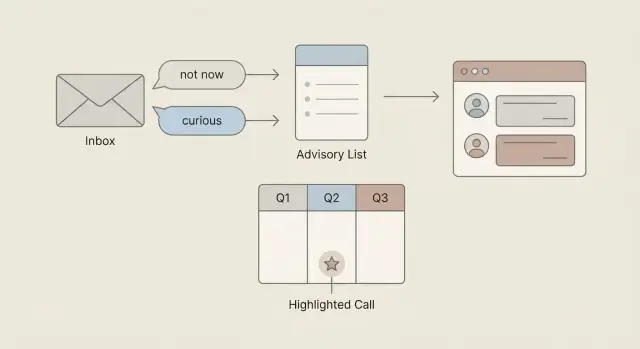
What a customer advisory list is (and why replies matter)
A customer advisory list is a small, permission-based group of people who agree to share honest feedback from time to time. They’re not prospects you keep chasing. They’re contacts you can ask for a quick perspective when you’re deciding what to build, how to position it, or why deals stall.
The easiest way to start is with people who already replied to you. A reply, even a short one, is proof of attention. It also signals the topic matters to them, which makes it a much better starting point than a cold survey request.
Outbound replies are often more useful than surveys because they happen in the moment. People respond while they’re busy, so they default to the real reason: timing, budget, priorities, internal politics, or a specific objection. Surveys invite polite, broad answers that are hard to act on.
The strongest advisory lists tend to start from two kinds of replies:
- “Not now” (they have the problem, timing is wrong)
- “Curious” (they want to understand, compare, or sanity-check)
Turn those into short quarterly feedback calls and you’ll get input that’s hard to find anywhere else: what buyers truly care about, the exact words they use, the objections that show up repeatedly, and early reactions to new ideas before you spend weeks building.
This works well for founders, SDRs, and small sales teams because you don’t need a formal customer advisory board. Ten to twenty advisory contacts is enough to keep you grounded.
Example: you email a head of operations and they reply, “We tried something like this last year. Might revisit in Q2. What makes you different?” That isn’t a dead lead. It’s an invitation to follow up later and a strong candidate for a 15 to 20 minute feedback chat.
If you use a platform that classifies replies (interested, not interested, out-of-office, bounce, unsubscribe), it’s easier to spot “not now” and “curious” responses before they get buried. LeadTrain does this kind of reply classification, so you can quickly route the right conversations into an advisory track instead of losing them in the inbox.
Pick the right replies to add to your advisory list
Not every reply belongs on an advisory list. You’re looking for people who are open to a future conversation and can teach you something useful, even if they’re not buying today.
Great candidates usually sound like they’re thinking out loud. They ask a question, mention a constraint, or share what they’re using now. Common examples:
- Curious: “Interesting, how does it work for teams like ours?”
- Not now: “We’re mid-project. Check back next quarter.”
- Using a competitor (or internal tool): “We already use X, but I’m not sure it covers Y.”
- Needs clarity: “Is this for sales teams or marketing?”
- Gives context: “We tried outbound before, deliverability was the issue.”
A simple rule: if their message includes real details (timing, tools, constraints, goals), they’re probably worth adding.
Protect trust. Some replies should never go into an advisory list because reaching out again will feel intrusive or risky:
- Angry or insulting replies
- Legal or compliance warnings (for example, “Do not contact us again”)
- Spam complaints or threats to report
- Unsubscribe requests
- Clearly mis-targeted replies (wrong country, role, or industry)
If you’re unsure, leave them out. An advisory list is a privilege, not a backup lead list.
Quick criteria (use all three)
Keep selection simple. Add someone only if they:
-
Match your ICP well enough (role, company type, problem area)
-
Wrote a thoughtful reply (not a one-word brush-off)
-
Shared specific context you can ask about later
If you use a tool that classifies replies, start with “curious” and “not now,” then scan for the most detailed messages.
How many people you need to start
Small is fine. Aim for 10 to 20 contacts. From that, you can often get 3 to 5 quarterly calls, which is plenty of signal to spot patterns. As you run calls, replace people who go quiet with new “curious” and “not now” replies so the list stays fresh.
Set up simple tagging so nothing gets lost
When replies start coming in, the fastest way to waste them is to treat your inbox like a to-do list. A simple tagging habit turns “not now” into a clear follow-up date, and “curious” into someone you can invite to quarterly feedback calls.
Keep your tags few and predictable. For most teams, five is plenty:
- Curious
- Not now
- Referral
- Too expensive
- Wrong person
Tags alone aren’t enough. The real value is capturing the “why” in one plain sentence. Think timing (“revisit after Q2 planning”), budget cycle (“new budget in September”), or priorities (“focused on hiring, not tools”). If you can’t summarize the reason in one sentence, you don’t understand it yet.
Add one date field you trust. Not “follow up soon,” but a real month or quarter. Pick the next contact date while the context is fresh, and make it sortable later (for example: 2026-04-01 for “early April”).
Finally, track consent. There’s a big difference between “check back later” and “yes, you can reach out for feedback calls.” Keep it as a simple yes/no field, plus a short note like “ok to email about quarterly feedback.”
A compact record for each advisory-ready reply (spreadsheet, CRM, or outbound tool notes) looks like this:
- Tag
- Why (one sentence)
- Next contact date (month/quarter)
- Consent for feedback calls (yes/no)
- Source context (one short note)
Example: someone replies, “Interesting, but we’re locked until next quarter. Can you remind me in May?” Tag it Not now, write “locked until next quarter, revisit in May,” set a May date, and keep consent as “no” unless they explicitly agree to feedback calls.
If you use LeadTrain, reply classification can help you sort quickly. Still, the human part matters: add the one-sentence “why” and the next date so the contact doesn’t disappear into a generic bucket.
Step by step: turn a reply into an advisory contact
When someone replies with “not now,” “curious,” or “maybe later,” you already have the hardest part: attention. The goal now is to turn that moment into a clear timeline and permission to reach out again, without pushing for a sale.
Here’s a simple flow you can use for soft-positive replies:
-
Translate “not now” into a date. Ask: “Totally fair. When would it make sense for me to follow up, roughly? Next month, next quarter, or later?”
-
Ask one clarifying question (only one). Pick the smallest question that helps you understand fit. Examples: “Are you mainly trying to solve deliverability, finding leads, or getting more replies?” or “Is this for you personally or a small team?”
-
Offer two low-pressure options. For example: “If it’s easier, we can do a quick 15-minute chat this week. Or I can add you to a small quarterly feedback list where I reach out for a short call every few months.”
-
Get clear permission for feedback outreach. Keep it explicit: “Are you ok if I contact you for a quarterly 15 to 20 minute feedback call?”
-
Save their exact words. Copy the phrases they used into your notes. Later, you can mirror them back: “Last time you said you were busy until after the launch. Is now better?”
A realistic reply you can send:
“Thanks - makes sense. When should I follow up, roughly? Also, quick question: are you more focused on getting better replies or improving deliverability? If you prefer, we can either do 15 minutes now, or I can add you to a small quarterly feedback list (short calls, no sales pitch). Are you ok with that?”
If your tool separates interested, not interested, out-of-office, bounces, and unsubscribes, you can act faster on the handful of replies that are actually worth a second conversation.
A practical invite message you can reuse
Your invite should feel like a small favor, not a trap. Keep it personal, specific, and easy to say yes or no.
A few neutral subject lines:
- Quick question (15 min)
- Can I get your take?
- Your honest feedback?
Use this template and swap in the bracketed parts:
Subject: Can I get your take?

Hi [First name] - thanks for getting back to me.

I’m not trying to sell you anything. I’m building a small “advisory” list of people who are close to [their role/problem], so we can sanity-check our messaging and product direction.

Would you be open to a quick 15-20 minute call? No prep needed. I’ll ask 5-6 questions, and that’s it.

If yes, would either of these work?
- Tue 11:00-13:00 [their time zone]
- Thu 15:00-17:00 [their time zone]

If not, no worries at all - just tell me what timing is better (or “not a fit”).

As a small thank-you, I can [share the notes / send a $20 gift card / donate $20 to a charity you pick].

Thanks,
[Your name]
[Company]
Keep the purpose to one sentence (feedback for messaging and direction), keep the time box tight (15 to 20 minutes), and offer two clear time windows so they can reply with “Tuesday works.” If you mention a thank-you, keep it modest and optional.
How to run a quarterly feedback call in 20 minutes
A 20 minute feedback call works best when it feels like a favor you’re asking, not a sales trap. Bring context fast, ask a few sharp questions, then leave them with a clean next step.
Start by reminding them what they replied to. Use one sentence that anchors the thread: what you sent, what they said, and why you’re calling now. Example: “You replied ‘curious, not this quarter’ to my note about outbound follow-up. I’m doing a quick 20 minute research call to learn what would make this useful when the timing is right.”
A simple 20 minute agenda
Keep the structure tight:
- 2 minutes: confirm context and the goal
- 12 minutes: guided questions (you talk less than half the time)
- 4 minutes: summarize what you heard in their words
- 2 minutes: agree on the next step and timing
Listen for exact phrases and write them down. Those phrases become strong copy later, and they help you segment future replies.
Five questions that get real answers
Ask these in plain language, and follow up with “tell me more” once:
- What made you reply or get interested in the first place?
- What is stopping you from acting right now?
- What are you using instead, or what did you try before?
- If this existed exactly how you want, what must it do?
- How do you decide and who else is involved?
Close with one clean next step. Don’t stack options. Pick one: a re-contact date (“Is it okay if I reach out the first week of April?”) or an intro (“Who’s the right person to sanity check this with?”).
Within 24 hours, send a short recap: three bullets of what you heard and the agreed next step. That recap builds trust and makes the next call feel natural instead of random.
Keep the list warm without turning it into a nurture spam chain
The easiest way to ruin an advisory list is to treat it like a newsletter. These people replied because they were honest. Keep that trust by contacting them rarely, with a clear reason, and by showing you used their input.
A practical approach is to keep the list bigger than you need and rotate who you invite each quarter. Show rates are usually lower than you hope, even with friendly contacts.
A realistic planning rule:
- Invite 12 to 20 people per quarter if you want 4 to 8 to show up
- Expect 25 to 40% to accept (higher if you keep the ask small)
- Expect 60 to 80% of accepters to attend
Rotation matters because goodwill is finite. If someone gave you thoughtful feedback once, don’t immediately ask again next quarter unless they asked to stay close. Splitting your list into three groups and cycling them usually works well.
For cadence, keep it boring and predictable:
- Quarterly: a short invite to a 20 minute feedback call
- Mid-quarter: one update with 2 to 3 bullets on what changed
- Once a year: ask if they still want to be on the list
That mid-quarter update is where you prove you listened. Keep it plain: “You mentioned X. We changed Y. If you want to sanity-check it, reply and I’ll share details.”
If someone becomes sales-ready during an advisory conversation, don’t pounce. Confirm intent: “Do you want to keep this as feedback, or would it be helpful to see how we handle it?” If they say yes, move them to a normal sales follow-up. If they say no, thank them and keep the call focused.
Example: from one outbound thread to a quarterly call
You send a short outbound note to 40 operations leaders with a simple ask: “Are you open to a 10-minute chat to see if this is relevant?” One thread gets three replies in the first day.
- “Curious. We’re exploring this, but we’re not ready to switch yet.” Best advisory candidate because there’s a real problem and a timeline.
- “Not now. Maybe next quarter after budget.” Useful, but treat it as timed follow-up, not a chase.
- “Out of office until next month.” Not advisory. It’s just a scheduling signal.
Tag each response based on intent, timing, and fit. In any system that lets you label replies, it can be as simple as a few tags and one note:
- Curious - advisory candidate (Q1 call)
- Not now - follow up next quarter
- Out of office - resurface on return date
A week later, you invite the “Curious” contact to a 20 minute feedback call. You make it clear it’s not a demo, and you ask questions that reveal what to fix in your message and your offer.
Questions that turn a chat into usable feedback
Ask 4 to 5 questions and write down the phrases they use:
- What made you reply instead of ignoring the email?
- What problem are you trying to solve right now?
- What would make this a “yes” in the next 90 days?
- What feels risky or annoying about changing tools?
- If you could wave a wand, what would the perfect setup look like?
You learn something concrete: they aren’t stuck on features. They’re stuck on deliverability fears and setup time. They also say your email sounded “like another outreach tool” and not “a way to stop inbox issues.”
How it changes your next outbound sequence
In your next sequence, you replace one generic line with something specific. For example, your first email leads with inbox placement and time to launch, and your follow-up addresses the fear: “What happens if deliverability drops?”
For next quarter, you record three things per advisory contact: their current stack, the trigger event that would make them act (budget window, hiring, new territory), and one quote you can reuse internally to sharpen copy. When the new quarter starts, don’t “check in.” Reference the trigger and ask for a quick reality check.
Common mistakes that kill response rates and trust
Most people who reply to outbound aren’t saying “yes” or “no.” They’re saying “not now,” “maybe,” or “tell me more.” Trust is the whole job, and one pushy follow-up can turn a useful contact into an unsubscribe.
The five mistakes that create friction
- Asking for a call before you understand the “why.” If someone says “not now,” start with one simple question like “What would have to change for this to be relevant?” Jumping straight to “Want to hop on a call?” sounds like you didn’t read their message.
- Turning the advisory call into a demo. The moment you start pitching, people feel tricked and stop replying. Keep the goal small: learn how they do the work today and what slows them down.
- No tagging means lost context. Without something like “curious,” “not now - Q3,” or “competitor contract until May,” you’ll follow up at the wrong time, with the wrong angle.
- Over-contacting “not now” replies. If they gave a window, respect it. Two helpful touches a quarter is plenty.
- Ignoring unsubscribe and negative signals. “Remove me” and “stop emailing” aren’t negotiation openings. Confirm removal and move on.
Quick example: a Head of Sales replies, “We just rolled out a new tool, maybe later.” The mistake is sending three follow-ups in two weeks and asking for 30 minutes. A better move is replying once with a single question about what success with the new tool looks like, tagging them “not now - tool rollout,” and setting a reminder for the month they mentioned.
If you’re using a system like LeadTrain (leadtrain.app), it’s worth making sure reply classification and your notes work together so “not now” doesn’t accidentally fall back into a generic sequence.
Quick checklist and next steps
Keep the goal small: a group of people who are willing to talk every quarter.
10-minute setup you can do today
Decide what counts as “advisory-worthy” before you send more outbound. A good rule is anyone who replied with “curious,” “maybe later,” “not now,” “send details,” or a thoughtful question.
Then set up a lightweight workflow:
- Define 3 to 5 tags and a clear rule for each
- Save two invite templates: one for Curious (offer a quick call), one for Not now (offer a later check-in)
- Pick the weeks you’ll run quarterly calls and set a simple goal (for example, 6 calls)
- Use a consistent notes format: best quotes, top pain points, what changed, and the next date
- Choose a single place for reply sorting and reminders so threads don’t get lost
Next steps that keep momentum
Start with what you already have. Open your last 30 days of outbound replies and tag them. You’ll usually find more “maybe” replies than you remember.
Send invites in small batches. Invite five people this week. If two accept, you’re already building the habit.
Finally, put one recurring task on your calendar: “Review advisory tags and schedule next quarter.” That’s what turns random outbound replies into a real customer advisory list.