CTA style for cold email outreach: services vs SaaS offers
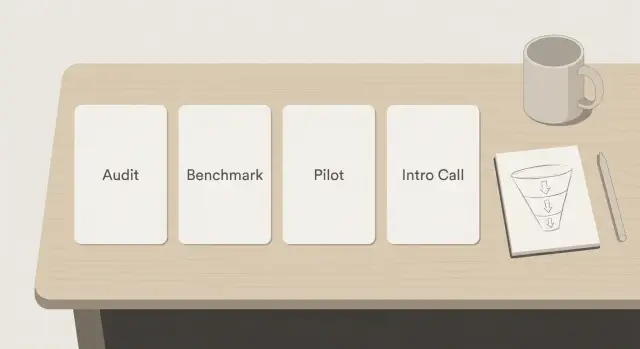
Learn how to choose the right CTA style for cold email outreach: audit, benchmark, pilot, or intro call, based on sales cycle length and deal size.
Why the wrong CTA stalls outreach
A cold email can get replies and still go nowhere if the ask is wrong.
Someone might answer “Sure” to be polite, or reply with a question, but the thread dies because the next step feels unclear, heavy, or risky. That’s almost always a CTA problem.
The CTA’s job is to match the buyer’s comfort level.
- If your ask feels like a commitment (demo, call, contract talk) before they trust you, they stall.
- If your ask is too small (a vague “thoughts?”) when they’re ready to evaluate, you waste momentum and the deal cools off.
What changes between services and SaaS is the kind of risk the buyer feels.
A service can mean time, coordination, and outcomes tied to people. A SaaS tool can mean setup work, switching costs, and whether it fits their workflow. Your CTA should reduce the specific risk they’re worried about first.
Deal size and sales cycle matter because they change how much proof a buyer needs before they spend time (or political capital) on you. The bigger the deal, the more “safe steps” you need. For a small, low-risk purchase, a direct intro call can work. For a larger deal, buyers usually want a step that shows value without committing to a full evaluation.
A mismatch shows up in predictable ways:
- You ask for a call, and they ask for details by email. The call feels too soon.
- You offer an “audit,” and they ask what happens after. The audit feels like a trap.
- You push a pilot, and they go quiet. The pilot sounds like work.
- They keep saying “interesting,” but no next step is agreed. The ask is too fuzzy.
Example: a services firm selling a $15k/month engagement often gets better traction with a quick benchmark and a clear deliverable. A SaaS product often converts better with a short pilot that proves value in one small slice, so the buyer isn’t signing up for a big rollout on day one.
Your goal is simple: make the next step feel easy, low-risk, and specific for where the buyer is right now.
Services vs SaaS: what buyers need before they say yes
Services and SaaS earn a “yes” for different reasons. If you use the same ask for both, replies slow down because you’re solving the wrong fear.
Services buyers are buying you, not a product
With services, prospects worry about scope risk and delivery uncertainty. They’re thinking:
- Will this team really do the work?
- Will it land on time?
- Will the engagement drift and rack up surprise costs?
Even if your offer is simple, they want proof that you understand their situation and that the work will stay bounded.
Service buyers also fear time waste. A long call that ends with “send me a proposal” feels like a setup. They respond better when the next step has a clear limit and sets expectations upfront.
SaaS buyers are buying proof and time-to-value
With SaaS, prospects want to see the product in action and understand how fast they can get results. Their big fear is switching pain: setup time, migration, training, and the risk that the tool won’t fit their workflow.
SaaS also tends to involve more stakeholders. A solo buyer can say yes to a trial quickly. A committee needs something they can forward internally: a simple benchmark, a pilot plan, or a success metric that’s easy to agree on.
A helpful rule of thumb:
- Services: reduce uncertainty about delivery and scope.
- SaaS: reduce uncertainty about adoption and value.
- Solo buyer: make the next step fast and personal.
- Committee: make the next step easy to share and discuss.
Example: an agency pitching outbound copy can offer a tight audit of one sequence. A SaaS cold email platform should offer a small proof step that speaks to what teams actually worry about, like inbox placement, operational effort, and how much time reply handling takes.
Four CTA styles and what they really offer
A good CTA isn’t a trick to get a meeting. It’s a clear trade: low effort from them, useful output from you.
1) Audit
An audit CTA offers clarity. You look at what they’re already doing and point to the biggest gaps.
Keep it tight. One area, one deliverable, one next step. Otherwise it reads like free consulting.
Example:
“Want me to review your outbound emails and send back 3 specific fixes?”
2) Benchmark
A benchmark CTA offers context. You compare their current numbers or setup against a baseline (peers, best practices, or patterns you see often).
The value is the comparison, not the call. Make the deliverable explicit.
Example:
“If you share the basics from your last 2 campaigns, I’ll tell you where you’re above or below typical reply rates for your space and what usually moves the needle.”
3) Pilot
A pilot CTA offers proof. You run a small, contained test that can show value without a big commitment.
A pilot isn’t a discounted rollout. It should be limited by time, scope, or audience.
Example:
“Open to a 2-week pilot with 200 leads so we can measure booked meetings?”
4) Intro call
An intro call CTA offers direction. It works best when the situation is complex, custom, or has a lot of moving parts.
What doesn’t work: “Let me pick your brain.” If you want a call, give it a job. One decision, one plan, one constraint to confirm.
Example:
“Open to a 12-minute call to confirm whether this is even worth testing, or should I close the loop?”
A quick way to choose:
- Choose an audit when they need clarity before they trust you.
- Choose a benchmark when a simple comparison will create urgency.
- Choose a pilot when you can prove value in a small test.
- Choose an intro call when requirements are unclear or stakeholders disagree.
Match the CTA to sales cycle and deal size
A good CTA matches how hard it is for someone to say yes.
Deal size and sales cycle usually tell you how much proof a buyer needs before they spend time, money, or reputation on you.
Small deal, short cycle
Make the next step quick. The buyer is mostly deciding if you seem credible and if the result sounds realistic.
Ask for something that takes 5 to 15 minutes and can happen this week.
Large deal, long cycle
A simple “book a call” often feels vague. People worry about:
- Budget risk (will I regret spending?)
- Reputation risk (will this look bad if it fails?)
- Time risk (will this drag on?)
Your CTA should offer a proof step that reduces those risks. A benchmark, a pilot, or a small scoped audit with clear outputs usually beats a generic meeting request.
Urgency changes the ask
If there’s a deadline (new quarter, pipeline gap, launch), you can ask for a faster commitment, but keep it specific.
If urgency is low, lower the effort even more and aim for learning, not buying.
A simple pairing:
- Small deal + short cycle: intro call or one “sanity check” question
- Medium deal: audit or benchmark with a promised one-page summary
- Large deal: pilot with clear success criteria and a short timeline
- Very large deal: benchmark first, then a pilot, then a call with stakeholders
Example: selling a managed outbound service to a small agency might start with an intro call. Selling a cold email platform to a team with multiple mailboxes and deliverability concerns often works better as a deliverability benchmark or a 2-week pilot, so they can see results before they commit.
Step by step: pick your CTA in 10 minutes
The best CTA isn’t “whatever gets a meeting.” It’s the smallest next step that still feels safe for the buyer and useful for you.
The 10-minute method
-
Write the top 1-2 outcomes you actually deliver. Keep them plain. “More booked demos from outbound.” “Higher reply rates.” “Less time spent sorting responses.” If you can’t name outcomes, your CTA will sound fuzzy.
-
Name the buyer’s biggest risk in saying yes. Is it wasted time, budget, brand risk, or switching cost? Services buyers often fear “we’ll spend weeks and get nothing.” SaaS buyers often fear “this won’t fit our stack or it’ll be a pain to adopt.”
-
Pick the smallest credible proof step. Choose the first step that can prove value without asking for too much commitment. Audits and benchmarks work when trust is the blocker. Pilots work when proof beats opinions. Intro calls work when scoping is the main job.
-
Time-box and scope it. Add one clear boundary so it feels easy to accept: “15 minutes,” “one sequence,” “one team,” or “one campaign.” Avoid “quick chat” with no definition.
-
Decide what happens next if it goes well. Say the next step in one sentence (proposal, rollout, paid engagement, or a deeper technical review). If you can’t describe the next step, the buyer won’t feel safe saying yes.
Quick example
If you sell an outbound service package, an “audit of your last 20 sends” can feel safer than a pilot because it requires less coordination. If you sell SaaS with a longer cycle, a small pilot like “run it on one segment for 7 days” can beat an intro call because it creates proof faster.
Write CTAs that feel easy to accept
A good CTA removes uncertainty. The reader should instantly know:
- what they get,
- how long it takes,
- what you need from them.
When you’re testing CTAs, lowering effort usually matters more than clever wording.
Keep it specific. “Can we chat?” is vague. “15 minutes to review your current outbound setup and share 3 fixes” is clear.
Ask for one thing per email. Multiple options (“call or send your deck or loop in procurement”) makes people pause. Pick the next smallest step that still moves the deal forward.
Simple CTA wordings that tend to feel low-commitment:
- Audit: “Open to a 10-minute audit of your current outreach? I’ll send back 3 specific improvements.”
- Benchmark: “If you share your average reply rate, I’ll tell you where it sits vs similar teams and what usually lifts it.”
- Pilot: “Would a 14-day pilot with a small list (50 contacts) be useful? Clear results, no big rollout.”
- Intro call: “Worth a quick 12-minute intro to confirm fit, or should I close the loop?”
When effort or pricing comes up, don’t write an essay. Confirm the constraint and offer a clean next step.
Example:
“Totally fair. Before numbers, can I ask one question about volume and who sends the emails? If it’s not a fit, I’ll tell you.”
One more tactic: make “yes” easy. Suggest a small window (“Tue or Wed morning?”) or ask for a simple reply (“Reply ‘yes’ and I’ll send two times”).
Use CTAs across a sequence, not just one email
A single CTA often fails because you’re asking for the same level of commitment from every reader.
A better approach is to treat the CTA like steps: start easy, then earn the right to ask for more.
That usually means beginning with a low-friction “yes” (permission, a quick check, a simple choice), then escalating only after they show intent (a reply, a question, or real context).
One sequence progression that works for both services and SaaS:
- Email 1: tiny ask - “Worth a look?” or “Should I send a 3-bullet benchmark?”
- Email 2: clarify scope - “If I run it, should I focus on X or Y?”
- Email 3: time-boxed call - “Open to a 12-minute intro to confirm fit?”
- Email 4: proof-based step - “Want a quick audit with 2-3 concrete fixes?”
- Email 5: commitment step - “If the numbers look good, open to a 14-day pilot?”
When do you move from a call to an audit or pilot? Use behavior as the trigger.
If they reply with details (“We use HubSpot, 3 SDRs, deliverability is rough”), an audit makes sense.
If they ask about pricing, implementation, or internal approval, propose a pilot with clear boundaries.
Follow-ups shouldn’t feel like repeats. Rotate the angle: remind them what you noticed, narrow the deliverable, or offer a smaller step.
Example:
“If a full audit is too much, I can just check your sending domain setup and reply with the top 2 risks.”
A/B tests help most when you test the shape of the commitment, not just the wording. Pick one variable at a time: CTA type, time box, deliverable framing, or specificity (“this week” vs “Tue/Wed?”).
Example scenarios: picking the right CTA in real outreach
Scenario 1: a service agency selling to a mid-market operations leader
A service offer usually means higher price, more risk, and more internal buy-in. An ops leader might like your message, but they still have to answer: “Will this fit our process, and what will it change?”
So the CTA should reduce uncertainty. Instead of “Want a quick call?”, offer a concrete audit or benchmark that produces a clear output.
Example CTA:
“If it helps, I can do a 15-minute process audit and send back a one-page ‘where time leaks happen + fixes’ summary. Want me to use your current handoff flow as the example?”
This works because the “yes” is small and the value is specific. It also matches a longer sales cycle and bigger deal size.
Scenario 2: a SaaS tool selling to a team lead with limited budget
A team lead with a small budget often needs something they can try fast, without approvals. Here, an intro call can feel like work. A pilot plan or a small setup step is usually easier.
Example CTA:
“If you want, I can send a 7-day pilot plan for one use case. If it looks simple enough, we can run it with clear success criteria.”
That’s often the right approach when the buyer can test value quickly.
How the CTA can evolve after interest
If someone replies “Maybe, what do you do?”, don’t force the call. Convert curiosity into the next smallest commitment.
Example progression:
- Start: “Open to a 15-minute intro call?”
- After interest: “Want a 10-minute benchmark first? I’ll send results before we talk.”
- After benchmark: “Should we run a 7-day pilot with success criteria we both agree on?”
As deal size and complexity go up, move from “talk” to “proof.” As the buyer gains confidence, your CTA can step up with them.
Common CTA mistakes that kill reply rates
The fastest way to lower replies is to ask for the wrong kind of commitment.
A buyer who’s unsure needs a small, low-risk next step, not a 30-minute call with a stranger.
One common mistake is skipping the proof stage.
- Services prospects often want to see how you think before they give you time.
- SaaS prospects often want to know if it fits their workflow before they agree to change anything.
The problems that show up most often:
- Asking for an intro call when the prospect is missing context, numbers, or a reason to believe.
- Offering an “audit” that sounds huge or fuzzy (no scope, no limits, no clear output), especially if it’s unpaid.
- Suggesting a pilot but not defining success, who needs to be involved, or how long it runs.
- Promising a benchmark that requires data the prospect can’t pull quickly (or won’t share with a cold sender).
- Writing a CTA that feels like homework: “Fill this out,” “Send me your deck,” “Add me to your tools,” “Export a report.”
A simple rule: your CTA should feel easier than ignoring you. If it creates work, risk, or embarrassment, people delay.
Concrete example: you email a head of sales at a 60-person team and ask for a “quick call.” They might actually want proof you can improve reply rates. A tighter CTA could be:
“If I send a 5-point teardown of your current sequence based on what’s publicly visible, would that be useful?”
That’s still an audit, but it’s scoped and safe.
Quick CTA checklist before you hit send
A CTA in cold email is either a proof step (low risk, easy yes) or a commitment step (time, access, budget).
If you ask for commitment too early, you get silence or “not right now.”
Before you send, run this quick check:
- Are you asking for a proof step or a commitment step, and is that right for this stage?
- Can they say yes in under 10 seconds?
- Is it time-boxed with a clear cap?
- Is the deliverable stated in one sentence?
- Do you know exactly what you’ll send back if they accept?
If you’re running multi-step outreach, keep the CTA consistent across the sequence and only raise the ask after you’ve earned it.
Next steps: test one CTA style and keep execution simple
Pick one CTA style to test this week. Not all four. If you change too many things at once, you won’t know what caused the result.
Choose based on your goal:
- If you need fast learning, test an intro call.
- If you need proof, test a pilot.
- If you sell expertise, test an audit or benchmark.
Keep the test small and time-boxed. Choose one audience segment, write two CTA versions (everything else stays the same), and run until you have a clean sample like 100-200 delivered emails per version.
Define one success metric before you send anything. Skip “good vibes.” Use one outcome that matches your sales motion, like positive replies, meetings booked, pilots started, or qualified “not now” replies with a real timeframe.
Execution matters more than most people think. Deliverability and organization affect results as much as copy. If you want fewer moving parts, LeadTrain (leadtrain.app) is built to consolidate domains, mailboxes, warm-up, multi-step sequences, A/B tests, and AI-powered reply classification in one place, which makes it easier to run clean CTA experiments without juggling multiple tools.
When you finish the test, keep the winning CTA style and change only one new variable next week (offer angle, list, or subject line). That pace is slow enough to stay grounded and fast enough to improve every week.
FAQ
Why do I get replies like “Sure” but the deal still doesn’t move?
A CTA stalls when it asks for the wrong level of commitment for where the buyer is. If it feels risky, unclear, or like extra work, they’ll reply politely and then delay. A good CTA makes the next step feel easy, specific, and safe.
What should I do when someone says “Can you send more details over email?”
When they ask for details by email, a live call likely feels too early. Send a tight, scannable response with a single promised outcome and a small next step, like a time-boxed benchmark or audit, so they can evaluate without committing to a meeting.
How should CTAs differ for services compared to SaaS?
For services, the risk is delivery and scope: will you waste their time, drift in scope, or miss outcomes. A strong service CTA usually offers bounded clarity, like a focused audit with a clear deliverable and a clear limit on time and scope.
What CTA works best for SaaS buyers who worry about setup and switching?
For SaaS, the risk is adoption and time-to-value: setup effort, switching costs, and fit with their workflow. A good SaaS CTA often offers proof in a small slice, such as a short pilot with clear success criteria, so they don’t feel like they’re signing up for a full rollout.
How do I choose between an audit, benchmark, pilot, and intro call?
Use an audit when trust and clarity are the main blockers and you can point to specific gaps quickly. Use a benchmark when a comparison will create urgency or focus, and you can deliver a concrete readout fast. Use a pilot when results are best proven by a contained test, and use an intro call when requirements are unclear and you need to scope before proposing anything.
How does deal size change the right CTA?
A large deal usually requires more “safe steps” before a buyer spends political capital internally. Instead of asking for a generic call, offer a proof step with a defined output and timeline, so they can share it with stakeholders and reduce perceived risk.
How do I offer an audit without sounding like I’m fishing for free consulting?
An audit feels like a trap when it’s vague, too broad, or implies unpaid deep consulting. Make it one area, one deliverable, one time cap, and say what happens next if the findings look good, so the buyer doesn’t worry you’re pulling them into a bigger commitment.
Should I use the same CTA in every email of a cold outreach sequence?
Start with the smallest “yes,” then only raise the ask after they show intent by replying with context, questions, or constraints. Rotating CTAs across the sequence works best when each step is clearly bigger than the last and each one has a concrete output, not just different wording.
What makes a CTA feel like “homework,” and how do I avoid it?
A CTA that feels like homework asks them to gather data, fill forms, export reports, or loop in other people before they trust you. Reduce effort by asking for one simple input they can answer from memory, or offer to produce a useful first pass from what you can see already.
How should I A/B test CTAs without wasting a month?
Test the shape of commitment, not just phrasing, and change one variable at a time. Pick one primary success metric that matches your motion, like positive replies, meetings booked, or pilots started, and run the test long enough to get a clean sample. If execution is slowing you down, an all-in-one platform like LeadTrain can help you run cleaner experiments by keeping domains, mailboxes, warm-up, sequences, A/B tests, and reply classification in one place.