Competitive displacement cold emails: respectful, proof-based
Learn how to write competitive displacement cold emails with respectful wording, credible proof, and clear positioning that wins interest without sounding like a smear.
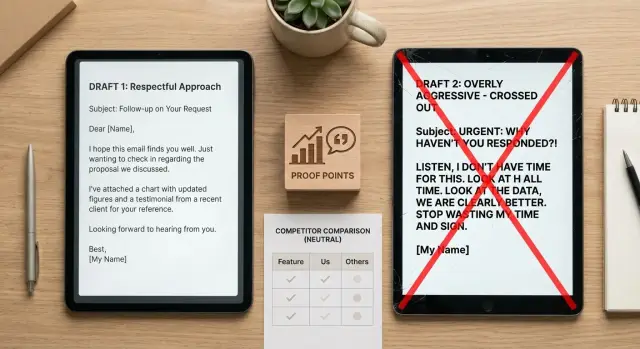
What competitive displacement emails are (and aren’t)
Competitive displacement cold emails are outbound messages aimed at teams already using another tool or vendor. You’re not introducing the category. You’re giving someone a reason to reconsider what they have and explore a switch.
Done well, a displacement email isn’t a competitor comparison email packed with claims. It’s a calm nudge: “If you’re seeing X problem with your current setup, here’s a different approach that tends to fix it.” The point is to create doubt about the status quo, not start a fight or win an argument.
Competitor mentions often backfire because most people feel loyal to the choice they already made. If you attack their current provider, it can sound like you’re attacking their judgment. It also puts your prospect in debate mode: they start defending, not evaluating.
A good displacement email focuses on one clear switch trigger. For example: deliverability drops, rising costs from stacking tools, slow support, limited reporting, or too much manual work. If you can’t name a realistic trigger, don’t force a competitor reference. You can still lead with outcomes and ask a simple question.
Displacement is a bad fit when you can’t support what you’re saying, when you only know a competitor’s brand name (not the prospect’s actual pain), or when the space is heavily regulated or reputationally sensitive. If your message depends on sarcasm, insults, or “everyone knows” statements, skip it.
If your product is genuinely different, you rarely need to trash alternatives. State the difference in plain terms, anchor it to a problem your prospect recognizes, and invite them to sanity-check whether switching is worth it.
Why respectful tone matters more than clever jabs
Prospects picked their current tool for a reason. Maybe it was the easiest option at the time, maybe their boss decided, or maybe it solved one specific need. When you mock that choice, you’re not just “attacking a competitor.” You’re putting the reader on defense.
Calling their current setup “bad” often feels personal. People want to feel smart and careful, especially about purchases they have to justify to others. A snarky line can turn a curious reader into someone who wants to prove you wrong.
There’s also a practical problem: exaggerated claims trigger skepticism. If you say “everyone hates Tool X” or “Tool Y never delivers,” the reader immediately looks for the catch. In displacement outreach, trust is the prize, and tone is the fastest way to lose it.
A respectful approach does two things at once. It lowers friction, and it keeps the door open for an honest comparison. Your goal isn’t to “win.” Your goal is to earn a reply and get permission to explore whether a switch makes sense.
A few tone rules protect reply rates:
- Describe trade-offs, not flaws (“great for X, harder for Y”).
- Talk about patterns, not absolutes. Use words like “often” when you’re describing what you’ve seen.
- Aim critiques at the situation (complex setup, scattered tools), not the buyer.
- Invite correction (“If you’re not seeing this, ignore me”).
- Keep it short and calm, like a note to a peer.
Example: instead of “Your provider kills deliverability,” try “Some teams see deliverability dip when they add more inboxes quickly. If that’s been a problem, I can share what we’ve seen work.” It reads like help, not a smear.
Know the switch trigger before you mention alternatives
A competitor name only helps when it matches a real reason to switch. If you bring up alternatives too early, your email can sound like a rant, or like you’re trying to create doubt without facts.
Start by guessing the most likely switch trigger for that account. The usual triggers are timing and friction, not curiosity. Price changes, new minimums, contract renewal, missing features that block a workflow (reporting, integrations, deliverability, compliance), or reliability problems like bounces, inbox placement issues, downtime, and support delays. Team changes matter too: a new head of sales or ops often wants a reset.
Then look at who you’re emailing, because the trigger depends on their role. A day-to-day user cares about daily pain (extra clicks, broken steps). A buyer cares about cost and risk. A champion cares about looking smart internally and getting an easy rollout.
You can find useful signals without “stalking.” Stick to what’s clearly public and relevant: a hiring post that hints at scaling outreach, a public pricing page change, review themes that keep repeating, or a product page showing a missing feature.
When you do use a competitor comparison email angle, frame the switch as risk reduction, not “winning.” Risk sounds like: fewer deliverability surprises, less manual setup, clearer reporting, or less time spent sorting replies.
Example: if a sales ops manager is hiring SDRs and reviews mention inboxing problems, you can ask if they’re open to a lower-risk setup where domains, authentication, warm-up, and reply sorting are handled in one place. For a tool like LeadTrain, that naturally leads to a calm alternative: “If you’re considering options before renewal, I can share what teams change when they want more consistent inbox placement.”
A simple language guide to avoid sounding like a smear
Displacement emails work best when they read like a calm option, not a takedown. You’re helping the reader make a safe decision. If you sound angry, absolute, or personal, they’ll assume your product is risky.
Use contrast language, not attack language
Talk about what you do and what the buyer might want, instead of what the other tool “does wrong.” You can acknowledge alternatives without making the competitor the main character.
These swaps usually keep the tone clean:
- “You may have considered X” instead of “X fails at this.”
- “Some teams prefer one place for domains, warm-up, and sequences” instead of “Their setup is a mess.”
- “If deliverability is a priority, here’s how we handle it” instead of “They send you to spam.”
- “We’re a better fit when you need [specific use case]” instead of “We’re better for everyone.”
- “Happy to share what we’ve seen with similar teams” instead of “Everyone is leaving them.”
If you mention an alternative, name one at most in the first email. Too many names turns your note into a comparison chart, and comparison charts invite arguments.
Compare categories, not motives
Compare features and outcomes (setup time, inbox placement, reply handling), not people, intentions, or competence. “Teams who want less manual DNS work often choose a platform that sets up SPF/DKIM/DMARC for them” is safer than “They make you do it because they don’t care.”
Watch for absolute words. They almost always sound like a smear unless you can prove them clearly: always, never, worst, broken, scam.
A quick self-check helps: if your line would feel rude face-to-face, rewrite it until it sounds like straightforward advice.
What counts as proof in a displacement email
In competitive displacement cold emails, “proof” means something a buyer can verify quickly or observe in their own workflow. The goal is to reduce uncertainty, not win an argument.
Proof that feels real to a buyer
The best proof is tied to outcomes and operations. It answers: “What will be different next week if I switch?”
Customer outcomes can be as simple as time saved per week, fewer manual tasks, or fewer tools needed to run the same process. Operational proof is often more convincing than hype: setup time in hours (not “fast”), steps removed, fewer handoffs, and fewer common errors.
Risk proof matters a lot in this category. Buyers care about deliverability controls, clear unsubscribe handling, and reputation isolation (your sending reputation isn’t affected by other accounts). Audit-friendly logs can also be a real differentiator in teams that need to report what happened and why.
Product proof should point to one concrete feature that replaces a workaround. For example, automatic SPF/DKIM/DMARC setup instead of a multi-tab checklist. Process proof is similar, but framed as “how we run it”: what happens on day 1, day 3, and day 7.
A concrete scenario often beats a feature list. Example: “Teams switching from a multi-tool stack often tell us the biggest change is fewer moving parts. Instead of buying domains elsewhere, setting DNS in a registrar, warming up in a separate tool, and sorting replies by hand, they run it in one place and spend that time on meetings.” Keep it factual and avoid naming the competitor unless the buyer already brought them up.
What doesn’t count as proof
Skip anything that reads like marketing fog or a dunk: vague awards without context, anonymous quotes with no detail, inflated stats (“10x results”) with no baseline, or claims about a competitor’s failures you can’t verify.
If you can’t back it up with numbers, steps, or a clear control, rephrase it as a question: “Would it help if domain setup and authentication were handled automatically?” That stays respectful and keeps the focus on buyer impact.
Step-by-step: a safe structure for the first email
The first message should feel like a helpful note, not a takedown. The goal is to make switching feel low-risk, and to let the reader decide what matters.
Start with a subject line that stays neutral and doesn’t name-and-shame. Options like these keep the door open:
- Quick question about your outbound setup
- Curious: what are you using for cold email today?
- Idea to reduce busywork in reply handling
- Worth comparing notes on deliverability?
Open by acknowledging their current setup without guessing too much. A simple line works: “Sounds like you may already be using a cold email tool - if so, you’re in good company.” If you do mention an alternative, keep it factual: “If you’re on [Tool], quick question.” No adjectives.
Use one clean contrast tied to a priority they likely care about. Make it conditional, not absolute: “If inbox placement matters, the difference is how sender reputation is managed across accounts.” Avoid piling on five comparisons.
A safe first-email structure:
- Context: one sentence that respects what they have today.
- Trigger: name the switch reason (deliverability, workflow, cost, reporting).
- Contrast: “If X matters, here’s the difference” (one point).
- Proof: one concrete, checkable detail (timeframe, count, or a specific workflow change).
- Close: a low-pressure question with two reply options.
For the proof line, write like this: “In a 2-week pilot with a 6-person SDR team, the main win was cutting manual reply sorting by 30 minutes per rep per day.” Only use numbers you can back up.
Close with an easy out: “Open to a quick comparison this week? Reply (1) yes, send times, or (2) no, not a priority.” If it fits, you can mention you’re using a platform like LeadTrain to keep domains, warm-up, sequences, and reply classification in one place. Then move right back to their goal.
Step-by-step: follow-ups that add value, not heat
Follow-ups are where displacement outreach often goes wrong. The simplest rule: each message should add one useful detail that helps them decide, not another negative claim about their current tool.
Follow-up 1: add one proof point (not a new accusation)
Bring something concrete they can verify in their own world: a metric, a workflow improvement, or a deliverability practice.
- Email 1 (2-3 days later): “One thing teams usually notice after switching is fewer manual steps. Example: domain + mailbox setup and warm-up can be done in one place, so reps spend less time babysitting sending.”
- Email 2 (4-6 days later): “If helpful, I can share a quick before/after checklist for inbox placement and reply handling (bounces, OOO, unsubscribes) so nothing gets missed.”
Keep it calm. Avoid lines like “they don’t care about deliverability” or “their support is terrible.” If you can’t prove it, don’t say it.
Follow-up 2: share a short switch path with minimal disruption
Make the change feel reversible and low effort. A simple switch path could be: keep the same targeting, test with one new domain, run a small A/B, compare replies for 7 days.
A mini scenario helps: “If you have 3 SDRs sending today, we’d start with 1 rep and 1 sequence, then expand only if results beat your current baseline.”
Follow-up 3: give an exit ramp and stop emailing
Respect earns replies. Offer a clean out.
- “If switching isn’t on the roadmap, tell me ‘not this quarter’ and I’ll close the loop.”
- “If you’re happy where you are, no worries - should I check back in 6 months, or not at all?”
If they say “we’re happy with them,” agree first, then ask one neutral question: “What would have to change for you to reconsider - deliverability, reporting, cost, or team time?” No debate.
Example scenario: replacing a competitor without trash talk
An SDR team is sending cold emails, but their setup is a patchwork: one place to buy domains, another to set DNS records, a warm-up tool, a sequencer, and a shared inbox where replies get missed. It works, but every change becomes a mini project.
Your angle isn’t “they’re bad.” It’s “you’re doing too much work to keep the engine running.” That usually means focusing on fewer tools, faster setup, and clearer reply handling so the team can spend time on real conversations.
Here’s a first email that references an alternative without taking shots:
Subject: Quick question about your outbound setup

Hi {{FirstName}},

Not sure what you use for outbound today, but if it’s a mix of tools (domains + warm-up + sequences + reply triage), I’m curious: is keeping deliverability and replies organized a time sink for your team?

We built LeadTrain to keep the basics in one place: buy and set up sending domains (SPF/DKIM/DMARC handled), warm up mailboxes automatically, run multi-step sequences, and auto-classify replies (interested / not interested / OOO / bounce / unsubscribe).

If you’re currently on {{Competitor}}, all good. When teams switch, it’s usually because they want fewer moving parts, not because they hate their current tool.

Worth a 10-minute look to see if this would simplify your process?

- {{YourName}}
How the second email changes should depend on their reply.
If they’re interested, ask what they use for domains, warm-up, and reply sorting today, then offer a short side-by-side based on their workflow.
If they say “we’re happy with {{Competitor}},” acknowledge it and ask one neutral question (“What part still takes manual effort?”). No debate.
If they don’t respond, follow up with a small, useful offer: a simple deliverability setup checklist or a suggested reply-labeling scheme their SDRs can copy, even if they never switch.
Common mistakes that turn displacement into a smear campaign
Most smear-y emails don’t start with insults. They start with sloppy shortcuts that make you sound biased, careless, or desperate.
One common trigger is dumping a big feature checklist with no tie to what the prospect is trying to fix. A long comparison reads like marketing, not help. Pick one problem that usually causes a switch (for example, “reply handling is messy” or “deliverability is unstable”) and keep everything else out.
Another is over-claiming. If you promise inbox placement, “guaranteed deliverability,” or “we always beat X,” you’ve moved from proof to hype. Deliverability depends on many factors outside any tool, so stick to what you can actually show and control.
Be careful with “evidence” that crosses a line. Screenshots, private quotes, or forwarded messages without clear permission and context can look unethical, even if your point is valid.
Also avoid pretending you know their exact situation. Guessing their contract terms, renewal date, or pricing (“you’re probably paying…”) can feel creepy and inaccurate. Ask a simple question instead.
Five mistakes to watch for:
- Listing features without connecting them to the prospect’s current pain
- Claiming guarantees about deliverability or results
- Using screenshots or quotes without permission and clear context
- Acting like you know their contract, usage, or internal decisions
- Naming too many competitors in one thread
If you need to reference alternatives, keep it narrow: mention one relevant tool, one specific use case, and one proof point. If your platform (for example, LeadTrain) includes domain setup, warm-up, sequences, and reply classification in one place, state that plainly and move back to the prospect’s goal.
Quick checklist before you hit send
Before you send a displacement email, do a quick “would I stand by this in public?” pass. Most problems happen when you try to win the argument instead of earning a reply.
Read your email once as the prospect, then once as the competitor. If either read makes you cringe, rewrite.
A fast checklist that keeps your message respectful and believable:
- Have you earned the right to mention an alternative? If the prospect didn’t bring it up, keep the first note focused on their goal and a common pain. Save names for a follow-up or a reply.
- Is the comparison one clear point, not ten? Pick the single difference that matters right now (setup time, deliverability control, reporting). Too many points sounds like a rant.
- Is your proof specific and checkable? Use concrete facts: what you changed, what improved, and in what time frame. “Better results” is vague. “Cut bounce rates after fixing SPF/DKIM and warming new mailboxes for 2 weeks” feels real.
- Would it stay kind if forwarded to the competitor? Remove loaded words like “terrible,” “scam,” or “they don’t care.” Replace them with neutral phrasing: “may be limiting,” “can be hard to,” “we’ve seen teams struggle with.”
- Is your ask easy to answer in one line? End with a yes/no or a simple choice. Example: “Worth a 10-minute look, or should I close the loop?”
If you can check every box, you’re not attacking anyone. You’re offering a measured reason to consider a switch, with proof that respects the reader’s time.
Next steps: test your message and stay organized
When you reference alternatives, small wording changes can swing replies from curiosity to defensiveness. The fastest way to improve is to pick a few clear comparison angles, then test them one at a time so you know what actually works.
Draft 2-3 angles that are easy to prove and easy to understand: faster setup, fewer moving parts, stronger deliverability controls, clearer reporting. Keep everything else the same while you test one angle (subject line, first line, call to action), or you won’t know what caused the change.
A simple testing plan:
- Write 2-3 first emails, each with one comparison angle and one proof point
- Send each version to a similar slice of your list
- Measure replies by intent, not just opens
- Keep the winning angle and improve only one thing next
Consistency matters as much as the first email. If email #1 sounds respectful and factual, but follow-up #2 turns snarky or vague, you lose trust. Use the same tone rules across the whole sequence: calm language, specific proof, and a fair frame like “teams switch when…” instead of “they’re doing it wrong.”
To stay organized, track replies by what they mean, not how they feel. At minimum, sort them into interested, not now, and not interested. Then add operational buckets that protect your sender reputation and your time, like out-of-office, bounce, and unsubscribe.
If you’re tired of stitching together five tools just to run outbound, it can help to centralize the basics. LeadTrain (leadtrain.app) is built to keep domains, mailboxes, warm-up, sequences, and reply classification together, which makes it easier to run clean tests and respond quickly to the right conversations.
FAQ
What is a competitive displacement cold email?
A competitive displacement cold email is a message to someone who already uses a tool in your category and might switch. The goal is to surface a real “switch trigger” (like deliverability, workflow friction, or tool sprawl) and invite a quick comparison, not to win an argument about who’s best.
Should I mention a competitor in the first email?
Default: no, not in the first email. Naming a competitor too early can put the reader in defense mode and turn your note into a debate. If you do mention one, keep it neutral and factual, and only when it clearly connects to a likely switch trigger.
How do I choose the right “switch trigger” to lead with?
Pick one trigger that a reasonable team could actually feel this month, like inbox placement dropping as volume grows, too many tools to maintain, reply triage taking too long, or reporting gaps. If you can’t name a believable trigger for that account and role, lead with the outcome you help with and ask a simple question instead.
How do I keep the tone respectful and avoid sounding like a smear?
Write like you’re talking to a peer who made a sensible choice with the info they had. Avoid insults, absolutes, and “everyone knows” lines, and aim your critique at the situation (manual setup, scattered tools) rather than the buyer’s judgment. If a sentence would sound rude face-to-face, rewrite it.
What kind of “proof” works in a displacement email?
Use proof the buyer can sanity-check quickly in their own workflow, like fewer setup steps, less time spent sorting replies, or clearer controls around authentication and unsubscribes. Product-specific proof works best when it replaces a workaround, such as automatic SPF/DKIM/DMARC setup, automated warm-up, or automatic reply classification into interested, not interested, out-of-office, bounce, and unsubscribe.
What’s a safe structure for the first displacement email?
Keep it simple: one line of context, one switch trigger, one clear difference, one concrete detail, and a low-pressure close. If you’re referencing a platform like LeadTrain, describe it in plain terms such as domains and mailboxes managed in one place, warm-up, multi-step sequences, and AI reply classification, then return to the prospect’s goal.
How should I write follow-ups without escalating the message?
Each follow-up should add one useful detail that helps them decide, not more negativity about their current tool. A good follow-up might offer a small “here’s how teams test this safely” pilot idea or a practical checklist they can use even if they never switch. If you can’t add value in the next message, it’s better to stop.
What do I say if someone replies, “We’re happy with our current tool”?
Agree first, then ask one neutral question that reveals whether a trigger exists, like what still takes manual effort or what would need to change to reconsider. Don’t argue or try to “prove them wrong”; your goal is to learn their thresholds and decide whether to bow out gracefully.
What are the most common mistakes that turn displacement into a smear campaign?
Over-claiming deliverability guarantees, dumping a long feature checklist with no clear pain, guessing private details like contract terms, and naming too many competitors in one thread. Another common mistake is using loaded words like “scam,” “broken,” or “terrible,” which signals bias and makes your email easy to dismiss.
How do I test displacement email angles and measure what’s working?
Test a few angles that are easy to explain and prove, like faster setup, fewer moving parts, clearer reply handling, or better reputation isolation via tenant-isolated sending infrastructure (so one customer’s sending doesn’t affect another’s). Keep everything else the same while you test, and judge success by reply intent (interested vs. not now vs. not interested), not just opens.