Cold email first line frameworks: 30 openers by industry
Cold email first line frameworks for SaaS, services, marketplaces, and consulting, with 30 ready-to-use opening sentence patterns and quick usage tips.
What your first line must do in 5 seconds
Your first line isn’t there to be clever. It’s there to earn the next 5 seconds of attention.
Cold email lives and dies on replies, not clicks. The opener has one job: make the reader feel like this message is actually for them.
Most cold emails fail for two reasons:
- They sound generic (anyone could’ve sent it to anyone).
- They feel creepy (too personal, too detailed, or oddly confident about things you can’t know).
Both trigger the same reaction: delete.
A good opener stays specific without pretending you’re an insider. Frameworks can help, but they’re not magic. Think of them as a shape you fill with one real detail.
Your first sentence should do three things, fast:
- Prove relevance with one believable detail (role, product category, recent change, public signal).
- Set a calm tone (no hype, no pressure, no fake familiarity).
- Create a simple reason to keep reading (a problem, a missed opportunity, a clear outcome).
If you paste the same line into 500 emails, it will read like a template. Use the pattern, then swap in a detail you can explain in plain words.
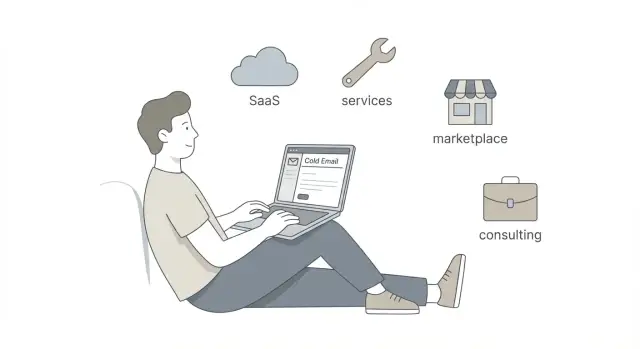
You’ll see openers tailored to four offer types:
- SaaS: best when your product replaces a manual process or a tool they already use.
- Services and agencies: best when results depend on execution, and proof matters.
- Marketplaces and platforms: best when timing matters and you’re balancing both sides.
- Consulting and advisory: best when the buyer wants judgment and a plan, not a deliverable.
If you’re running outreach in a tool like LeadTrain, one of the fastest loops is tracking which openers get “interested” vs “not interested” replies and iterating from there.
Simple rules that keep first lines believable
A believable first line reads like a real human noticed something real. The goal isn’t to impress. It’s to earn the second sentence.
Start with them, not you. If your opener begins with your company name, your product, or “we help,” it blends into the rest of the inbox. Lead with their situation, then earn the right to talk about yours.
Specific beats fancy. “Noticed you’re hiring 3 SDRs” is stronger than “Love what you’re building.” Look for observable details: their role, a recent change, a visible initiative, or a simple trigger (new pricing page, new job post, new region).
Five rules that keep openers natural:
- Use one concrete detail, not three vague ones.
- Skip fake familiarity (no “quick one,” no first-name jokes).
- Avoid big praise unless you can name why.
- Keep it one sentence.
- Match the tone to the buyer (operators want direct; founders may tolerate a broader angle).
Example: you’re emailing a Head of RevOps at a mid-size SaaS.
Believable: “Noticed you’re hiring for Sales Ops and rolling out a new outbound motion.”
Not believable: “Huge fan of your innovative approach to growth, and I’d love to connect.”
If you use AI to draft openers, sanity-check the “proof.” Tools can generate options quickly, but you still need to remove anything you can’t back up. LeadTrain’s reply classification helps you sort responses after you send, but the opener still has to sound like you wrote it.
How to write a good opener in 4 steps
A strong first line is not where you prove your value. It’s where you earn the right to say the second sentence.
The 4 steps
-
Choose one reason you’re emailing. Pick a single angle (reduce churn, speed up onboarding, hire faster). If you try to cover three angles, it turns into a pitch.
-
Find one real signal. Use something easy to believe: a recent change, a visible initiative, a new role, a launch, a hiring push, a review mention, or a job they obviously do.
-
Turn it into a neutral observation. Avoid claims about results or assumptions about pain. Neutral sounds like: “noticed,” “saw,” “curious,” “looks like,” “seems like.” Most people break frameworks here by jumping straight to “I can 10x your pipeline.”
-
Set up the next line. The opener should naturally lead into the problem you help with, without a hard turn. Think: observation first, then a short question or a one-sentence “why it matters.”
Two quick rewrites
Before: “I can help you increase revenue with our AI platform.”
After: “Noticed you are hiring 3 new SDRs this quarter. Curious how you are keeping outreach consistent across the team.”
Before: “We have the best solution for agencies to get more leads.”
After: “Saw you launched a new service package for e-commerce brands. Are you mostly getting discovery calls from referrals, or are you building an outbound channel too?”
If your opener can be read as true by someone who has never heard of you, you’re on the right track.
30 patterns, part 1: SaaS opening sentence frameworks
These openers work best when they point to something the buyer can recognize in one glance. Avoid vague compliments.
1) New role trigger
When it works: right after a promotion or role change.
60-second research: job title change and post date.
Example: "Saw you just stepped into {Role} at {Company}, congrats. When that happens, teams usually re-check {Process} before Q{Quarter} gets busy."
2) New tool trigger
When it works: they publicly rolled out or mentioned a new stack tool.
60-second research: job posts, engineering blog, or team updates mentioning {Tool}.
Example: "Noticed {Company} is using {Tool}. Curious, did you set it up mainly for {UseCase} or was it more of a quick fix for {Problem}?"
3) Integration angle
When it works: your offer connects two systems they likely use.
60-second research: tech stack clues and a quick scan of product pages.
Example: "Quick one: are you already connecting {SystemA} with {SystemB}, or are teams still copying data between them at {Company}?"
4) Usage gap (activation) angle
When it works: product-led SaaS where value depends on a specific action.
60-second research: docs, onboarding steps, or common setup patterns in their category.
Example: "A lot of teams get {ToolOrCategory} installed fast, but never hit {KeyAction} that drives {Outcome}. Is that something you see at {Company}?"
5) Hiring signal
When it works: they’re hiring for roles tied to the problem.
60-second research: open roles mentioning {Keyword} or {Tool}.
Example: "Saw you are hiring a {Role} focused on {Keyword}. Is the goal to reduce {Pain} or to push harder on {Goal} this quarter?"
6) Pricing page cue
When it works: their plan limits create predictable friction.
60-second research: plan names, limits, add-ons.
Example: "On your {PlanName} plan, {Limit} looks like the main constraint. Do teams usually outgrow it because of {Reason1} or {Reason2}?"
7) Feature adoption nudge
When it works: you suspect a high-leverage feature isn’t being used.
60-second research: release notes and help center feature pages.
Example: "You added {Feature} recently. Are customers actually turning it on, or does it get skipped because {FrictionPoint}?"
8) Security or compliance trigger
When it works: after a regulation change, audit cycle, or trust-page update.
60-second research: trust center, compliance badges, security announcements.
Example: "Noticed {Company} highlights {ComplianceStandard}. When you prep for audits, is {RiskArea} still the biggest time sink?"
30 patterns, part 2: Services and agencies
Service providers win replies by sounding observant, not superior. Keep the tone neutral: point to a real signal, then ask a simple question. Avoid lines that imply their current site, ads, or ops are “bad.”
1) Recent launch
Example: “Noticed {Company} (Acme) just launched {launch} (a new pricing page). Who’s owning the first round of {follow-up} (conversion QA)?”
2) Site change / rebrand cue
Example: “Saw {Company} (Acme) updated {site element} (the homepage headline) recently. Was that tied to {goal} (a new ICP), or just a refresh?”
3) Performance issue hint (without accusing)
Example: “Quick question, {Name}: when I loaded {page} (your case studies page), it took a bit to fully render. Is {Company} (Acme) already looking at {area} (site speed) this quarter?”
4) Review volume / reputation momentum
Example: “Noticed {Company} (Acme) has {review count} (120+) reviews on {platform} (Google). Are you doing anything specific to turn that demand into {next step} (booked calls)?”
After you get a “yes” or “kind of,” offer a tiny next step (an audit, a screenshot, a 10-minute call). Keep it low pressure.
5) Hiring surge / capacity signal
Example: “Saw {Company} (Acme) is hiring for {role} (3 SDRs). Are you planning to adjust {process} (lead routing and follow-up) as the team grows?”
6) Ad spend cue
Example: “I noticed {Company} (Acme) is running {ad type} (search ads) for {keyword} ("IT support"). Do you have someone watching {metric} (lead quality) day to day, or is it more set-and-check?”
7) Seasonal workload
Example: “Is {Company} (Acme) gearing up for {season} (Q4) right now? A lot of teams see {pain} (response times slip) when volume spikes.”
8) Vendor switch / tool change
Example: “Looks like {Company} (Acme) recently switched {tool/vendor} (your chat widget). Was that part of a bigger push to improve {outcome} (lead capture)?”
Local vs remote targeting matters. For local services, use geography naturally (“Saw you’re expanding in {City}”). For remote teams, skip location and anchor on delivery (handoffs, time zones, response times, project velocity).
30 patterns, part 3: Marketplaces and platforms
Marketplaces are great for first lines because there are plenty of public signals. Keep it light: “noticed” beats “saw your numbers,” and “curious” beats “you should.”
Seller outreach patterns
Category expansion (new products, new category pages): “Noticed {Store} recently added {NewCategory} on {Marketplace} - curious what prompted the expansion, and whether you’re also looking at {AdjacentCategory} next?”
Stockouts (availability gaps): “Noticed a few {Product} listings from {Store} are showing {OutOfStock/LowStock} on {Marketplace} - curious if that’s temporary, or if you’re changing inventory plans for {Season/Event}?”
Listing quality (photos, titles, compliance, variations): “Noticed your {Product} listing on {Marketplace} has {LowPhotoCount/MissingVariants/ShortTitle} - curious if you’re actively testing the page, or if it’s just due for an update?”
Reviews trend (recent shift, recurring theme): “Noticed recent reviews for {Product} mention {Theme} a few times - curious if you’re already addressing it, or still figuring out the best fix?”
Platform/operator outreach patterns
New geography: “Noticed {Marketplace} is pushing into {NewRegion} - curious how you’re thinking about {Supply/Partners/Compliance} there, and what you want more of in the first 90 days?”
Policy updates: “Noticed the recent {PolicyName} update on {Marketplace} - curious what kind of seller confusion you’re seeing most, and how you’re handling it?”
Fulfillment changes: “Noticed {Marketplace} is changing {FulfillmentProgram/DeliverySLA} for {Category} - curious if you expect sellers to shift inventory strategy, or keep business as usual?”
Competitor movement: “Noticed {CompetitorMarketplace} launched {Feature/Promo} for {SellerType} - curious if that’s something your team is watching, or if your priorities are elsewhere this quarter?”
Who to email depends on what you actually help with. If your offer helps individual merchants (creative, ads, inventory, catalog, customer support), email the seller/brand owner or Head of Ecommerce. If it helps the ecosystem (onboarding, trust and safety, seller education, partnerships), email the marketplace team (partnerships, category manager, seller growth).
30 patterns, part 4: Consulting and advisory
Consulting openers work best when they point to a visible moment (a change, a bet, a risk) and ask a small, reasonable question. Stay specific by naming the trigger, not the exact metric.
Use signals you can verify: role changes, a new initiative on the site, hiring plans, product updates, a press note, or a quote from a leader. If you can’t confirm it, write it as a hypothesis.
Strategic initiative (strategy):
Example: "Saw [Company] is pushing [initiative, e.g., enterprise expansion] - are you the person who owns the plan for [workstream, e.g., packaging and positioning] in Q[1-4]?"
Board pressure (finance/strategy):
Example: "When boards start asking about [topic, e.g., payback period], teams often re-check [area, e.g., CAC by segment] - is that on your radar at [Company]?"
Reorg or new leader (ops):
Example: "Noticed [new role/leader] joined as [title] - are you revisiting [process, e.g., forecasting and handoffs] as the team structure settles?"
KPI shift (GTM/ops):
Example: "Quick check: are you moving focus from [old KPI, e.g., top-line growth] to [new KPI, e.g., retention and efficiency] this half, or is that off?"
Keep it grounded. If you’re not sure, say so: “I may be off” or “curious if.” You can be direct without acting like you know their numbers.
New market entry (GTM):
Example: "Saw [Company] is entering [market/region] - who is driving the [GTM piece, e.g., first 10 reference customers] work?"
Churn spike hint (ops/customer):
Example: "I might be wrong, but with [signal, e.g., new pricing tiers] teams often see churn questions spike - is reducing [type, e.g., early churn] a priority right now?"
Pipeline gap (GTM):
Example: "With [season/event, e.g., Q4 planning] coming up, are you already looking at [area, e.g., pipeline coverage for mid-market], or is that owned by someone else?"
Merger/acquisition (finance/ops):
Example: "Congrats on the [acquisition/merger] - are you combining [function, e.g., RevOps + finance reporting] into one model, or keeping them separate for now?"
Authority note: consulting deals usually need a champion and a signer. The champion is often a VP (RevOps, Marketing Ops, Strategy, Finance, CS). The signer is commonly the CRO, COO, CFO, or CEO, depending on whether the work is GTM, ops, or finance-led.
Common first-line mistakes that hurt replies
Most bad openers fail for one reason: they make the reader feel like you either don’t know them, or you know a little too much.
Over-personalizing is a common trap. If your first line mentions someone’s family, home address, or a personal photo, it can feel creepy. Even if the detail is public, it signals you were digging. Stick to work facts they’d expect a stranger to notice: a launch, a hiring push, a role change.
Another reply-killer is making claims you can’t support in one line. “I can double your pipeline” sounds like an ad unless you immediately give a specific, credible reason. If you can’t show the “why” right away, soften it.
Template-sounding openers are also easy to ignore. People have seen the same phrases a thousand times. The point of a framework is to sound like a real person who noticed something real, not a script.
Five patterns that usually hurt response rates:
- Private or personal details that cross a line
- Big promises with no proof attached
- Buzzwords and overused lines that feel mass-sent
- Jokes or sarcasm without knowing the audience
- Two openers crammed into one sentence
Humor is especially risky. A joke that lands for one person can annoy ten others and make you look less serious than you are. If humor fits your brand, keep it light and optional, not the main point.
Also avoid packing multiple triggers into one opener. For example: “Loved your post on onboarding, and congrats on the Series A, and I noticed you are hiring SDRs…” Pick one angle, make it clear, then move on.
A simple fix: write three candidate first lines, then choose the most specific and shortest. Tools like LeadTrain can help you test variations with A/B tests, but the biggest lift often comes from removing extra fluff first.
Quick checklist before you hit send
Read your first line out loud once. If you stumble, it’s probably too long or too packed.
Quick opener checklist:
- Does it reference one real signal (post, job change, new feature, hiring, a review), not a guess?
- Is it one sentence under 25 words?
- Would it still make sense if you removed your product name?
- Is the tone neutral, not judgmental or salesy?
- Can your next sentence explain why you wrote, without a hard pivot?
If you fail one item, fix just that and re-read. Small edits add up.
Example: you want to pitch an analytics tool, but your opener says, “Noticed your reporting is probably messy.” That’s a guess, and it sounds rude.
A safer version: “Saw you just launched the new pricing page - curious how you’re tracking plan upgrades week to week.” It points to a real event and sets up a clean second sentence.
One more test: delete anything you couldn’t prove in 30 seconds. Keep what you can point to, then use the next line to connect the dots.
Example: one prospect, three opener angles
Offer type: SaaS.
Prospect: Jamie, Head of RevOps at a 120-person SaaS company. You sell a workflow tool that reduces time spent routing inbound leads.
Three opener angles for the same person, each setting up a different second line:
-
Signal-based (recent change) Opener: "Saw you’re hiring for a Sales Ops Analyst to clean up lead routing." Second line: "Curious if the bigger issue is speed to first touch, duplicate ownership, or reporting gaps?"
-
Role-based pain (day-to-day reality) Opener: "Most RevOps leads I talk to spend Friday afternoons untangling lead ownership rules." Second line: "If that’s even partly true for you, what’s the one rule that breaks the most often?"
-
Outcome + light proof (specific, not braggy) Opener: "A few SaaS teams cut their lead-to-meeting time by 20 to 30% just by fixing routing handoffs." Second line: "Want me to share the 3 checkpoints we use to find the bottleneck in under 10 minutes?"
When to use which opener depends on how strong your signal is:
- Use signal-based when you have a clear, fresh trigger (new role, new product line, org change).
- Use role-based pain when your research is thin but the persona is a perfect fit.
- Use outcome + light proof when you can name a measurable result without sounding like a case study ad.
Day 3 follow-up opener variation: "Quick nudge, Jamie, is lead routing something you’re trying to improve this quarter, or is it stable for now?"
Next steps: turn patterns into a repeatable system
The fastest way to get consistent replies is to treat your opener like a tiny product: save what works, cut what doesn’t, and keep testing small changes.
Build a small swipe file by industry and role. Keep it short: a few openers that fit SaaS founders, Heads of Sales, ops leaders, agency owners, marketplace sellers, and consultants. Add a note about when each one fits (“use this when they just hired,” “use this when they shipped a new feature”). After a week, you’ll stop guessing.
When you test, only A/B two opener patterns at a time. If you change the opener, subject line, and offer all at once, you won’t know what caused the lift. Run each variant long enough to get a clean signal, keep the winner, then test the next idea.
Don’t ignore setup and warm-up. Even great openers fail if your domain and mailbox reputation are weak. A warmed-up mailbox plus correct authentication (SPF, DKIM, DMARC) helps emails reach inboxes and protects your sending long term.
If you want fewer moving parts, LeadTrain (leadtrain.app) combines sequences, warm-up, domains and mailboxes, and automatic reply classification (interested, not interested, out-of-office, bounce, unsubscribe) so you spend less time sorting replies and more time having real conversations.
Three actions to do this week:
- Build a 20-line swipe file: 5 openers each for two industries you sell to, plus the role they fit.
- Launch one A/B test: two opener patterns, same subject, same offer, same list.
- Audit deliverability basics: confirm authentication is set, warm-up is running, and you’re not sending from a brand-new mailbox at full volume.