How to choose an ICP with no data: a wedge segment method
Learn how to choose an ICP with no data using a simple wedge approach, clear disqualifiers, and quick checks so you can start outreach with confidence.
Why picking an ICP is hard when you have no data
When you have no results yet, “everyone” feels like the safest choice. If you don’t narrow it down, you can’t be wrong. The tradeoff is slow learning: your message stays vague, your offer gets fuzzy, and every sales call sounds different because you’re reacting to whoever shows up.
An ICP (ideal customer profile) isn’t a label for your website. It’s a focus tool. It helps you write one clear pitch, choose channels that match the buyer, and get faster feedback because you’re talking to similar people with similar problems. If you’re testing outbound, a clear ICP also keeps the test clean so you can tell whether the issue is your list, your copy, or the offer.
The key mindset: you’re choosing a starting point, not your forever niche. You’re making a smart bet, running a small test, learning quickly, and adjusting. A good first ICP is one you can reach, understand, and sell to in the next few weeks, not the “perfect” segment you might reach someday.
By the end, you want two outputs:
- A best-fit profile: who you’ll target first (role, company type, trigger, and the pain you solve).
- Not-a-fit rules: who you’ll avoid for now (disqualifiers and red flags).
A concrete example: if you sell a cold email service, “B2B companies” is too wide. “US-based B2B SaaS, 5-50 employees, first SDR hire, founder still selling, needs meetings this quarter” is narrow enough to write one message and run a focused outreach test. And just as important, you can say “not a fit” to agencies, very large enterprises, or anyone who can’t use outbound email due to strict policy.
What a wedge segment is (and why it works)
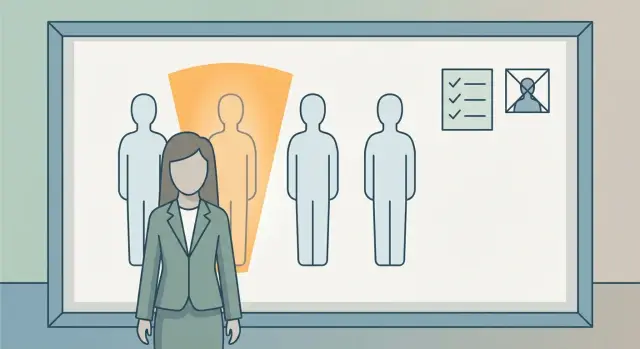
A wedge segment is a small, specific slice of a market you can reach easily and serve well with what you have right now. It’s not your forever ICP. It’s your best first bet for learning fast without spraying messages at everyone.
“Narrow” doesn’t mean “tiny opportunity.” It means less guessing. A strong wedge usually locks onto three things at once: one role, one situation, and one sharp pain.
Compare these two targets:
- Broad: “B2B SaaS companies that need more leads.”
- Wedge: “Seed-stage B2B SaaS founders doing outbound themselves who need replies this month because they have 6 weeks of runway.”
The wedge works because it turns vague questions (Who cares? Why now? What do they already use?) into testable assumptions. When your segment is tight, you can write a message that feels personal, pull a cleaner list, and spot patterns in replies sooner.
What a wedge can look like
A wedge doesn’t have to be complicated. Common ways to make it specific:
- Industry + role (for example, “accounting firms + owner”).
- Tool stack (for example, “teams using HubSpot with no dedicated outbound tool”).
- Trigger event (for example, “just raised seed,” “hired first SDR,” or “expanded to a new country”).
If you plan to test your wedge with cold outreach, a narrow segment also makes the experiment easier to read. You can run a small campaign, see who replies, and categorize responses (interested, not interested, out-of-office, bounce, unsubscribe) to judge whether the wedge has pull or needs a tweak.
What you can use as input before you have metrics
If you’re stuck, widen your definition of “data.” Early on, your best signals are usually lived experience, access, and constraints, not dashboards.
Start with what you can gather quickly:
- Your past: industries you worked in, roles you sold to, problems you solved, and the exact words people used.
- Warm paths: former teammates, friends-of-friends, investors, advisors, and anyone who can introduce you to real buyers.
- Where buyers already gather: communities, events, newsletters, and recurring comment threads where the same complaints show up.
- Inbound micro-signals: questions in DMs, comments on posts, feature requests, and objections people raise without being prompted.
- Your unfair advantages: credibility, speed, pricing flexibility, or a niche network.
Then get honest about hard limits, because they shape your first wedge more than your vision does. If you need $6k monthly revenue within 90 days, avoid segments with long procurement and legal review. If you can’t support HIPAA or SOC 2 expectations yet, avoid buyers who require them. Also factor in what you can repeat each week. If you only have two hours a day for sales, you need a segment you can reach predictably and support lightly.
A quick example: you can get intros to 20 agency owners, and you can also reach 200 ecommerce founders via cold email. If your offer needs live setup and hand-holding, agency owners might be the better first wedge. If your offer is self-serve, ecommerce may fit.
Write these inputs down. You’re not picking the “best” market yet. You’re picking the market you can learn from next week.
A step-by-step method to choose your first ICP
Don’t try to find the perfect segment. Pick one wedge you can reach quickly, test it, and learn.
The 5-step wedge method
Give yourself a deadline. Speed beats certainty here.
-
Brain dump 10 segments you could contact in the next 2 weeks. Be specific (role + company type + context). “US-based Shopify store owners doing $1-5M revenue” beats “ecommerce.”
-
Score each segment (1-5) on four factors: pain level, reachability, willingness to pay, and urgency. Don’t overthink it. You’re just creating separation.
-
Take the top two and write a one-sentence ICP hypothesis for each:
“We help [role] at [company type] who [trigger] achieve [outcome] without [common headache].”
If you can’t write the sentence, the segment is still fuzzy.
-
Choose one wedge and commit to a short test window (often 2 weeks). No switching mid-test. Your goal isn’t scale, it’s signal.
-
Pick one simple success signal before you start: a minimum number of qualified replies, booked meetings, or a reply rate above a baseline.
A practical tie-breaker: if “local accounting firms” scores well on pain but is hard to reach, and “B2B agencies hiring SDRs” scores slightly lower on pain but is easy to reach and urgent, pick the second wedge. Early traction is worth a lot.
Define who is not a fit (disqualifiers and red flags)
When you have no data, it’s tempting to say “we can help anyone.” That usually leads to weak messaging, long sales cycles, and unhappy customers. A simple not-a-fit list protects your time and your brand while you learn.
Start with disqualifiers: objective reasons to stop early, even if the prospect sounds excited. Most disqualifiers fall into four buckets:
- Budget: they can’t afford your minimum, or they need months of free “trial.”
- Urgency: no clear reason to act in the next 30-60 days.
- Workflow limits: restrictions that block the workflow (for example, no outbound email allowed).
- Decision access: you can’t speak to the person who owns the problem and can approve the purchase.
Then add red flags: patterns that often lead to churn, scope creep, or reputational risk. Examples include no clear owner for the project, no timeline, or heavy custom requests before commitment. Another common red flag is demanding outcomes you don’t control, like “guaranteed meetings,” without changing targeting, copy, or offer.
Write one polite decline line you can reuse:
“Thanks for sharing the details. Based on what you described, I don’t think we’re the right fit right now. If you want, I can point you to what typically works in your situation.”
The point isn’t to be strict. It’s to stay focused long enough to learn what really converts.
Turn the ICP into a clear message and offer
Once you’ve picked a wedge segment, turn it into one simple promise. The fastest way to get ignored is to pitch “we solve everything” to people who feel one urgent problem.
Choose a single pain that costs them time, money, or deals. Match it to a promise that’s easy to picture. Then add one trigger that explains why they’d look for help now, not “someday.” Triggers can be a new role, a new revenue target, a new market, a tool change, or a spike in leads that broke their current process.
Before you write copy, clarify four basics:
- Who signs off (the decision-maker)
- Who uses it daily (the day-to-day user)
- What result they care about first (the top metric)
- What they want to avoid (risk, wasted spend, lost time)
Then draft a positioning line you can reuse:
“For X in situation Y, we help Z without A.”
Example for outbound:
“For SDR managers at small B2B SaaS teams who need to book more meetings this quarter, we help them launch deliverable cold email campaigns without juggling domains, warm-up, and reply sorting.”
If you’re using a platform like LeadTrain, that “without” can be literal: it combines domains, mailboxes, warm-up, multi-step sequences, and reply classification so the workflow is simpler for a small team.
If you can’t say the promise in one breath, your ICP and offer are still too wide. Tighten the pain and trigger until the line feels obvious to the right reader.
Quick checks before you commit to the wedge
Do a fast sanity check before you build a whole plan around one wedge. You’re not trying to be perfect. You’re trying to avoid an ICP that’s too fuzzy, too hard to reach, or impossible to explain.
If you fail two or more, narrow the wedge or pick a different one:
- Can you name the buyer in 5 words or less (for example, “owner of a 10-50 person agency”)?
- Can you find 50 real prospects without paid ads (search, job boards, directories, community lists, attendee lists)?
- Do you know what they already tried, and why it failed?
- Can you explain the value in one sentence without buzzwords?
- Do your disqualifiers remove at least 30% of leads?
These checks force a practical kind of clarity: pick a segment you can reach, describe, and exclude.
How to validate the ICP fast with a small outreach test
When you have no real numbers yet, a small, time-boxed outreach test is the fastest way to learn if your wedge is real.
Start tiny on purpose. Pick 30 to 100 prospects from the exact wedge you wrote down. Send one simple message with one offer (one CTA). If you change the audience, the message, and the offer at the same time, you won’t know what caused the result.
Track only a few signals:
- Positive replies (interest, “Yes, tell me more,” “Book time”)
- Clear objections (“We already use X,” “Not a priority,” “Too expensive”)
- Delivery issues (bounces)
- Unsubscribes or angry replies (strong mismatch)
Then tighten one thing based on what you see. If many say “we don’t have this problem,” add a disqualifier (company size, tool stack, geography). If you hear “bad timing,” refine the trigger (recently hired SDRs, just launched outbound, new revenue goal).
Set a decision rule before you start. Example: “After 7 days or 80 sends, if we get 5+ positive replies, we keep this wedge and expand. If we get 0 to 1 positive reply and multiple mismatch signals, we move to the next wedge.”
This won’t prove everything, but it will tell you if you’re pointed at a door or a wall.
Example: picking a wedge segment from two decent options
A solo founder is selling a scheduling add-on to small clinics. It reduces no-shows and makes it easier for staff to confirm appointments.
They have two “pretty good” options:
- Option A: independent dental clinics (1-3 locations). High no-show cost, clear owner, simple decision path.
- Option B: physiotherapy clinics (3-8 practitioners). Still painful, but more variation in booking flow and who owns the decision.
The tie-breaker is the clearest buyer and the most obvious “this hurts today” trigger. Here, that’s independent dental clinics.
ICP hypothesis (version 1): Independent dental clinics with 1-3 locations in English-speaking markets, using online booking but still relying on front desk follow-ups. Buyer is the practice owner or practice manager. Trigger: a recent increase in cancellations or a full schedule that still turns into empty chair time.
Before sending a single email, the founder defines not-a-fit:
- Clinics that are part of a large corporate group (slow procurement).
- Clinics without online booking (too much process change required).
- Clinics locked into a full practice-management suite that already covers reminders (high switching cost).
They run a small outreach test and get 20 replies. The pattern is clear: practice owners forward the email to the office manager, and the best conversations start when the message mentions “same-day gaps” and “last-minute cancellations.”
ICP hypothesis (version 2 after 20 replies): Independent dental clinics with 2+ hygienists, where the office manager is responsible for filling same-day gaps. Strongest trigger: a spike in last-minute cancellations in the past 30 days.
That’s the core loop: make a bet, write down disqualifiers, and let real replies tighten the role, trigger, and not-a-fit list.
Common mistakes when choosing an ICP with no data
The fastest way to waste weeks is to pick an ICP that looks good on paper but is hard to contact in real life. If you can’t get a reliable list, find valid emails, or reach people who actually answer, you’ll confuse “no traction” with “bad ICP.”
Another trap is choosing the biggest market instead of the most urgent pain. A huge segment with mild discomfort rarely moves fast. A smaller wedge with a burning problem will teach you more in 10 conversations than a broad market will in 100 ignored messages.
Common mistakes:
- Picking a segment you can’t reach consistently (unclear titles, weak list sources, no reliable channel).
- Choosing size over urgency (nice-to-have problem, long buying cycles, low willingness to pay).
- Changing the ICP every few days (you reset the experiment before patterns appear).
- Skipping not-a-fit rules and taking every call (you drown in polite maybes and edge cases).
- Treating low reply rates as only a product problem (often it’s list quality, message, offer, or deliverability).
A practical example: you run a small cold email test to founders, agencies, and recruiters. Replies are low, so you assume the offer is wrong. Later you notice many emails bounced, and the few replies say “not my job.” That points to targeting and setup, not the product.
Next steps: document it, test it, and iterate
Your first ICP is a hypothesis, not a fact. Capture it clearly, run one focused test, and learn without changing direction every week.
Create a one-page ICP note you can share internally:
- Wedge definition: who they are, what they do, and when they feel the problem
- 3-5 must-have traits (role, team size, tool stack, trigger)
- Disqualifiers and red flags
- Your offer in one sentence
- The first channel you’ll use to test
Once it’s written, run a campaign that targets only this wedge. Don’t mix two different audiences in the same test.
If cold email is your channel, keep the setup boring and consistent: clean sending domains, warmed mailboxes, a short sequence, and a way to sort replies. If you’re using LeadTrain (leadtrain.app), it’s designed to keep those pieces in one place, including domains and authentication setup, warm-up, multi-step sequences, and automatic reply classification.
Review results weekly, not hourly. Look for patterns:
- Are replies coming from the right people, or the wrong ones?
- What reasons do prospects give for “no” (timing, budget, already solved)?
- Which line gets repeated back to you (the real hook)?
- Are your disqualifiers working, or are you still attracting bad fits?
Hold the wedge until you see a clear pattern for several weeks: consistent reply quality, repeatable objections, and a few real conversations. Then expand by changing only one variable at a time (role, sub-industry, or trigger) so you still know what caused the improvement.
FAQ
What should I do if I have zero data and “everyone” could be my customer?
Start with one narrow group you can actually reach and talk to this month. Write a one-sentence hypothesis for them (role, company type, trigger, pain), run a small test, and treat the result as feedback—not a verdict on your business.
Why is an ICP more than just a label for my website?
An ICP is a focus tool for learning fast. It forces you to write one clear message, pull a cleaner prospect list, and compare replies without constantly changing the audience and the pitch.
What exactly is a wedge segment, and why does it work?
A wedge segment is a small, specific starting slice of the market that’s easy for you to reach and serve right now. It works because it reduces guessing, so you can see patterns in replies and objections much faster.
How narrow should my first ICP be?
Pick one role, one situation, and one sharp pain. Add a “why now” trigger like “just raised,” “hired first SDR,” or “needs pipeline this quarter,” so your message has urgency instead of sounding generic.
What counts as “data” before I have metrics?
Use what you already have: your past experience, warm introductions, where buyers hang out, common questions you get, and your real constraints (time, budget needs, compliance limits). The best first ICP is often the one you can learn from next week, not the one that looks biggest on paper.
What’s a simple step-by-step way to pick my first ICP?
Score 10 reachable segments on pain, reachability, willingness to pay, and urgency from 1–5. Take the top two, write a one-sentence ICP hypothesis for each, then commit to testing one for a fixed window (often two weeks) without switching mid-test.
How do I define “not a fit” without sounding too picky?
Disqualifiers are objective stop signs like no budget, no urgency, strict workflow restrictions (for example, no outbound email allowed), or no access to the decision-maker. Red flags are patterns that waste time later, like vague ownership, endless custom requests before commitment, or demanding guaranteed outcomes without changing anything.
How do I validate an ICP quickly with cold outreach?
Use 30–100 prospects from the exact same wedge and send one simple message with one offer and one call to action. Track positive replies, clear objections, bounces, and unsubscribes; then change only one thing at a time based on what you see.
What success signals should I track in a small outreach test?
Decide before you start what “good enough” looks like, such as a minimum number of qualified positive replies or meetings within 7–14 days. If you get strong mismatch signals (like “not my job” or angry unsubscribes), tighten your targeting or trigger; if you get delivery issues, fix your sending setup before judging the segment.
Can a tool like LeadTrain help with early ICP testing?
It can help if you want fewer moving parts while testing. LeadTrain combines domains, mailboxes, warm-up, multi-step sequences, and AI reply classification in one place, so you can focus on whether the wedge and message are working instead of juggling multiple tools.