Buying committee email sequencing: role-based proof and asks
Learn buying committee email sequencing with role-specific proof points and asks for champions, finance, and security so your outreach gets clearer replies.
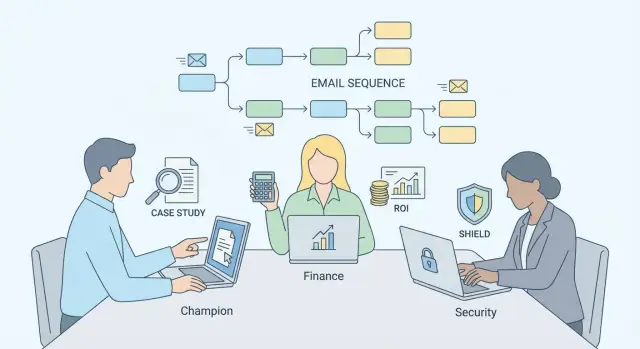
Why generic cadences fail with buying committees
A single, generic sequence might get a reply from one person, then fall apart right after. The first email can be interesting, but the follow-ups start to feel vague because they’re written for “everyone.” Buying committees aren’t “everyone.” They’re a small group of people with different jobs and different worries.
Different roles define value and risk in different ways. A champion thinks, “Will this make me look good and help my team hit numbers?” Finance thinks, “What will it cost, what will it replace, and when do we see payback?” Security or IT thinks, “What can go wrong, and how painful will review be?” Send the same proof points to all three and you’ll sound irrelevant to two of them.
Proof is role-specific, too. For a champion, proof is often practical: a short story about a similar team booking more meetings, a before-and-after workflow, or a win they can repeat. For finance, proof looks like simple math: fewer tools, fewer hours wasted, clearer cost per meeting, and a concrete baseline. For security, proof is readiness: how data is handled, what the review process looks like, and whether the vendor can answer questions directly.
The “ask” has the same problem. One ask can’t fit all. A good ask for a champion is a quick working session or a short demo focused on their workflow. For finance, it’s a budget-shaped ask: confirm pricing range, what gets removed from the stack, and a basic ROI model. For security, it’s a review-shaped ask: “Who owns security review on your side, and can we send the standard questions now?”
This works when each role gets the proof they care about and an ask that matches their next step, not yours.
Map the buying committee roles you need to cover
Most deals are decided by a small group, even if only one person answers your first email. Your job is to guess who else will have a vote, and be ready with a message for each role.
You don’t need org charts. You just need to know what each person protects: outcomes, budget, or risk.
Most teams will involve some mix of:
- Champion: wants the win and will push it internally
- Finance: wants numbers, payback, and budget timing
- Security or IT: wants low risk, clear controls, and a clean review
- Procurement: wants terms, pricing structure, and vendor paperwork
- End users: want the day-to-day to be easier
There are signs you’re dealing with a committee, even if you only have one contact. Watch for language like “I need to run this by...”, “send this to my manager”, “we have a process”, or “security will ask.” Another tell: replies slow down after initial interest because your champion is collecting approvals.
To find the next approver, keep it simple and make it easy for your champion:
“Who usually signs off on budget and who reviews security? I can send a short note they can forward.”
If you have a name, ask for the intro. If you don’t, ask for the function.
Across roles, keep your story consistent with the same three anchors: what it is, what changes, and what it costs (time or money). Then swap the proof and the ask. A champion gets a quick success story and a clear next step. Finance gets a one-screen ROI summary. Security gets a short “ready for review” note.
If you run outreach in LeadTrain, it’s easier to keep separate role-based threads organized while reusing the same core positioning, so the committee hears one story instead of five different pitches.
Build a proof point and ask matrix by role
Role-based sequencing works best when one thing stays the same and everything else adapts. Keep a single, plain value claim across roles (one sentence you can reuse), then swap the proof and the ask depending on who’s reading.
Build two small libraries you can pull from quickly:
- Proof points: measurable results, recognizable references, risk controls, and how much work implementation really takes
- Asks: meeting to validate fit, intro to a stakeholder, budget range check, security questionnaire, or approval for a short pilot
Then map each role to what they care about, and pick one proof point and one ask that match that concern.
| Role | Top concern | Best proof to lead with | Best ask |
|---|---|---|---|
| Champion (user/owner) | Will this help me hit my goal fast? | Specific outcome + time to value | 15-minute fit check or “who else should join?” |
| Finance | Is it worth the money and predictable? | ROI math, payback period, avoided costs | Budget range confirmation or approval path |
| Security/IT | Will this create risk or extra work? | Controls, data handling, audit readiness, deployment effort | Security review packet or questionnaire intro |
Example: if you sell an outbound tool like LeadTrain, the value claim can stay “book more meetings with fewer tools.” For finance, lead with “replaces multiple subscriptions and reduces manual sorting of replies,” then ask for a rough budget band. For security, lead with “tenant-isolated sending infrastructure and clear authentication setup,” then ask who owns the security review.
Sequence for the champion (the internal driver)
Champions want momentum. They feel the pain, believe in the change, and have to sell it internally. Your job is to make them look good while keeping the steps small and clear.
What the champion cares about
Lead with outcomes, speed to value, and credibility. Keep each email tight and easy to forward.
A simple three-touch flow:
- Touch 1: Name the problem in their words, then offer a quick win (what changes in the first 7 to 14 days).
- Touch 2: Add proof (one short story or a before/after metric) and answer the obvious objection.
- Touch 3: Map the internal path: champion -> budget -> security/IT.
Keep proof specific, not grand. For example: “An SDR team cut time spent sorting replies by auto-categorizing responses, and used the saved time to follow up faster.”
Your asks should help the champion navigate the committee without feeling pushy:
- “Who usually owns budget for this, you or finance?”
- “If you like what you see, can you introduce the person who approves spend?”
- “Do you need IT or security involved for email infrastructure, or is it self-serve?”
- “What would make this an easy yes internally: ROI, risk, or workload?”
Forwardable lines they can copy/paste
Give your champion lines they can drop into Slack or email:
- “This would reduce manual reply sorting and help us follow up faster.”
- “Setup is low lift: domains, mailboxes, authentication, and warm-up are covered.”
- “Budget question: who approves tools for outbound, finance or sales ops?”
- “Security question: do we need a review for sending infrastructure and data access?”
- “If you’re open, I can share a 10 minute demo and a one-page ROI estimate.”
Sequence for finance (ROI and budget clarity)
Finance doesn’t need the same story as your champion. They need a clean reason to believe the spend is controlled, the payback is real, and the contract won’t create surprises later.
Keep the finance thread short and checkable. A useful opener is one simple math line instead of a long pitch:
“If you book 4 extra meetings a month and 1 closes per quarter, the tool pays for itself.”
Then add a pricing range so they can place you on the right shelf without a call.
In the first one or two touches, finance usually wants:
- A plain ROI model with 2 to 3 inputs they can adjust (volume, close rate, deal value)
- Total cost clarity (license, add-ons, onboarding, and any usage-based parts)
- Predictability: what billing looks like, what can change, and what is fixed
- Cost of delay: what they lose each month if the current approach stays
- Contract signals: renewal terms, cancellation window, and who signs
Match your ask to their job. Instead of pushing for a meeting, ask for confirmation:
- “Are you the budget owner for tools like this?”
- “What’s your procurement path for a $X-$Y annual purchase?”
To avoid sounding like you’re haggling in the first email, use ranges and options: “Most teams land between $A-$B depending on seats.” Offer to send a one-page breakdown.
If your product removes extra tools (for example, consolidating domains, warm-up, sequences, and reply sorting in one platform such as LeadTrain), mention it as a cost-reduction angle, not a feature tour.
Sequence for security or IT (risk and review readiness)
Security and IT don’t want a pitch. They want to know what you access, what you store, and what can go wrong. Your goal is to reduce uncertainty and make the review easy to schedule.
Start with a plain-language note that shows you understand their concerns: data handling, access control, audit trails, and vendor risk. Keep it short and avoid buzzwords.
Proof points that feel safe (without getting technical)
A simple controls summary and operating model go a long way:
- What data you collect and where it is stored
- How access is controlled (who can see what, and how it is logged)
- Your hosting model and isolation approach (separate tenant reputations, separate infrastructure where relevant)
- How you handle email sending reputation and bounce/unsubscribe management
- What you can provide quickly (security questionnaire, policy docs, audit info)
For example, with LeadTrain you can say sending is tenant-isolated via AWS SES so one customer’s deliverability reputation isn’t mixed with others, and that email authentication (SPF/DKIM/DMARC) is set up as part of domain configuration. Those are risk reducers a reviewer can evaluate.
Asks that work with security reviewers
End each email with one clear request:
- “Who owns vendor security review for your team?”
- “Can I send your standard security checklist?”
- “Is there a target week for security review if the business says yes?”
- “Do you require a DPIA, DPA, or specific data retention terms?”
Keep the tone calm and practical. If they reply with a questionnaire, respond fast and stay consistent. A slow, messy security thread can kill a deal even when the champion is excited.
Step-by-step: build a role-based sequence (not one thread)
Treat each role like a different conversation, not a single chain where everyone gets the same proof and the same ask. Start with one “home” thread for your champion, then create two short branches you can trigger when finance or security enters the deal.
A simple 5-step build
-
Write a champion-first opener that’s easy to say “yes” to. Focus on the day-to-day pain, a quick win, and a low-risk next step.
-
Draft two branch messages (finance and security/IT) with different proof. Finance wants numbers and decision clarity. Security wants risk controls and review readiness.
-
Define role-specific reply options. Champions can choose a time. Finance can choose “send ROI assumptions” or “share pricing range.” Security can choose “send security overview” or “loop in our IT contact.” Keep it plain text and low pressure.
-
Set stop rules before you send. If someone unsubscribes, says “not a fit,” or you learn it’s the wrong person, stop that thread immediately. Either ask for the right owner or close the loop politely.
-
Add a short internal-forwardable recap email. This is what your champion can paste into Slack: what you do, who it’s for, two proof points, and the exact ask.
Example: your champion likes the idea, but finance asks “why now?” Your finance branch should lead with payback and a clear next step: “If you share rough volume and deal size, I’ll reply with a one-page estimate.” If security replies, be ready with review basics.
If you run this in a platform like LeadTrain, keep each role in its own branch and let reply classification (interested, not interested, out-of-office, bounce, unsubscribe) route the right follow-up without mixing messages across roles.
Timing and branching: when to introduce each role
The trick is choosing the moment to branch so you move fast without turning your champion into a messenger.
A simple rule: keep the first few touches aimed at the champion, then branch only when there’s enough signal that the deal is real.
When to branch
Use triggers instead of guessing:
- After interest: they ask a question, request details, or agree to a quick call. Start a finance track with a short ROI summary and a small ask (“who owns budget timing?”).
- After a soft yes: they say “this could work” or “send me something.” Start the security/IT track with review-ready basics.
- After no response: don’t blast all roles. Send one “who else should be involved?” note to the champion, then wait.
Between branches, give the champion room to breathe. If you open finance and security threads at the same time, keep the champion email lightweight and optional: “Happy to loop them in directly if you prefer.”
How many touches per role before you pause
Set caps so you don’t create noise:
- Champion: 4 to 6 touches before a longer pause or a new angle
- Finance: 2 to 3 touches, then pause until budget timing is confirmed
- Security or IT: 2 to 3 touches, then pause until they request artifacts or a review
If two roles reply with conflicting feedback, don’t “average” it. Reply to each role in their language, then send the champion a short recap with one decision point: “Finance needs payback under X months; security needs Y. Which one should we solve first?”
Common mistakes and traps to avoid
The fastest way to break committee sequencing is to treat the whole committee like one person. Different roles need different proof, different risk comfort, and different next steps.
A common miss is reusing the same proof point and the same ask for everyone. A champion might respond to a quick story and a simple “Can you introduce me to the owner of this project?” Finance needs numbers in plain language and a clear budget range. Security wants your controls and process, not your pitch.
Another trap is pulling security in too early with “Can we book a security review?” If the champion hasn’t agreed on problem and scope, security sees it as noise. A better move is to tell the champion you’re ready when needed, and offer a short one-pager style summary they can forward.
Finance has its own pitfall: sending a huge spreadsheet or a long ROI essay. Most finance reviewers want something they can sanity-check: current cost, expected impact, payback window, and the assumptions behind it.
Security questions also expose tone problems. If you sound evasive (“We’re secure, trust us”), you lose credibility. If you drown them in jargon, you look unprepared. Be direct: what data you store, how you isolate tenants, how access is controlled, and what happens on unsubscribe or bounce.
Five quick traps to watch for:
- Asking every role for a meeting instead of the next smallest step
- Treating security like a blocker instead of a reviewer with a checklist
- Sending finance complex math instead of simple assumptions
- Dodging basic security questions or replying vaguely
- Forgetting to equip the champion with a forwardable summary
Example: if your champion is happy but needs buy-in, give them a short email they can copy/paste to finance and IT. Platforms like LeadTrain help by keeping separate threads organized, so each role gets the right message without turning outreach into one messy chain.
Quick checklist before you launch
Before you hit send, make sure your role variants still feel like one story. The point isn’t to change your product every time. It’s to keep the core value claim consistent, while changing the proof and the ask to match the reader.
Pre-flight check:
- Same promise, different angle: your first line and value claim should match across champion, finance, and security, even if the details change.
- One proof point per email: pick a single concrete proof that fits the role.
- One clear ask per email: end with one decision request, not a menu.
- Champion-ready to forward: include a short summary they can paste internally plus a clean intro request.
- Finance and security specifics: finance gets simple numbers and process questions; security/IT gets concrete controls language (SPF/DKIM/DMARC, tenant isolation, audit trail, data handling) and a direct review ask.
Do one final sanity pass so replies route correctly and nothing feels awkward:
- Read each email out loud in 20 seconds. If it drags, cut.
- Check the reply path: who answers, and what happens next for each role.
- Verify your “yes” is easy: suggested times, or one question they can answer in a single line.
If you’re building these threads in LeadTrain, double-check your branches and reply classification rules so an interested champion doesn’t get the same follow-up as a security reviewer asking for documentation.
Example: one deal, three roles, three different threads
A simple scenario: your champion (Head of Sales Ops) loves the product and wants to move fast. Finance is nervous about cost and wants proof it will pay off. Security wants a basic review before anyone signs.
Run three short threads, not one generic cadence. Here’s what the next email can look like for each role.
To the champion (keep momentum):
Subject: Quick plan for the next 10 days?
If we start with 2 reps, we can measure replies, meetings, and deliverability in week 1. If it looks good, we expand in week 2. Who should be in a 15 min kickoff with you?
To finance (cost and ROI clarity):
Subject: Numbers for a small pilot
We can cap the pilot at X seats for 30 days. If we do Y emails per rep per day and book even Z meetings, the cost per meeting is about __. Is there a target cost per meeting you need us to hit?
To security or IT (make review easy):
Subject: Security review - what do you need from us?
Happy to do a quick review. Do you prefer a short checklist or a call? We support SPF/DKIM/DMARC setup and keep each customer’s sending reputation separate. What are your must-haves before a pilot?
To keep the champion in the loop without making them do extra work, send a short update after each response: one sentence on where finance and security stand, plus the next step you already proposed.
A realistic positive outcome looks like this: the champion books a kickoff, finance agrees to a capped pilot with a success metric, and security schedules a 20 to 30 minute review.
Next steps: test, measure, and keep sequences organized
Role-based sequencing only works if you treat it like a living system, not a one-time setup. Learn which role is slowing the deal down, then adjust the proof point or the ask for that specific person.
Track outcomes by role, not just overall reply rate. If champions reply but finance goes quiet, your ROI story or budget ask is the bottleneck. If security replies with long question lists, your risk answers are missing or too vague.
A simple way to measure what’s working:
- Champion: % of replies that move to a meeting or internal intro
- Finance: % of replies that confirm budget range or request pricing/terms
- Security/IT: % of replies that agree to a review step or share requirements
- Time-to-next-step: days from first reply to the next stakeholder
- Drop-off step: the email number where replies stop
Then route replies to the right owner fast. When a security contact asks about access controls, it shouldn’t sit in a general inbox. With LeadTrain, teams can run multi-step sequences per role, keep mailboxes warmed up for deliverability, and use AI-powered reply classification to triage responses so the right teammate can jump in.
When you test, keep changes small. A/B test one proof point at a time (customer result vs. time saved) and one ask variant (15-minute call vs. “who owns budget?”).
Example: if finance keeps asking “what does this replace?”, swap your proof for a short before/after cost line and change the ask to “Is a $X-$Y range realistic if this removes tool A and tool B?” Keep everything else the same so you know what caused the lift.
FAQ
Why does a generic cold email sequence fall apart once more people get involved?
Because each role is filtering for something different. A champion wants momentum and a quick win, finance wants cost and payback clarity, and security/IT wants risk and review readiness. If you reuse the same proof and the same ask, two out of three readers will feel like it’s not for them and the thread stalls.
What roles should I assume are in the buying committee?
Start with what they protect: outcomes, budget, or risk. In most B2B deals, you’ll usually run into a champion, finance, and security/IT, and sometimes procurement and end users. You don’t need an org chart; you just need to be ready with role-specific proof and a next step that fits each role.
How can I tell I’m dealing with a buying committee if only one person replies?
Watch for phrases like “I need to run this by…,” “we have a process,” “send this to my manager,” or “security will ask.” Another sign is initial interest followed by slower replies, which often means your champion is gathering approvals. When you see those signals, prepare a short finance note and a short security/IT note instead of adding more generic follow-ups.
What’s the simplest way to structure role-based messaging without rewriting everything?
Keep one sentence consistent across roles: what it is and what changes. Then swap two things by role: the proof point and the ask. That way the committee hears one coherent story, but each person gets the evidence and next step that matches their job.
What should my emails to the champion focus on?
Lead with a concrete outcome and time to value, then add one believable example they can repeat internally. End with a small next step like a 15-minute fit check or “who else should join?” Your goal is to help them look good and make the internal path feel easy, not to dump a full product tour.
What does finance actually want to see in an email?
Open with simple math and a pricing range so they can place you quickly. Use a short ROI model with a few inputs they can sanity-check, like volume, close rate, and deal value, and make total cost predictable. Your ask should be a decision question such as who owns budget and what the approval path looks like, not a push for a long meeting.
How do I write to security or IT without sounding salesy or evasive?
Be direct about what you access, what you store, and how the review will work. Offer a short controls summary in plain language and ask who owns the vendor security review and whether they prefer a checklist or a brief call. Avoid marketing language; clarity and speed of response matter more than persuasion in this thread.
When should I introduce finance and security instead of keeping everything with the champion?
Branch after you get real signal, like a question, a request for details, or a soft yes. At that point, start a finance thread with ROI and budget timing, and a security/IT thread with review-ready basics. If there’s no response yet, don’t blast other roles; ask the champion one simple question about who else should be involved and pause.
How many follow-ups should I send per role before I pause or stop?
Keep caps so you don’t create noise. A practical default is 4 to 6 touches for the champion before a longer pause, and 2 to 3 touches each for finance and security/IT before waiting for a clear next step. If someone unsubscribes, says it’s not a fit, or you learn it’s the wrong owner, stop that thread immediately and close the loop politely.
How do I measure whether my role-based sequence is working?
Track role-specific outcomes instead of only overall reply rate. Measure whether champion replies turn into a meeting or intro, whether finance replies confirm budget range or request pricing/terms, and whether security/IT replies agree to a review step or ask for documentation. Also watch time-to-next-step and where replies drop off so you know which role’s proof or ask needs improvement.