How to build credibility without logos in early-stage teams
How to build credibility without logos using founder background, clear benchmarks, and transparent pilots that show results without overpromising.
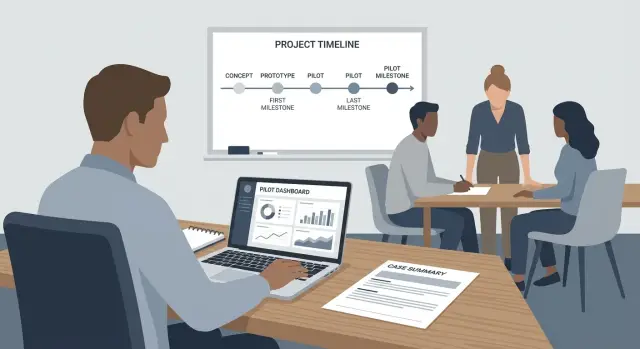
What “no logos” really means to a buyer
Early-stage teams keep hearing the same question in different forms: “Who are you, and why should I trust you?” That usually isn’t a rejection. It’s a risk check.
Most buyers aren’t asking for fame. They want signals that you understand their situation, can do the work, and won’t create problems for their team. Big customer logos are a shortcut. They suggest someone else took the risk first. But logos aren’t the only way to reduce doubt, and in many deals they’re not the strongest proof.
When a buyer says “you have no logos,” they often mean:
- Show me you’ve done something close to this before.
- Make the cost of trying you low.
- Be specific about what happens next.
- Put some numbers on the table so I’m not guessing.
The real danger is sounding impressive but unclear. “We help fast-growing teams unlock predictable growth” reads well and helps nobody decide. Clarity beats hype: what you do, who it’s for, what changes after, and how you’ll measure it.
If you sell outbound services or tools, “we improve deliverability” is too fuzzy. “We set up SPF/DKIM/DMARC, warm up mailboxes, and track inbox placement weekly” gives a buyer something they can evaluate, even if you’re new.
Start with the buyer’s risk, not your pitch
Buyers don’t hesitate because you lack a logo slide. They hesitate because saying “yes” can backfire on them.
Common risks in B2B decisions are predictable: wasted time (lots of meetings, no result), career risk (they backed the wrong vendor), data/security risk (something leaks or breaks), delivery risk (you can’t ship or support), and budget risk (surprise costs).
Match each risk to proof that actually lowers it:
- Wasted time: a tight scope, timeline, and a small pilot with one visible success metric.
- Career risk: a repeatable process, written assumptions, and one credible reference who will respond.
- Data/security risk: your security checklist, how you handle data, and what you do not access or store.
- Delivery risk: a short implementation plan, clear ownership, and examples of similar work (including work done at a previous company).
- Budget risk: pricing rules in writing and what triggers extra costs.
Also think about timing. Before a call, keep proof lightweight: a one-page overview, a pilot outline, and a few baseline metrics you can explain. After a call, share deeper materials: a draft statement of work, security answers, a demo environment, or an intro to a reference.
Aim for verifiable claims. If you can’t back it up with a screenshot, a doc, an email thread, or a measured pilot result, soften it. “We always get 40% reply rates” is a red flag. “In our last pilot, this message got 18% replies over 10 business days, and here’s the audience we targeted” is believable.
Turn founder background into proof, not a resume
When you don’t have customer logos, your background can help, but only if it reduces the buyer’s risk. A long career story forces them to guess what matters.
Pick two or three earned facts that connect directly to the job they’re hiring you for. Think “evidence,” not “identity.”
Useful proof sounds like: “I’ve solved this kind of problem under these constraints, and here’s what changed.” Name-dropping rarely helps unless it explains your decision-making.
Earned facts that tend to land well:
- You built outbound from zero to a steady pipeline (include volume and timeframe).
- You shipped under a painful constraint (limited budget, regulated industry, tiny team).
- You fixed a known failure mode (deliverability, churn, onboarding drop-off) with measurable impact.
- You ran the same playbook multiple times (across two or three products or teams).
Add specifics so it doesn’t feel like “trust me.” Use numbers when you can. When you can’t, use ranges and context (team size, lead volume, deal size, sales cycle).
A simple packaging trick is a three-sentence credibility bio your team can reuse in emails, decks, and call intros:
- Who you are and what problem you’ve worked on (not your title).
- A concrete outcome with scale and constraints.
- What that experience lets you do for this buyer right now.
Benchmarks that build trust (and how to present them)
Benchmarks work when they set expectations, not when they try to “prove you’re amazing.” Ranges signal honesty and reduce the fear of being sold a fantasy.
A good benchmark answers two questions: what “good” looks like for a similar buyer, and what can push results up or down. In cold email, buyers typically care about delivery (inbox vs spam), reply rate, and how many replies are actually positive.
When you share numbers, make context impossible to miss. Include how you measured it so people don’t assume it was cherry-picked.
How to present benchmarks without overpromising
Use consistent framing:
- Share a range and a time window (for example, “over 14 to 21 days, 2% to 6% reply rate”).
- Define the audience (for example, “US mid-market IT buyers, 500 to 2,000 employees”).
- Name the biggest factors (list quality, offer clarity, deliverability, volume).
- Show the sample size (emails sent, prospects, domains).
- Say what you exclude (for example, whether auto-replies count as positive).
If you separate “interested” from “out-of-office” and bounces, spell out the rules. That way your reporting stays consistent across campaigns and across people.
Avoid the skepticism triggers
Don’t lead with a single best-week screenshot. Show a small run of weeks or campaigns using the same definitions each time. Avoid claims like “3x higher performance” unless you include the baseline and the measurement period.
A simple test: if a buyer asked, “How did you measure that?” your doc should already answer.
Build a small proof pack your team can reuse
When you don’t have logos yet, buyers look for consistency. If different people explain the product in different ways, it feels risky. A proof pack keeps your story stable.
Keep it small on purpose. It should answer: what this is, how it works, what could go wrong, and what happens next.
A practical pack can be:
- A one-page overview (who it’s for, problem, outcome, and what the first 7 to 14 days look like).
- A short FAQ (setup time, what you need from the customer, what success looks like).
- A plain-language security and data note (what you store, who can access it, retention, opt-outs and unsubscribes).
- A handful of annotated screenshots (three is often enough), with one sentence on why each matters.
Keep one source of truth. Put an owner on it, date each page, remove old versions, and only include claims you can measure or show. Add a “known limits” line so you don’t overpromise.
Step-by-step: designing a transparent pilot
A pilot is a time-boxed test where both sides agree on what will happen and how you’ll judge it. For early-stage teams, it’s one of the cleanest ways to earn trust without stretching the truth.
Start with one narrow goal tied to a real business outcome. “See if the team likes it” is hard to measure. “Book qualified meetings from outbound” or “reduce manual reply sorting time” is clearer.
The pilot plan (keep it to one page)
Write it so it can be pasted into an email:
- Goal: one outcome, one audience, one use case.
- Metrics: two or three numbers, with a baseline and a timeframe (often 14 or 21 days).
- Responsibilities: what you do, what the customer does, and what “done” means.
- Success criteria: the minimum result that turns the pilot into a “yes.”
- If results are mixed: what happens next (extend, adjust, or stop).
Be plain about dependencies. For example: you build the sequence and reporting; the customer supplies the target list and approves messaging within 48 hours. If either side misses their part, you note it in the final readout.
Transparency is part of what the buyer is evaluating. A tight pilot feels safer than big promises.
How to communicate pilot results without exaggerating
Call it what it is: a test. Add constraints up front (short timeline, small sample, one segment, limited channels). Buyers relax when you’re not pretending results are guaranteed.
Weekly updates beat a big end-of-pilot deck. Keep them repeatable: what you tried, what changed, what you saw, and what you’ll do next.
A clean structure:
- Baseline: what was happening before (even if small).
- Change: what you did differently.
- Result: what moved, by how much, over what period.
- Limits: what didn’t improve yet, and why.
- Next test: one focused step to confirm the signal.
Drop vague claims like “massive lift” or “customers loved it.” Use counts, ranges, and simple language. If the data is noisy, say so: “We only sent 220 emails, so the rate can swing week to week.” That sentence builds trust.
An anonymized case summary is often enough:
“Pilot (14 days) with a B2B services team in North America. Goal: increase booked calls from cold email. Baseline: 0 to 1 replies/day, no consistent tracking. During the pilot we tested two sequences and added reply labeling. Result: reply rate rose from ~1.8% to ~3.1%; 4 positive replies; 1 call booked. Limits: deliverability improved, but the offer message underperformed in one niche. Next: run a second 2-week test with a tighter list and one revised value prop.”
Common traps that make early proof backfire
Early proof is fragile. Without logos, buyers judge your honesty as much as your results.
Overclaiming without a baseline or timeframe is the fastest way to lose trust. “We increased response rate” is meaningless. “Over 14 days, replies went from 1.2% to 2.0% on the same audience and offer” is useful.
Another trust-killer is hiding tradeoffs, requirements, or setup time. If success depends on clean data, enough volume, or specific work on the buyer’s side, say it early. Constraints are fine. Surprises aren’t.
Be careful with vanity metrics. Opens and clicks can mislead. Focus on what the buyer actually values: qualified replies, time saved per rep, cost per meeting, fewer hours spent sorting responses.
Finally, don’t change definitions mid-pilot. If “success” starts as “positive replies,” don’t later switch to “any reply.” Lock rules before you start:
- What counts as success (and what doesn’t)
- Baseline period and comparison period
- Exact audience and message being tested
- Stop date and what you will report
A realistic example: earning trust in the first 30 days
Maya and Chris run a two-person startup selling a workflow tool to a mid-market operations team (about 120 employees). The product works, but they have no recognizable customer logos. The first call starts with polite skepticism: “Who else uses this?” and “How do we know this won’t become another half-finished project?”
They don’t argue. They reduce risk.
They propose a short pilot with clear rules, acknowledge their limited track record, and set expectations around what will and won’t be proven in two weeks.
The 14-day pilot they agree on
They keep it tight: one team, one workflow, one shared document that tracks progress. The ops lead gets weekly updates, even if the update is “no change yet.”
They pick a small set of metrics tied to the ops lead’s reality:
- Time saved on one repeating task (minutes per run vs baseline)
- Error rate before vs after (missed steps, rework requests)
- Adoption (how many people used it at least twice)
- Support load (how many questions or fixes were needed)
- A decision point (keep, pause, or expand)
By day 7, they share early numbers and one miss (an edge case that broke) along with the fix and a note on how they’ll prevent it.
What their proof pack looks like by day 30
They package the results into assets the ops team can forward internally. Nothing is inflated, and anything uncertain is labeled.
They keep it simple: one-page summary, a before/after table, two screenshots with sensitive data removed, one approved quote, and a short “limits” section.
They still don’t have a public logo, but they now have specific, verifiable proof that lowers the next buyer’s risk.
Quick credibility checklist before you start outreach
Before you send the first email, have proof a buyer can understand in under a minute. The goal is to answer the real question behind “no logos”: what exactly will happen, and how will we know it worked?
Start by tightening your promise into one sentence that names a business outcome, not an activity. “We help B2B SDR teams book more qualified meetings” is clearer than “We improve outbound.”
Then make proof measurable. Buyers trust numbers when you explain the baseline, timeframe, and measurement method.
A practical pre-outreach set:
- One outcome sentence (what changes, for whom, by when)
- A measurement plan (baseline, timeframe, how you measure)
- One safe artifact (an anonymized report screenshot or before/after summary)
- Clear limits (what you don’t cover, why results vary)
- Requirements (what you need from the buyer and when)
A sales readiness test: can someone on your team explain what success is, what has to be true for the plan to work, and what you’ll do if early signals are weak? If yes, your outreach will sound grounded.
Next steps: a simple plan for the next two weeks
You don’t need a huge strategy. You need one repeatable pilot offer, a small set of proof assets, and a habit of updating them based on real buyer pushback.
Days 1-3: lock the offer and the proof
Write one pilot template you can reuse: who it’s for, what you’ll do, what the buyer provides, how you’ll measure results, and what happens if the signal isn’t there. Keep it specific and avoid guarantees.
Build a small proof pack (one folder, one doc) you can share in follow-ups. Include only what you can defend.
Days 4-10: run the first pilot and collect clean evidence
Put weekly check-ins on the calendar. Track inputs (what you did) and outputs (what changed). Write down surprises, especially when results are weaker than you hoped. Those notes often become the most trust-building parts later.
If cold email is part of your pilot, it helps to keep setup, warm-up, multi-step sequences, and reply categorization consistent. Tools like LeadTrain (leadtrain.app) bundle domains, mailboxes, warm-up, sequences, and reply classification in one place, which makes it easier to report results using the same definitions every time.
Days 11-14: update assets based on objections
Review call notes and email threads. What objections came up most? Add one proof point per objection to your pack. Set a monthly review so screenshots, numbers, and benchmarks stay current.
FAQ
When a buyer says “you have no logos,” what are they really saying?
It usually means they’re checking risk, not asking you to be famous. They want evidence you understand their situation, can deliver, and won’t create extra work or surprises for their team.
What’s the fastest way to reduce buyer doubt without customer logos?
Start by naming the specific risk they’re trying to avoid, then show one piece of proof that lowers that risk. A tight pilot plan, clear scope and timeline, and a measurable success metric often works better than a generic “we’re great” story.
How do I stop sounding impressive but unclear in my pitch?
Make your claims concrete and verifiable. Say exactly what you will do, what will change after, and how you’ll measure it within a set time window, instead of relying on big promises or vague outcomes.
What should a “proof pack” include if we’re early-stage?
Aim for one page that answers what it is, who it’s for, what the first 7–14 days look like, and what could go wrong. Add a short FAQ and a plain-language note on data and security, and only include claims you can show or measure.
How do I turn founder background into credibility instead of a resume?
Use two or three earned facts that connect directly to the job the buyer is hiring you for, and attach an outcome to each. Keep it in the format of constraints, actions, and measurable change, not titles or a long career summary.
How should I share benchmarks without overpromising?
Share ranges with context rather than a single best screenshot. Include the audience, the time window, the sample size, and your definitions, especially what you count as a positive reply versus out-of-office, bounces, or unsubscribes.
What does a transparent pilot plan look like in practice?
Keep it narrow, time-boxed, and measurable. Define one goal, two or three metrics with a baseline and timeframe, clear responsibilities on both sides, and a minimum success threshold that decides whether you expand, adjust, or stop.
Why is changing metric definitions during a pilot such a trust killer?
Lock definitions before you start and keep them consistent through reporting. If you change what “success” means mid-pilot, buyers will assume the numbers are being massaged, even if you didn’t intend that.
How should I report pilot results so they feel believable?
Give a short weekly update that states what you tried, what changed, what you saw, and what you’ll do next. Include constraints like small sample size or short timeline so the buyer doesn’t mistake early signals for guarantees.
If we sell outbound tools or services, what proof actually helps?
Be specific about tasks and reporting so the buyer can evaluate your approach. For example, instead of “we improve deliverability,” say you set up SPF/DKIM/DMARC, warm up mailboxes, and track inbox placement and replies using consistent labels; platforms like LeadTrain can help keep setup, sequences, and reply classification consistent so reporting stays comparable week to week.