B2B outbound subject lines: curiosity vs clarity examples
B2B outbound subject lines that get opened: learn curiosity vs clarity patterns, how to match the subject to your email body, plus a spam-free checklist.
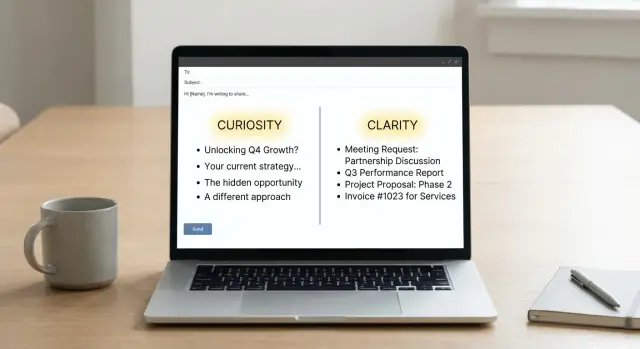
Why subject lines fail in B2B outbound
A subject line has one job: get the right person to open the email and give you a fair first read. It can’t make your offer good, fix a weak list, or save a message that feels irrelevant. If the email doesn’t quickly prove “this is for me,” the subject line turns into a forgettable detail.
Most outbound subject lines fail because they promise one thing and deliver another. “Quick question” sounds like a personal note, but the first sentence is often a pitch deck in disguise. People feel that mismatch instantly. Even if they open, they stop reading, delete, or mark it as spam because it feels like a trick.
B2B readers decide fast because inboxes are full and time is scarce. In about two seconds, they look for two signals: who is this from, and why should I care right now? If the subject is vague, overhyped, or oddly formal, it creates extra work. If it’s too clever, it creates uncertainty. Either way, it loses.
A useful rule: earn the first read, not the open.
A subject earns that first read when it’s:
- Specific enough to set expectations
- Honest about what the email contains
- Relevant to the recipient’s role or situation
- Calm in tone (no hype, no pressure)
If you run sequences and A/B tests in a tool like LeadTrain, treat the subject line as a promise you can keep. When the subject and the first line agree, opens might not spike, but replies usually improve.
Curiosity vs clarity: how to choose the right approach
Curiosity and clarity both work, but they work for different reasons.
Curiosity creates a small, safe question in the reader’s head. Done well, it feels human, like a quick note from a real person. Done poorly, it feels like clickbait.
Clarity tells the reader what the email is about. It reduces uncertainty and makes the next step obvious. It’s often the better choice when the ask is bigger, the offer is specific, or the recipient is scanning quickly.
A simple way to choose: match the subject style to the risk of your ask.
- Low-risk ask (30 seconds, confirm a detail): lean curiosity
- Medium-risk ask (share a resource, suggest an idea): either can work
- High-risk ask (book a meeting, switch tools, change process): lean clarity
- Warm-ish context (met at an event, mutual contact, prior touch): curiosity often works
- Cold, role-specific pitch (clear fit like CFO, Head of Sales, RevOps): clarity usually wins
What that looks like:
Curiosity (works when the body explains the point immediately): “Quick question about your outbound” or “Is this on your radar?”
Clarity (works when you have a direct offer and proof): “Idea to improve reply rates for {{Company}}” or “Reducing bounces on your cold email”
Whatever you pick, the subject and first line must match.
- If the subject promises a “quick question,” the first line should be one specific question.
- If the subject says “idea to improve reply rates,” the first line should name the idea in plain words.
That’s the fastest way to make a cold email feel trustworthy instead of tricky.
Core patterns that usually work (without sounding salesy)
Most subject lines work when they read like normal business email, not an ad. Keep them short (often 3 to 7 words), use the same plain words your buyer uses, and stick to one idea.
Patterns you can rely on
These formats are easy to reuse without sounding pushy:
- Company or context + question: “Acme and renewals?” or “Q1 pipeline plan?”
- Role + specific topic: “For RevOps: routing rules” or “For SDRs: no show rate”
- Trigger based: “Saw the new hiring” or “Noticed your pricing page”
- Clear ask (soft): “Quick question, Alex” or “Worth a chat?”
- Straight reference: “Re: your webinar” or “Following up on X”
They work because they set expectations without hype. If the body talks about reducing no shows, don’t use a subject about “growth” or “revenue” in general.
What makes personalization feel real
Personalization isn’t first-name tokens. It’s a real reason you chose them. A good subject can include one concrete detail: their company, their role, or a trigger you observed.
“New territories at Acme?” is stronger than “Quick win idea” because it anchors the message.
Avoid vague claims like “Huge results” or “Guaranteed meetings.” Those words raise suspicion and invite spam complaints.
If you’re running sequences in LeadTrain, keep the subject style consistent across steps so the thread feels coherent, and make sure every subject matches the first sentence.
Subject line examples you can copy and adapt
Good cold email subject line examples earn the open by being specific, believable, and easy to understand in two seconds.
Curiosity (honest, no bait)
Use curiosity when you have a real reason to write and you can explain it fast in the first line.
- Quick question about {{company}}'s {{team/process}}
- Noticed something on your {{job post/site}} - 1 idea
- Saw you moved to {{tool/tech}} - worth a quick compare?
- About {{competitor}}'s approach to {{topic}}
- Is {{metric/problem}} a priority for you this quarter?
These work best when the email body immediately answers what you noticed, where you saw it, and why it matters.
Clarity (direct and easy to place)
Use clarity when you want the reader to instantly know what the email is about.
- Intro: {{your company}} x {{their company}}
- Question on {{topic}} for {{company}}
- {{topic}} - quick benchmark for {{industry}}
- Pricing for {{category}} (for teams like yours)
- Can I send 2 options for {{outcome}}?
Clarity wins when you can deliver exactly what the subject promises within the first 3 to 5 lines.
Here are side-by-side rewrites that turn weak lines into stronger ones:
Weak:   Increase revenue fast
Better: Question about reducing churn for {{company}}

Weak:   Partnership opportunity
Better: Intro: {{your company}} x {{their company}} ({{1-line reason}})

Weak:   Quick chat?
Better: 2 ideas to improve {{process}} at {{company}}

Weak:   Amazing offer inside
Better: Pricing for {{category}} - does {{range}} fit?
When you adapt these, keep one rule in mind: the more general it sounds, the more spammy it feels. Pick one topic, add one real detail, and make sure the body matches the promise.
How to match the subject line to the email body
Your subject line makes a promise. The first line of your email should confirm that promise right away.
If the subject hints at a specific topic, name it again in the opening so the reader feels they opened the right thing.
Tone has to match, too. A serious subject like “Pricing for SOC 2 readiness” shouldn’t open with a jokey hook. And a casual subject like “Quick question” shouldn’t be followed by a formal, multi-paragraph pitch.
Specificity builds trust fast. If your subject is specific, your first sentence should be specific. The mismatch that hurts most is a short curiosity-style subject followed by a long, salesy monologue.
A quick alignment check:
- Repeat the subject topic in the first sentence using different words.
- Pay off the subject within the first 2 lines.
- Keep the same level of detail: numbers and names in the subject means numbers and names in line one.
- If the subject is a question, explain why you asked it immediately.
- If the subject implies a short note, keep the email short.
A quick example:
Subject: “Question about your renewal process”
Good opening: “I noticed your team renews vendor tools around Q2. Who owns the renewal workflow, and is it still handled in spreadsheets?”
Bad opening: “Hope you’re doing well. I’m reaching out because our platform helps teams improve productivity across the entire organization…”
The good version delivers the renewal topic instantly and asks a focused question. The bad version switches to a general pitch, which makes the subject feel like bait.
A practical habit: draft the email first, then write the subject last so it accurately describes the first 2 lines, not your product.
A simple step-by-step method to write better subject lines
Better subject lines usually come from being clear about one thing: what is the email really asking the reader to do or consider?
If you try to cover three ideas (problem, proof, offer), the subject turns into a messy headline.
Start by deciding the single point of the email. One point only. Examples: “confirm you own X,” “share a quick benchmark,” or “ask about a process you mentioned.”
Next, write your first sentence before you write any subject lines. If the opening is solid, the subject only needs to set it up.
A workflow that keeps you honest:
- Write the email’s one-point summary in 8 to 12 words.
- Draft the first sentence that delivers on that point.
- Create five subject options: three plain and specific, two that hint at the topic without hiding it.
- Delete anything you can’t support quickly in the first two lines (numbers, claims, “best,” “guaranteed,” big promises).
- Choose the subject that matches your opening the closest, even if it feels boring.
Example: your email opens with “Noticed you’re hiring 3 SDRs this quarter - are you also updating your outbound setup?”
A good subject: “Quick question about SDR ramp” or “SDR ramp plans?”
A weaker choice: “Increase reply rates,” because it promises a result your first sentence doesn’t prove.
If you’re A/B testing in LeadTrain, keep the body the same and test only the subject. Otherwise you won’t know what actually caused the change.
Common mistakes that make subject lines feel spammy
Most “spammy” subject lines don’t fail because of one word. They fail because they look mass-sent, or because they try to trick the reader into opening.
A common offender is fake familiarity. Using “Re:” or “Fwd:” to pretend there was a previous thread might get an open once, but it burns trust fast. If your email body doesn’t clearly explain why you’re following up, it reads like a bait-and-switch.
The second red flag is visual noise. ALL CAPS, lots of symbols, or multiple exclamation points make your message look like an ad, not a person. The same goes for “urgent” energy and pushy words like “free,” “guarantee,” “act now,” or “limited time.” Even if your offer is real, the vibe is wrong for B2B.
Vagueness is another trap. Subjects like “Quick question” or “Question” hide the topic. That can feel sneaky, and the reader can’t tell if it’s worth their time.
Over-personalization can also creep people out. Mentioning a niche detail (their child’s name, their exact commute, a photo from social media) crosses the line from “relevant” to “watched.”
Quick gut-check before you send:
- Does the subject honestly describe what the first sentence delivers?
- Would you send it to a colleague without feeling weird?
- Is it readable without caps, emojis, or punctuation tricks?
- Does it avoid promo pressure words (urgent, guarantee, act now)?
- Is personalization limited to work context (role, company, relevant trigger)?
If you use a platform like LeadTrain with reply classification, you can see which “spam-feel” patterns correlate with more bounces or unsubscribes and retire them faster.
Spam filters and “spam feel”: what to avoid in phrasing
Spam filters look at patterns, but people do too. Even if your email lands in the inbox, a spammy subject can kill opens because it feels like a blast.
Start with punctuation and formatting. Subject lines like "RE:!!!" or "Quick question..." with extra dots often look automated. One question mark is fine. Multiple exclamation points, ALL CAPS, or heavy symbols (%, $, |, ###) are common spam signals and also read as pushy.
Numbers can help when they’re normal and specific, but avoid anything that looks like a coupon. Weird spacing is another red flag: “F R E E”, “M e e t i n g”, or “50% off”. It can trigger filters and looks like you’re trying to cheat.
Don’t cram the subject with multiple offers or keywords. The subject should pick one clear idea and let the email do the explaining. If the subject says “3 quick ideas for your outbound,” the body should actually contain those ideas.
Be careful with money and risk terms. Words like “discount,” “save,” “winner,” “guarantee,” “earn,” or “risk-free” are often harmless in legit marketing, but in cold outreach they can spike the spam feel fast.
Avoid implying a relationship that doesn’t exist. “Following up on our call” or “As discussed” can get opens, but it also gets annoyed replies and spam complaints.
A quick phrasing check:
- Keep it plain text: no emojis, no shouting, no extra symbols
- Use normal spacing and a natural sentence
- One promise only (one topic, one ask)
- Skip coupon language and hype words
- Don’t fake familiarity (no fake “re:” or invented context)
If you want a safe alternative, use simple clarity: “Question about {company}’s outbound” or “Idea for {team}”, then make the first line match.
Quick checklist before you hit send
A good subject line sets the right expectation and leads smoothly into the first line of your email. Before you send, run this quick check.
The 60-second pre-send check
Read the subject and the first sentence back-to-back. If they feel like two different conversations, the reader will feel tricked and bail.
- Same topic, same promise: the subject should point to the exact thing your first line talks about.
- Keep it short: aim for under 50 characters when you can (especially on mobile).
- One clear reason to open: a question, a relevant trigger, or a specific outcome.
- “Would I send this internally?” test: if you wouldn’t send it to a colleague without cringing, rewrite it.
- Remove hype and fake closeness: cut urgency, pressure, and “Hey friend” energy.
Quick example (match matters)
Subject: “Quick question about your outbound”
First sentence should start with the same idea, like: “Quick question: are you currently running outbound emails from one domain or multiple?”
If your first sentence instead jumps to a pitch like “We can boost meetings by 3x,” the subject and body no longer match. Even if the claim is true, it feels like bait.
If you’re sending through LeadTrain, do this check right before launching a sequence. It’s easier to fix one subject line now than to wonder later why opens were fine but replies were cold.
Realistic example: choosing a subject line for one prospect
An SDR is emailing a VP of Operations at a 200-person logistics company. On a podcast, the VP mentioned a recurring pain: quote-to-invoice takes too long because data is copied between tools.
Two subject options:
Curiosity: "Quick question about quote-to-invoice"
Clarity: "Cut quote-to-invoice time (logistics ops)"
Which to pick? If you have a strong, specific claim you can support in two sentences, choose clarity. If you only have a reasonable hypothesis and need permission to ask, choose curiosity. Here, the SDR only knows the pain from the podcast, so curiosity is safer and more honest.
Here’s a short body that fulfills the promise of the subject line:
Subject: Quick question about quote-to-invoice

Hi Maya -

Heard you mention on the Ops Leaders pod that quote-to-invoice still involves a lot of copy/paste.

Is that mainly slowing you down at quoting, invoicing, or the handoff in between?

If it helps, we’ve seen teams shave days off by auto-pushing approved quotes into invoicing with a simple approval step.

Worth a 10-min chat next week?

- Jordan
A follow-up subject that stays aligned (and doesn’t try to be clever): "Re: quote-to-invoice question"
If the first send gets no reply, adjust the second message, not just the subject. Keep it shorter, add one concrete detail, and make the ask smaller:
- Restate the exact pain you observed (podcast, job post, metric)
- Ask one either-or question
- Offer a specific, low-effort next step (for example, "Should I send a 3-bullet breakdown?")
- Remove any big claims you can’t prove yet
- If still no response, switch angles or stop after a reasonable number of attempts
Next steps: build a repeatable subject line library
If you want subject lines to get better month after month, treat them like assets, not one-off ideas. Build a small library you can reuse, tagged with what worked and why.
Start with a tight testing set. Five to ten options is plenty if they’re meaningfully different (clarity, curiosity, question, referral, or a short “about X” line). Run fair tests so you learn something real.
- Build a set of 5-10 subject lines for one campaign
- Segment results by audience (role, industry, company size, awareness level)
- Keep tests fair by changing one thing at a time
- Log the winner plus the context it won in
- Retire anything that wins only by sounding hypey
Don’t only track opens. A subject line that gets opens but hurts replies isn’t a win. Add simple notes like: who it was sent to, what pain point the email promised, and what the first sentence delivered.
A simple documentation format:
- Subject: "Quick question about onboarding"
- Segment: SaaS, 50-200 employees, Head of CS
- Body promise: reduce time-to-first-value
- Result: higher replies, more "not now" than "not interested"
If you already use LeadTrain, it’s easier to keep domains, warm-up, sequences, and A/B tests in one place, then use reply classification (interested, not interested, out-of-office, bounce, unsubscribe) to see which subjects lead to real conversations instead of empty opens.
FAQ
Why do B2B outbound subject lines fail even when they get opens?
Because the subject sets an expectation, and the first line confirms whether that expectation was real. If the subject sounds like a quick personal note but the email opens with a long pitch, people feel tricked and stop reading, even if they opened it.
Should I use curiosity or clarity for cold outreach?
Default to clarity when the ask is bigger, like requesting a meeting or proposing a change, because it reduces uncertainty fast. Use curiosity when the ask is low-risk and you can explain the reason for your email immediately in the first sentence.
How long should a cold email subject line be?
Aim for short enough to understand at a glance, especially on mobile. A practical target is one idea in plain words, often around 3–7 words or under roughly 50 characters, so it’s easy to place and doesn’t look like an ad.
What kind of personalization actually helps a subject line?
Real personalization is a work-relevant reason you chose them, not just a first name token. Use something grounded like their company, role, or a clear trigger you saw, and make sure the first line explains that detail so it doesn’t feel random.
Is it okay to use “Re:” or “Fwd:” in a subject line?
It’s usually a bad idea unless there truly was a prior conversation and the body makes that clear right away. Faking a thread can spike opens briefly, but it tends to create angry replies, spam complaints, and long-term trust issues.
What phrasing makes a subject line feel spammy?
Avoid hype and pressure language that reads like a promo, along with visual noise like ALL CAPS, multiple exclamation points, odd spacing, or heavy symbols. Even if a filter lets it through, people often ignore it because it looks mass-sent.
How do I make sure the subject matches the email body?
Write the email first, then write the subject last to describe what the first 1–2 lines actually deliver. If you can’t “pay off” the subject immediately after the open, rewrite the subject to match the opening, not the product pitch.
How should I A/B test subject lines in a sequence?
Keep everything the same except the subject line so you know what caused the difference. Run the test on the same audience segment and judge success by replies and outcomes, not just opens, since a catchy subject can attract the wrong attention.
What should I measure besides open rate to know a subject line is working?
Track replies by type so you learn which subjects create real conversations rather than empty opens. In LeadTrain, AI-powered reply classification can separate interested, not interested, out-of-office, bounce, and unsubscribe responses, which helps you spot subjects that raise complaints or kill intent.
What’s a good approach to follow-up subject lines?
Keep follow-up subjects consistent with the original topic so the thread feels coherent and honest. If there’s no reply, improve the message itself by tightening the ask or adding one concrete detail, rather than trying to “save it” with a clever new subject.