Agency cold email positioning that doesn’t sound templated
Agency cold email positioning that avoids templated vibes by picking a narrow niche, naming one outcome, and adding one proof artifact prospects can verify.
Why agency cold emails often feel templated
A busy buyer can spot a templated email in seconds. Not because it uses a template, but because it reads like it could be sent to anyone. It opens with a vague compliment, jumps to a broad promise, and ends with a generic ask for "15 minutes." The words are fine. The problem is that nothing feels tied to the buyer's world.
Agencies get filtered fast because most buyers have seen the same pitch a hundred times: "We help businesses grow with paid ads/SEO/brand." Even if it's true, it's hard to picture. When the offer is blurry, ignoring it is the safest choice.
Most "templated" emails share the same tells: they talk about the agency instead of the prospect's situation, promise big results without naming the conditions, list services instead of one clear outcome, ask for a call before earning any trust, and recycle the same proof for every industry.
The goal isn't to sound clever. It's to be specific. A plain email that names a narrow type of company, a measurable outcome, and a believable reason you can deliver will beat a "creative" email that reads like marketing.
That's why positioning matters more than copy. When positioning is sharp, the email can be simple: "I work with X, I help them get Y, here's a small thing that shows how I think." When positioning is fuzzy, you try to rescue it with longer emails, fancy wording, and fake personalization.
A quick example: instead of "We do SEO for SaaS," say "We help seed-stage HR SaaS teams turn comparison pages into demo requests, and I pulled a one-page list of missed buyer-intent keywords for your top three competitors." Even if they say no, they understand what you mean.
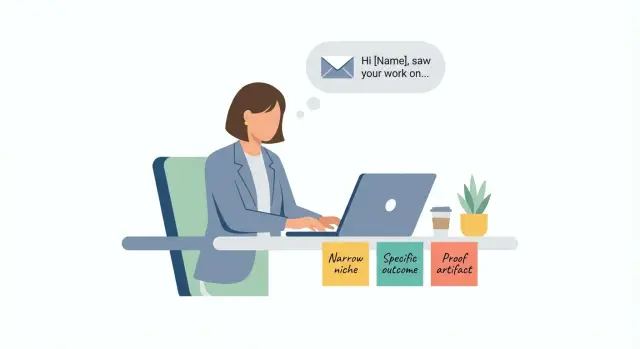
The positioning formula: niche + outcome + proof
If your email could be sent to 1,000 agencies with only the name changed, it'll feel templated. Positioning fixes that before you write a single line. A simple formula works well: niche + outcome + proof.
Start with a niche that's easy to picture. "B2B companies" isn't a niche. A niche is a role plus a company type, like "the founder of a 10-30 person Shopify app" or "the VP of marketing at a regional accounting firm." When the reader recognizes themselves, they keep reading.
Next, choose one clear outcome, not a menu of services. A menu makes you sound like everyone else and forces the reader to guess what you actually do. A single outcome is easier to understand, easier to evaluate, and easier to say yes or no to.
Make the outcome measurable. Avoid fluffy promises like "improve your brand" or "boost growth." Pick something you can realistically influence, like booked calls, demo quality, no-show rate, or demo-to-close.
Finally, add one proof artifact. Not a long case study. Not "we're experts." A small, fast piece of evidence that reduces risk and can be checked in under a minute.
Put together, your email becomes: "I help [role at company type] get [measurable outcome] by doing [one service]. Here's [one small proof artifact] so you can see how I think."
How to choose a narrow niche you can actually serve
A niche only helps if you can describe it in one sentence and explain why you're a fit. If it takes a paragraph, it's too wide.
Start with what you can deliver repeatedly: one service, one type of buyer, and one common situation they're in. This is the fastest way to make a cold email for agencies feel specific without writing a brand new message for every lead.
"SaaS companies" isn't a niche. "Seed-stage SaaS with a sales hire in the last 60 days" is. The difference is constraints.
To narrow the slice, combine one or two signals like their tech stack (Shopify, HubSpot, Webflow, AWS), stage (bootstrapped, seed, Series A), hiring triggers (just hired SDRs, hiring paid media, opening sales roles), geography (UK only, US East Coast, DACH), or business model (high-ticket B2B, usage-based, annual contracts).
Keep it realistic. Choose a slice where you already have context. If you can't name the top three pains they face this quarter, you'll default to vague claims and your email will read like a template.
A useful test is "why now?" A good niche often implies timing. For example, "agencies that just hired their first SDR" suggests they're trying outbound for the first time and will hit predictable setup problems.
Build a niche list you can reuse for 30-60 days
You don't need endless niches. You need one solid niche long enough to learn what works.
Write five one-sentence niche options, pick the one you can support with proof today, and commit to it for 30-60 days of outreach. Keep a simple note of what replies mention (pain, timing, objections), then refine the niche sentence once you see patterns.
Example niche sentence: "US-based Shopify brands doing 20-100 orders/day that recently launched a subscription offer." It's clear, searchable, and tied to a real moment.
How to name a specific outcome without sounding salesy
Most agencies describe what they do. Buyers care about what changes after they hire you. A good outcome line makes your offer feel real, and it makes your email feel less like a template.
Translate your service into the buyer's scoreboard. "We run ads" is activity. "We add qualified demos" is an outcome. If you're unsure which scoreboard matters, pick one metric your prospect likely tracks weekly: booked calls, pipeline created, CAC, activation, or churn.
To stay specific without overpromising, add a timeframe and a boundary. Timeframe answers "when would I see this?" Boundary answers "for which segment, channel, or stage?"
A simple structure:
- Metric: what number moves?
- Timeframe: when does it move?
- Boundary: for which part of the business?
- Method hint (optional): one plain clue about how
Examples you can adapt (and keep honest):
- PPC agency: "Increase booked demo calls from paid search by 20-30% in 60 days, without raising cost per lead."
- SEO/content agency: "Add 10-15 sales-qualified leads a month from high-intent pages within 90 days, focused on your top three services."
- CRO agency: "Lift trial-to-paid activation by 10-15% over 6 weeks on your top signup flow, starting with one funnel."
- Email lifecycle agency: "Reduce churn by 1-2 points in 90 days by fixing onboarding and win-back emails for one customer segment."
- Outbound/lead gen agency: "Create 15-25 qualified sales conversations a month from cold email within 45 days, targeting one buyer role."
Avoid "guaranteed" language. Ranges plus constraints read confident and believable.
Build a small proof artifact that earns attention
A proof artifact is a tiny, concrete piece of work you do before asking for a meeting. It proves you understand their world and can spot real opportunities fast. It's not a full strategy deck, a free project, or a generic audit that could apply to anyone.
This works for agency cold email positioning because it replaces claims ("we can help") with evidence ("here's what I saw"). The best artifacts feel like something the prospect could forward internally without feeling awkward.
Lightweight options that usually land well include a one-page teardown of one page (homepage, pricing, landing page) with three specific fixes, a mini-audit of one channel with two quick wins and one risk, a simple benchmark against a small peer set, a before/after screenshot mock, or a short "reply map" that predicts objections and responses.
Keep it verifiable and small. Verifiable means you reference things that are clearly true: a screenshot, a public page, a specific line of copy, an observable step in their flow. Small means it can be created in 10-20 minutes and read in 60 seconds.
Be careful with long videos. "I recorded a 12-minute Loom" is hard to skim, harder to share, and can feel like pressure.
When you reference the artifact, do it in one sentence, then stop. For example:
- "I made a one-page teardown of your pricing page (three fixes, one screenshot). Want me to send it over?"
- "I put together a mini-audit of your outbound: one deliverability risk, two quick copy changes. Should I share it?"
- "I mocked up a before/after headline for your landing page. Can I send the screenshot?"
Step-by-step: write a non-templated email in 15 minutes
You don't need a clever template. You need one real observation, one clear outcome, and one tiny piece of proof. That's the fastest way to make a cold email for agencies feel human.
The 15-minute workflow
Do this in one pass, then edit once. Time-boxing keeps you from over-writing.
- Start with a niche signal you noticed (3 minutes). Pick one detail that fits that niche: a tool in their job posts, a repeated offer on their homepage, a review that mentions a pain, or a pattern across their ads.
- State the outcome in plain language (3 minutes). Use numbers only if they're believable. Keep it simple: "more booked calls from X" or "lower churn in Y." Avoid vague outcomes like "growth" or "scale."
- Offer the proof artifact, not a call (3 minutes). Offer something small you already made or can make quickly: a one-page teardown, a five-bullet audit, a short list of missed keywords, or a mini script rewrite.
- Ask a low-friction question (3 minutes). Make it easy to answer in one line. Yes/no or A/B questions work well.
- Keep it under 120 words and remove filler (3 minutes). Cut extra adjectives and anything that reads like a brochure.
Here’s a realistic example (adjust the niche signal and artifact each time):
Subject: Quick idea for your {niche} leads

Hi {Name} - noticed you’re hiring a {role} and your pricing page pushes {offer}.

If you’re targeting {niche}, a small change to the first 20 seconds of the funnel can lift booked calls without changing ad spend.

I put together a 1-page teardown of your landing flow (3 fixes + suggested copy).

Want me to send it here, or is someone else best for this?
After you draft, do one clean-up pass:
- Can they reply with one word?
- Did you include one niche-specific detail?
- Is the outcome something they care about this month?
- Is the artifact concrete and easy to glance at?
- Is it under 120 words?
A realistic example: one niche, one outcome, one artifact
Imagine you run a small growth agency focused on seed-stage dev tools with PLG. These teams often have signups coming in, but the handoff from "signed up" to "talk to sales" is fuzzy. Your outcome isn't "more revenue" or "more leads." It's more qualified demos from existing signup volume.
Your proof artifact is small and fast: a three-slide onboarding friction teardown. It shows you did work before asking for time.
Cold email example
Subject: 3-slide teardown of your onboarding (signup -> demo)

Hi Maya - quick note after trying the {Product} signup.

You’re a seed-stage dev tool with PLG, so I’m guessing you already have signup volume - the issue is turning the right users into qualified demos without adding friction.

I put together a 3-slide onboarding friction teardown for {Product}:
1) where the “aha” moment is delayed
2) the 2 spots that likely reduce activation (and who it affects)
3) one low-effort change to drive more demo requests from high-intent signups

If I send it over, would you like the version aimed at (a) getting more demo requests, or (b) getting cleaner qualification before the demo?

- Sam
{Agency}
PS: If this isn’t on your plate, who owns signup-to-demo?
Simple follow-up that stays specific
Subject: Re: onboarding friction teardown

Hi Maya - closing the loop.

One example from the teardown: on the {Page/Step}, the first meaningful action is buried behind {small friction point}. In PLG dev tools, that usually filters out the exact users who later become strong demo candidates.

Want me to send the 3 slides?
- Sam
What does the work here is simple: one clear niche, one outcome tied to existing demand, and one artifact that proves you looked closely.
Common mistakes that make emails feel copy-pasted
Most "template smell" comes from trying to appeal to everyone.
1) "We work with any industry"
When you claim you can help anyone, you describe nothing specific. Your outcome turns generic and your fit signals disappear.
Pick a narrower lane than feels comfortable. Even "B2B SaaS" is often too wide. "Seed-stage HR SaaS selling to US-based mid-market teams" instantly feels more real.
2) Stuffing the email with credentials and logos
Long credential dumps read like a brochure. The prospect isn't asking, "How impressive are you?" They're asking, "Is this for me, and is it worth replying?"
If you want proof, use one sharp detail: one outcome, a short before/after snippet, or a small artifact you can share in two lines.
3) Asking for 30 minutes with no context
"Can I get 30 minutes?" is a big ask when the email hasn't earned it. Without a clear reason, it feels like a calendar grab.
Name the problem you think they have, the outcome you can drive, and offer a smaller next step, like sending a five-point teardown first.
4) Pretending you "noticed something" you didn't
Fake personalization is worse than none. "Loved your recent post" with no specifics, or "I noticed you're hiring" when you didn't check, kills trust.
If you can't be real, be direct. Lead with the niche you focus on and the outcome you usually deliver.
5) Changing the offer every email
If every message has a new promise (ads, SEO, LinkedIn, websites, automation), the prospect assumes you're guessing. A stable offer makes you feel credible and makes your outreach easier to run.
Keep one clear offer for a full test window (2-4 weeks).
Quick checklist before you hit send
Read your email once as if you got it from a stranger. If anything feels like it could be pasted into 100 inboxes, tighten it.
- Can someone repeat your niche in one try? Use a plain sentence that includes a boundary (industry + size + situation).
- Is your outcome measurable and tied to a real business problem? "More leads" is vague. "More booked calls from demo requests" is clearer.
- Is your proof artifact small and easy to verify? One screenshot, a short teardown, a three-point audit, a mini before/after.
- Does every sentence earn its place? If it doesn't add niche, outcome, proof, or a simple next step, cut it.
- Does your follow-up add one new detail? A follow-up should feel like a second useful message, not a reminder that you exist.
For follow-ups, add one new piece of value from your proof artifact: "I checked your pricing page and found two spots where the offer is unclear on mobile. Want the notes?"
If you can answer "who is this for, what changes, why believe me, what next" in under 20 seconds, you're ready to send.
Next steps: test, measure, and scale without losing quality
Once your message stops sounding copy-pasted, the next risk is scaling so fast that quality drops. Treat this like a small experiment: keep the offer and proof tight, change one thing at a time, and let results tell you what to keep.
Split outreach into a few clear segments. You want enough variety to learn, not so much that every email becomes a new project. Create two or three narrow segments you can truly serve, build one proof artifact per segment, and keep one core email per segment stable for a week. Personalize with one or two real details, not a whole paragraph.
When you test, keep it simple. Don't test five things at once. Pick either the subject line or the first sentence and run it long enough to get signal.
Scaling also means deliverability. If you add mailboxes or ramp volume too quickly, your best copy can still land in spam. Warm up new mailboxes, increase daily sends gradually, and keep your list clean. If you're doing outreach for multiple clients, isolate sending reputations so one bad list doesn't drag down everything else.
Measure replies by type, not just total replies. Fewer replies can still be a better campaign if the "interested" share is higher.
If you want fewer moving parts while you run multi-step sequences, LeadTrain (leadtrain.app) keeps domains, mailboxes, warm-up, and reply classification in one place. It's still your positioning that makes the message sound human, but having the setup and sorting handled makes it easier to stay consistent as you scale.
FAQ
Why do my agency cold emails still sound templated even when I personalize them?
A template becomes a problem when it reads like it could be sent to anyone. Keep the structure, but swap vague lines for one real niche signal, one measurable outcome, and one small proof artifact tied to their situation.
What matters more for cold email results: copywriting or positioning?
Positioning answers “who this is for” and “what changes” before the copy does. If your niche and outcome are sharp, the email can be plain and still feel specific; if they’re fuzzy, you’ll sound generic no matter how good the writing is.
How do I choose a niche that’s narrow enough without boxing myself in?
Pick a slice you can describe in one sentence and you truly understand right now. Use constraints like stage, role, tech stack, hiring triggers, geography, or business model so the reader can instantly tell it’s meant for them.
How do I name a specific outcome without sounding salesy or overpromising?
Lead with what the buyer measures weekly, not what you do. Turn activities into a scoreboard line like “more booked demos from paid search” or “higher trial-to-paid activation,” then add a timeframe and a boundary to keep it believable.
What is a “proof artifact,” and what are good examples?
A proof artifact is a small, verifiable piece of work you can create quickly, like a one-page teardown, a mini-audit, or a before/after copy mock. It should be easy to skim and easy to forward internally, so it reduces risk without demanding a meeting first.
Should I ask for a call in the first email?
Offer the artifact first and ask a low-friction question like “Want me to send it here?” or “Who’s best to share this with?” Earning attention with something concrete usually gets more replies than asking for time with only claims.
What’s the fastest way to write a non-templated cold email?
Keep it simple: one niche signal, one outcome line, one artifact offer, and one easy question, all under about 120 words. Time-box the draft to one pass and one edit so you don’t add brochure language.
What are the biggest mistakes that make emails feel copy-pasted?
Avoid vague compliments, big promises with no conditions, a menu of services, long credential dumps, and fake personalization. Also don’t change your offer every email; a stable offer for a few weeks makes you sound credible and helps you learn what works.
How do I write follow-ups that don’t annoy people?
Make the follow-up a second useful message by adding one new specific detail from your artifact. Don’t “bump” with no substance; share one observation and repeat the low-friction offer to send the notes.
How do I scale outreach without hurting deliverability or quality?
Warm up new mailboxes, ramp volume gradually, keep lists clean, and isolate sending reputation when doing outreach for multiple clients. A platform like LeadTrain can help by keeping domains, mailboxes, warm-up, sequences, and reply classification in one place so scaling doesn’t break deliverability or workflow.