3-sentence outreach pitch exercise for clearer cold emails
Learn the 3-sentence outreach pitch exercise to write clearer cold emails: define the problem, promise an outcome, and add proof without sounding pushy.
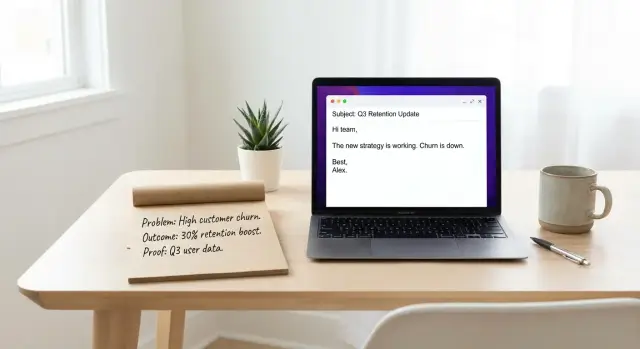
Why most outreach pitches get ignored
Most cold emails get ignored for a simple reason: the reader can’t tell what you want, why it matters, or why they should believe you. When the message feels fuzzy, people take the safest option and do nothing.
A lot of first-touch pitches are written from the sender’s point of view. They talk about the company, the product, the features, and the “we” story. The reader is scanning for one thing: “Is this about a problem I have right now?” If that answer isn’t obvious in the first few seconds, the email’s gone.
Most outreach pitches die in the inbox because:
- the problem is too broad (or missing), so the reader can’t place it
- the outcome is vague (“save time”, “grow faster”), so it blends in
- proof is missing, so it reads like a guess
- the email tries to do too much, so nothing stands out
Clarity in a first-touch message looks almost boring on purpose. It names one specific problem, hints at one specific outcome, and gives one small piece of proof. You don’t need to overshare. You just cut everything that doesn’t help the reader decide if this is relevant.
Constraints improve writing faster than “tips” because they force hard choices. If you only have three sentences, you can’t hide behind fluff or a long setup. A 3-sentence outreach pitch makes you pick one angle, one claim, and one reason to trust it.
This exercise is a writing drill, not a magic prospecting email template. It won’t fix bad targeting, weak offers, or poor deliverability. If your emails aren’t landing in inboxes, you still need the sending basics (domains, authentication, warm-up) handled correctly. Platforms like LeadTrain exist for that side of the work, but even perfect deliverability can’t save a confusing pitch.
Picture a busy SDR manager reading on a phone between meetings. If your message doesn’t clearly say “here’s the issue, here’s the result, here’s why it’s real,” it feels like extra work. Extra work rarely gets a reply.
The 3 sentences: problem, outcome, proof
The point of the 3-sentence outreach pitch is simple: remove everything that doesn’t help a busy person understand why they should care. If you can be clear in three sentences, you can be clear anywhere.
Sentence 1 names the prospect’s problem in plain words. Not your product. Not a trend. Pick one problem they likely feel today. Good examples sound like something a real person would complain about: “Your reps spend hours sorting replies,” or “Your outbound emails keep landing in spam.”
Sentence 2 states the outcome you help them reach. Keep it specific, but not technical. Outcomes are what changes for them: more meetings booked, less time wasted, higher reply rate, cleaner follow-up. If you have to explain how it works, you’re sliding into features.
Sentence 3 is proof that reduces doubt. Proof can be a number, a credible customer type, or a simple mechanism that shows you understand the job. For example: “We automatically classify replies as interested, not interested, out-of-office, bounce, or unsubscribe, so reps focus on real leads.” If you use a platform like LeadTrain, it’s easier to ground that kind of proof because reply categories and deliverability signals are tracked in one place.
What to leave out matters just as much: feature lists, tool names, your company backstory, buzzwords, and extra problems. One message, one lane.
A quick mini-example:
“Most SDR teams lose hours each week digging through messy inbox replies. We help you turn replies into clear next steps so follow-up happens fast. Our reply classification tags every response automatically, so the right leads get attention the same day.”
Set up the exercise in 5 minutes
This drill is about speed and focus. If you try to cover every buyer, every feature, and every “maybe” use case, you’ll end up with three vague sentences that sound like everyone else.
Start by choosing one persona and one specific moment in their week. “SDR” is too broad. “New SDR, week 2, trying to book first meetings without burning the domain” is specific enough to write to.
Next, pick one problem that’s either costly or genuinely annoying. If the reader shrugs at it, your pitch will die in the first line. Strong problems usually show up as wasted time, lost deals, low reply rates, bounces, or messy follow-up.
Then choose an outcome they can picture soon, not “transform your pipeline.” Think in weeks: more booked calls, fewer no-shows, cleaner reply handling, stable sending reputation.
Finally, decide what kind of proof you can honestly support. Proof isn’t hype. It can be a small result you’ve seen, a quick case detail, a credible mechanism, or a simple fact about how you work.
A repeatable 5-minute setup looks like this: decide who you’re writing to and what’s happening right now, pick one painful problem, pick one vivid outcome within 7-30 days, and pick one proof type (result, mechanism, social proof, or a relevant detail). Add one constraint: no extra claims beyond what you can back up.
Example setup: you’re writing to a small B2B founder sending cold emails from a new domain and landing in spam. The problem is wasted time and missed replies. The outcome is “steady inbox placement and consistent daily sends within 2 weeks.” Proof could be a mechanism you can stand behind, like correct SPF/DKIM/DMARC plus automated warm-up.
Once you’ve made those choices, the three sentences get easier because every word has a job.
Step-by-step: write your first 3-sentence pitch
Start with one real person you email (not “HR teams” or “SaaS founders”). Picture their day and choose one situation you can describe without buzzwords.
1) Write Sentence 1 (the problem) as a visible symptom
Don’t name the category (“lead gen is hard”). Describe what they actually see.
Good symptoms sound like: “reps spend 30 minutes a day sorting replies,” “follow-ups stop after day 2,” or “half the list bounces after the first send.” If you can’t imagine them nodding at it, it’s too vague.
2) Write Sentence 2 (the outcome) as a simple before-after
Keep it concrete and easy to picture. You’re not promising a miracle. You’re naming the change.
Useful patterns:
- “Instead of X, you get Y.”
- “So you can go from X to Y.”
- “Which means fewer X and more Y.”
Make sure the “after” is something they want this week, not “long-term brand awareness.”
3) Write Sentence 3 (the proof) with one solid anchor
Pick one: a metric, a recognizable customer type, or a clear process.
A metric can be small (“cut manual triage by 15 minutes/day”). A customer type can be specific (“used by 6-person SDR teams”). A process can be a believable method (“we tag replies into interested, not interested, OOO, bounce, and unsubscribe so nothing gets missed”).
Now combine your three sentences into one tight block. Read it out loud once. If you run out of breath, remove extra adjectives and extra clauses.
A quick self-check:
- Can you underline the symptom, the change, and the proof?
- Does each sentence still work if you remove one fancy word?
- Would a busy reader understand it on a phone screen?
Optional: add one plain question after the three sentences, like “Worth a quick look?” or “Open to a 10-minute chat this week?” Keep it simple, and don’t add a fourth sentence that introduces a new idea.
How to make each sentence sound natural
A good 3-sentence outreach pitch should read like a normal note you’d send a colleague: simple, specific, calm. The fastest way to ruin it is to make any sentence about you, your company, or your “solution” before you’ve earned attention.
Sentence 1 (problem): keep it about them
Your problem sentence isn’t your product description. It’s a mirror. Name something the reader likely recognizes in their day-to-day, using their language.
Instead of “We help teams increase outbound efficiency,” try: “Not sure if this is true for you, but a lot of SDR teams end up spending 30-60 minutes a day sorting replies and chasing dead threads.”
Small tweaks that make it feel human: use “you” more than “we,” allow one softener (“might,” “often,” “tends to”), and avoid big labels like “pipeline generation” unless your buyer actually says that.
Sentence 2 (outcome): skip vague promises
The outcome sentence should be a clear, believable change. If you write “improve results” or “boost ROI,” it sounds like an ad because it could mean anything.
Aim for a practical outcome the reader can picture: fewer hours on a task, more replies worth answering, faster follow-up, fewer bounces, cleaner handoffs.
One quick test: if your outcome could apply to any company in any industry, it’s too vague.
Sentence 3 (proof): specific, not braggy
Proof isn’t “we’re the best.” Proof is a small fact that reduces risk. Keep it concrete and low-key.
Good proof options include a simple number, a short before/after, or a clear mechanism. For example: “We tag replies as interested, not interested, OOO, bounce, and unsubscribe automatically, so reps only open the ones that need a response.” If you’re using a tool like LeadTrain, make sure your proof lines up with what the system actually does (for example, reply classification and warm-up).
If you’re unsure what words sound less salesy, try these swaps:
- “increase” -> “reduce” (time, bounces, manual sorting)
- “optimize” -> “make it easier to”
- “solution” -> “way to”
- “industry-leading” -> delete it
- “guarantee” -> “typically” or remove the claim
The goal isn’t to sound clever. It’s to sound like a real person who knows the job and can prove it in one calm sentence.
Common mistakes that ruin the drill
The drill only works when each sentence has a single job. Most “failed” attempts aren’t about writing talent. They happen when the pitch turns into a mini brochure.
Mistake patterns to watch for
- A problem that fits everyone. “Struggling with growth?” could describe any business, so it won’t feel personal. Pick a narrow, visible problem.
- Stacking outcomes in one sentence. “Book more meetings, lower churn, improve brand, and save time” makes the reader work. Choose one outcome they can picture next week.
- Proof that isn’t proof. Hype words (“best-in-class”, “trusted”, “powerful”) aren’t evidence. Proof is a specific fact: a number, a named process, a short before/after, or a credible constraint.
- Making it about features. “We have warm-up, A/B tests, and AI classification” is product talk. Features can support proof, but they shouldn’t be the message.
- Hiding the ask inside a paragraph. If the last sentence is long, polite, and vague, the drill breaks. The ask should be obvious and easy to answer.
A quick test: if you can swap your text into a different industry and it still “works,” your problem is too broad.
Quick fixes that keep the 3 sentences sharp
Before you send, do a fast pass:
- Replace general words (growth, efficiency, scale) with something you can observe.
- Limit the outcome to one measurable change (time saved, replies handled, meetings booked).
- Swap hype for a concrete detail (numbers, timeframe, method, or a small credible claim).
- Rewrite feature lines into reader language (“less manual triage”) and only then mention the tool.
Example: if you use LeadTrain, don’t lead with “all-in-one platform.” Lead with the pain: “Replies are messy and reps miss the interested ones.” Then make proof specific: “We auto-classify replies (interested, not interested, out-of-office, bounce, unsubscribe) so nothing gets lost.”
When each sentence stays in its lane, the pitch feels calm, direct, and believable.
Quick editing rules to tighten the 3 sentences
Good writing in this drill is mostly deleting. Your goal is to make each sentence do one job, fast: state the problem, name the outcome, show proof. If a word doesn’t help one of those jobs, it’s taking up space.
A fast edit pass (takes 2 minutes)
Read the pitch out loud once, then:
- Swap weak verbs for specific actions. “Help” becomes “reduce,” “fix,” “prevent,” or “recover.”
- Make nouns concrete. “Process” becomes “follow-up sequence.” “Pipeline” becomes “SQLs this month.”
- Remove softeners that make you sound unsure: just, really, maybe, kind of, a bit, I think.
- Keep sentences short enough to read quickly on mobile (roughly 12-18 words).
- Circle the proof and ask: would a skeptical reader believe this from someone at my stage?
That last point matters. Early on, believable proof might be “We tested this on 120 emails last week” or “One agency used it to book 3 calls.” Later, it can be “Cut reply handling time by 40%” or “Used by 12 SDRs across 3 teams.” If you can’t back it up, make it smaller and true.
The “three buckets” test
Open a blank note and label it: Problem, Outcome, Proof. Copy your pitch under those labels. Any extra words that don’t land in one bucket get deleted or rewritten.
If you’re using the 3-sentence outreach pitch inside a tool like LeadTrain, trimming helps twice: your subject line and preview text stay clean, and the first screen on mobile actually gets read.
Example: turning a rambling pitch into 3 sentences
Picture an SDR emailing a Head of Sales at a mid-size B2B company. The goal is a quick reply, not a full product demo in the first message.
Here is Draft 1, the messy version that tries to say too much:
Subject: Quick question

Hi Jamie - I hope you’re doing well. I’m reaching out because we help sales teams automate outreach and improve deliverability with better sending infrastructure, and we also have personalization, templates, analytics, A/B testing, and a bunch of other features. Our platform is easy to set up and can integrate with your current tools, and we’ve worked with many companies in different industries. If you’re open to it, I’d love to show you how we can help you book more meetings and save time for your team. Are you free this week or next for a quick call?
Now Draft 2, the 3-sentence version (problem, outcome, proof):
Subject: Fewer emails hitting spam

Hi Jamie - noticed many sales teams see reply rates drop when deliverability slips (more emails land in spam than they realize).
If we could help your team keep more outbound in the inbox, you’d get more replies without sending more volume.
We’ve seen teams improve results by fixing setup (SPF/DKIM/DMARC) and warming mailboxes before scaling sequences - would it be worth a 10-minute chat?
The second version is easier to reply to because it gives the reader a clear path: one problem they recognize, one outcome they want, one reason to believe, and one small ask.
Optional follow-up line (low-pressure) if you want to soften the ask:
If not, I can send a 3-point checklist our SDRs use to spot deliverability issues fast.
Practice plan: improve one sentence per week
If you change all three sentences at once, you never learn what caused the lift (or the drop). A simple weekly loop keeps the 3-sentence outreach pitch honest: tweak one sentence, measure replies, then decide what to keep.
Pick one audience segment to start (for example: agency owners, SaaS founders, or local service businesses). Write 3 variants for that segment, not 20. The goal is focus, not volume.
A 4-week loop you can repeat
Run one small test per week, keeping the other two sentences exactly the same:
- Week 1: test the problem sentence vs an alternative framing
- Week 2: test the outcome sentence (same promise, different wording)
- Week 3: swap the proof sentence (same claim, different proof type)
- Week 4: keep the winners, then create 2 new variants for a second segment
Keep the send list and timing as consistent as you can so the test is fair. Even a simple split (50/50) is enough to see direction.
Rotate proof types without changing the claim
Proof is where many pitches get shaky. Rotate the proof sentence while keeping the problem and outcome fixed:
- a metric ("cut no-shows by 18% in 30 days")
- a recognizable customer type ("used by 12-person SDR teams")
- a short process ("we audit deliverability, fix auth, then run a 7-day warm-up")
- a credible constraint ("only doing 3 onboardings this month")
Track replies by category, not just reply rate. Interested, not interested, out-of-office, bounce, and unsubscribe tell different stories. If bounces rise after a change, your message may be fine but your targeting or sending setup needs attention. If you use a platform like LeadTrain, automated reply classification can make this tracking faster so you spend time rewriting, not sorting.
The rule for rewrites: only touch one sentence at a time, and write down why you changed it. After four weeks, you’ll know what your audience reacts to, not what you guessed.
Checklist and next steps for real campaigns
Before you send, do a simple pass-fail check. The goal is to keep your pitch focused enough that it still makes sense when someone skims it on their phone.
Quick checklist (pass-fail)
- You wrote for one specific persona you can name in plain words.
- All three sentences point to one problem and one outcome, not five ideas.
- Each sentence is short enough to read in one breath (aim for 12-18 words).
- Your proof is true, specific, and easy to sanity-check.
- If you remove your company name, the message still feels useful and not like an ad.
Once you have a clean 3-sentence outreach pitch, don’t stop at the pitch. Turn it into a small, repeatable sequence so you get a few chances to be noticed without becoming annoying.
Next steps: turn it into a real sequence
Write a 3-email sequence where each email keeps the same core idea. Email 1 uses the three sentences and one simple question (yes/no works well). Email 2 keeps the problem and outcome but swaps the proof (a quick example instead of a metric). Email 3 keeps only the outcome and proof and asks if you should close the loop. Add personalization only when it’s real and relevant.
If you’re running multiple sequences, the busywork adds up fast. If you want to keep the focus on writing and testing, tools like LeadTrain (leadtrain.app) can handle the operational pieces like domains, mailboxes, warm-up, multi-step sequences, and reply classification, so you spend more time improving those three sentences and replying to the people who are actually interested.
FAQ
What is the 3-sentence outreach pitch exercise?
Write a first-touch cold email in three sentences: one sentence states a specific problem the prospect likely has, the second names a concrete outcome they want soon, and the third provides one believable proof point.
The constraint forces you to cut filler so the reader can decide relevance fast.
Why does limiting it to three sentences help?
Because it prevents you from hiding weak thinking behind extra words.
If you can’t clearly state one problem, one outcome, and one reason to believe it in three sentences, the message usually isn’t clear enough for a busy reader.
How do I choose the right “problem” sentence?
Pick a visible symptom they’d recognize in their day, not a broad category.
A good problem sounds like a complaint someone would actually say out loud, and it should be narrow enough that it doesn’t fit everyone.
What counts as a strong “outcome” sentence?
State a before-and-after change they can picture within the next few weeks.
Aim for a practical result like faster follow-up, fewer missed interested replies, fewer bounces, or more replies without increasing volume.
What can I use as proof if I don’t have big case studies yet?
Use one solid anchor that reduces doubt: a small metric you can back up, a specific customer type, or a simple mechanism that shows you understand the work.
Avoid hype words and “we’re the best” claims; the goal is believable, not loud.
Should I add a question or call to action after the three sentences?
Default to a simple yes/no question that’s easy to answer, like asking if it’s worth a quick chat or if they want a short checklist.
Keep it low-pressure and don’t introduce a new idea that turns your three sentences into a fourth pitch.
Is it okay to mention my product or platform in the first email?
Yes, but only if you can support it and it fits the proof role.
If naming the tool turns the email into a product pitch, remove it and keep the proof focused on the reader’s reality instead.
Can good deliverability make up for a weak pitch?
No. Better deliverability helps your email get seen, but it can’t make a confusing message relevant.
Treat deliverability as the baseline and clarity as the differentiator; you need both for replies.
How do I A/B test this exercise without getting lost?
Keep the core idea the same and vary just one sentence at a time.
For example, test two versions of the problem sentence while leaving outcome and proof unchanged, then repeat the process for the other sentences so you learn what caused the change.
How can LeadTrain help when running these 3-sentence pitches in real campaigns?
Use a single system to handle the operational work so you can focus on writing and testing.
LeadTrain combines domains, mailboxes, warm-up, multi-step sequences, and AI reply classification, which helps you spend less time on setup and sorting replies and more time improving the three sentences.